

THREAD ECONOMY: EXAMPLES, TYPES AND CALCULATIONS
-
Post author

-


ou launched an online store, started advertising, got lots of orders, and feel satisfied. But then you realize something—sales are going up, but your net profit is not. You’re spending more to get each customer than you’re earning from them—this often happens in e-commerce. You may have a constant flow of orders, but your costs for production, shipping, and marketing are even higher. In this article, we’ll talk about unit economics and how understanding it helps marketers and business owners.
What is this about?
- What is unit economics and why is it important?
- How to calculate unit economics?
- Types of unit economics
- Unit economics examples:
- How to improve unit economics?
- Conclusion
- FAQ
What is unit economics and why is it important?
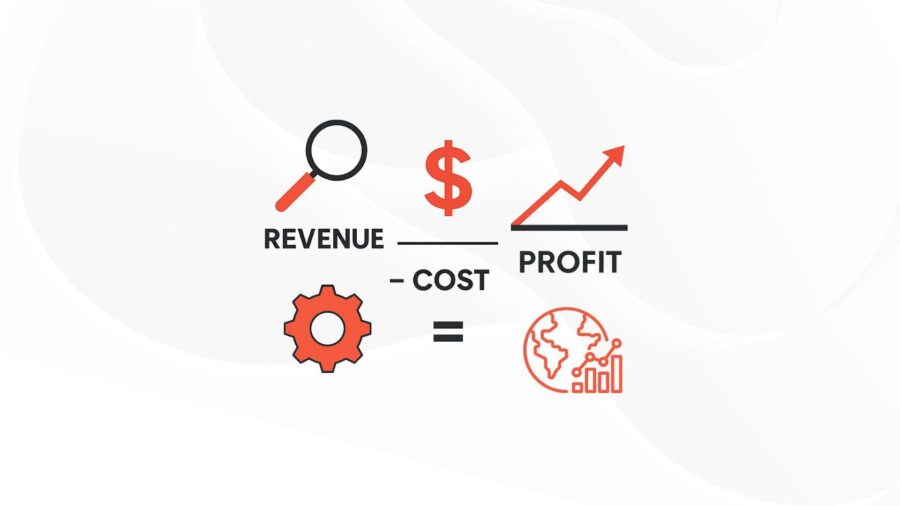
Unit economics is about understanding the revenue and costs related to one unit that brings value to the business. For example, for a taxi service, a unit is one ride. For a movie theater, it’s one ticket sold. In e-commerce, the model includes four main variables.
Here’s the growth formula for e-commerce:
(V × CR × LTV) – VC = $
- V—website visits (clicks)
- CR—customers
- LTV—how long a person stays your customer
- VC—number of delivered products

These numbers help explain the basics of unit economics.
Many new business owners focus only on profit and may not track all expenses. But expenses fall into two main types:
- Variable costs—go up as the above VC metric increases, meaning they rise with sales. These include things like packaging, fuel, and anything else needed to get the product to the customer.
- Fixed costs don’t depend on the number of orders. These are operational expenses like rent, utilities, and employee salaries.
Unit economics may seem complex, but it actually makes it easier to assess a business’s profitability. You simply compare the cost of selling one unit to the revenue from that sale.
For example, let’s say an online store buys a book for $10 and spends another $5 on shipping and packaging. The total cost is $15. If the store lists the book for $20, the profit is $5. But if there are other expenses, like $1 for ads and $1 in taxes, the net profit drops to $3.
If the store later decides to invest in a call center or website redesign, it will need to revisit its unit economics to avoid selling at a loss. To improve margins, the seller might raise prices, offer high-margin add-on products, or reduce other business costs.
In another example, where the unit is not a product but a paying user, imagine a developer of a paid mobile app. To figure out profit, the company should track how many daily users it has and how many people download and sign up for the app. For instance, if 1,000 users bring in $100, the average revenue per user is 10 cents per day.
Now consider the costs: if the developer pays $2 per 1,000 ad impressions to acquire users, this is the customer acquisition cost (CAC). Then we calculate: 20 days × $0.10/day = $2. So, the user needs to stay for at least 20 days to break even.
Analyzing unit economics helps with better financial planning. There are many reasons to use it—here are some key ones:
- Profit forecasting becomes easier and more accurate. Even if your startup hasn’t turned a profit yet, unit economics shows where to go to grow faster and smarter.
- It helps improve your product or service. You may adjust your pricing, break it into segments, or change it entirely. You’ll also see if your marketing spend makes sense and whether the methods are effective.
- You can estimate product demand and profitability. That’s why it’s smart to apply unit economics early in your business journey.
- Investors and partners look at unit metrics. It’s especially useful if you’re applying for a grant.
- Business owners can decide whether to produce more or focus on product quality and features. Everything depends on how many new customers you can serve and at what cost.
- You get a better understanding of your target audience when you have a clear picture of unit economics. It may not seem connected, but early on, it helps identify your most valuable customers.
Unit economics is key for risk management. When you track per-unit metrics, you make better business decisions. Marketers use unit economics to figure out how many units they need to sell—or how many new customers they need to acquire—to cover fixed business costs.
How to calculate unit economics?
Here’s the formula for unit economics:
Unit Economics = Revenue per Customer / Customer Acquisition Cost (CAC)
To find revenue per customer, divide total company revenue by total number of customers.
CAC depends on your business model, but often looks like this:
CAC = Marketing Spend + Cost of Goods Sold
Add all variable costs per customer.
To find monthly cost per customer:
V = LTV / CAC
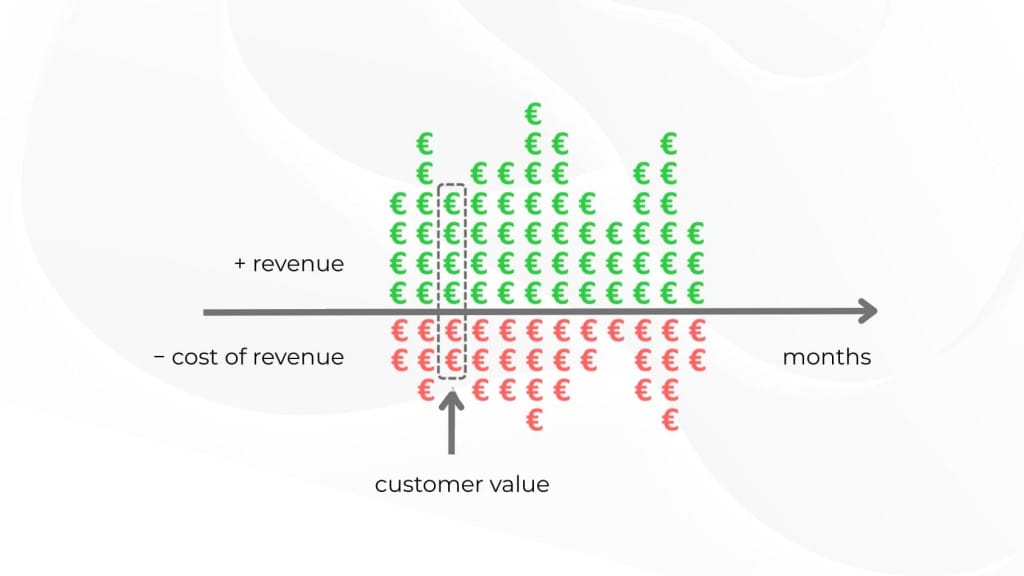
Then calculate how long the customer stays with your business:
LT = LTV / CAC

Also, find the cost per unit:
CAC = LTV / CAC

For example, if monthly marketing and sales costs are $50,000 and you get 10 new customers each month, CAC = $50,000 / 10 = $5,000 per customer.
Here’s an example using an online outerwear store. Say one coat sells for $150. The company spends $30 to acquire a customer (CAC), and each customer orders again about every two years.
Revenue per customer is $150.
If the customer orders once every two years, then:
Revenue per Customer / CAC = 150 / 30 = 5.
So, the unit economics for an online store is 5. In other words, for every dollar spent to acquire a customer, the company earns 5 dollars in revenue over the entire customer relationship.
So, if a business is customer-focused—like in the case of SaaS companies—the key metrics in unit economics are CAC (Customer Acquisition Cost) and LTV (Customer Lifetime Value). For online stores and most retail businesses, the main metrics are revenue per product sold and the cost of goods sold (COGS).
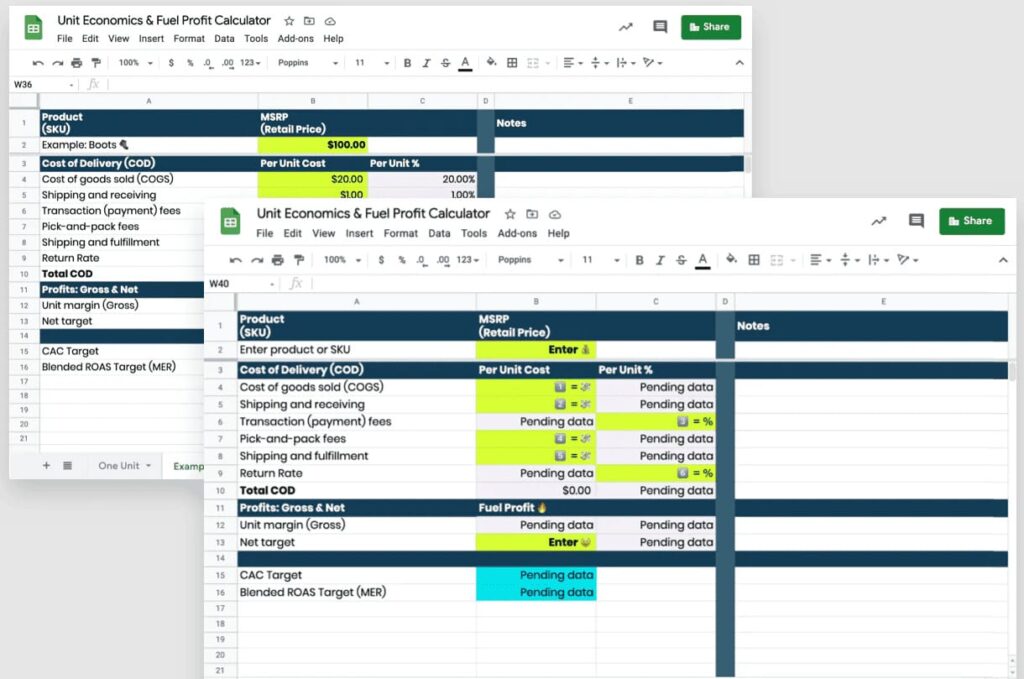
You can calculate unit economics manually, but it’s much easier to use special templates that are freely available—for example, as Google Sheets on Coefficient.

Some companies offer their own online unit economics calculators, such as commonthreadco.com.
Types of Unit Economics
There are two types of Unit Economics (UE), or more precisely, two ways to calculate them. The only difference is what you consider to be a “unit” in your business.
One Product Sold
The formula looks like this:
UE = price per unit − variable costs per sale
One Customer
In this case, the formula is:
UE = LTV/CAC
- LTV is the customer’s lifetime value.
- CAC is the customer acquisition cost.
So, in the second case, you need to figure out how much money your company makes on average from each customer before they stop buying from your brand.
The customer acquisition cost means how much money you spend to get each buyer. You also need to know this if you treat each individual customer as your unit in unit economics.

If you choose the second calculation method, and the number of customers (not the number of products sold) is your main success measure, then you’ll need to model the customer’s lifetime value.
There are two ways to model customer lifetime value: predictive and flexible. These methods are more complex and involve deeper calculations.
📌 Read in the article: What is CPC: Cost Per Click and How to Calculate It
Predictive LTV
This method helps you understand how an average customer might act in the future. The formula is:
LTV = (T × AOV × AGM × ALT) / number of customers during the chosen time period
- T is the average number of purchases—the total number of transactions divided by a set number of days.
- AOV stands for Average Order Value. It’s calculated by dividing total revenue by the number of orders.
- AGM means Average Gross Margin. You subtract the cost of all sales from the revenue. This gives you your actual profit.
Then use this formula:
GM = ((TR-CS) / TR) x 100
The last formula we use to calculate Predictive LTV is ALT. This metric shows the average customer lifetime. It’s the churn rate divided into 1. The formula looks like this:
ALT = ((CB-CE)/CB) x 100
Flexible LTV
Flexible customer lifetime value is useful because it accounts for possible changes in income. It’s especially helpful for new businesses and startups. The formula for calculating Flexible LTV is:
LTV = GML x (R/(1 + D – R))
Here’s what the terms mean:
GML is the average gross margin over the customer’s lifetime. In other words, it’s the profit per customer during their average time with your company. To calculate it, multiply gross profit by total revenue, then divide the result by the number of customers during the chosen period.
D is the discount rate, meaning the return on investment.
R is the retention rate. It’s calculated by comparing the number of repeat customers (Cb and Ce) to the number of new customers (Cn), using this formula:
We use the formula:
((Ce – Cn) / Cb) x 100
where Cb and Ce are customers who made more than one purchase, and Cn are newly acquired customers.
Let’s recall the unit economics formula according to the second model, where the unit is one customer:
UE = LTV/CAC
We’ve already explained LTV, but what about CAC?
We analyze Customer Acquisition Cost as follows:
CAC = (sales and marketing expenses / number of acquired customers)
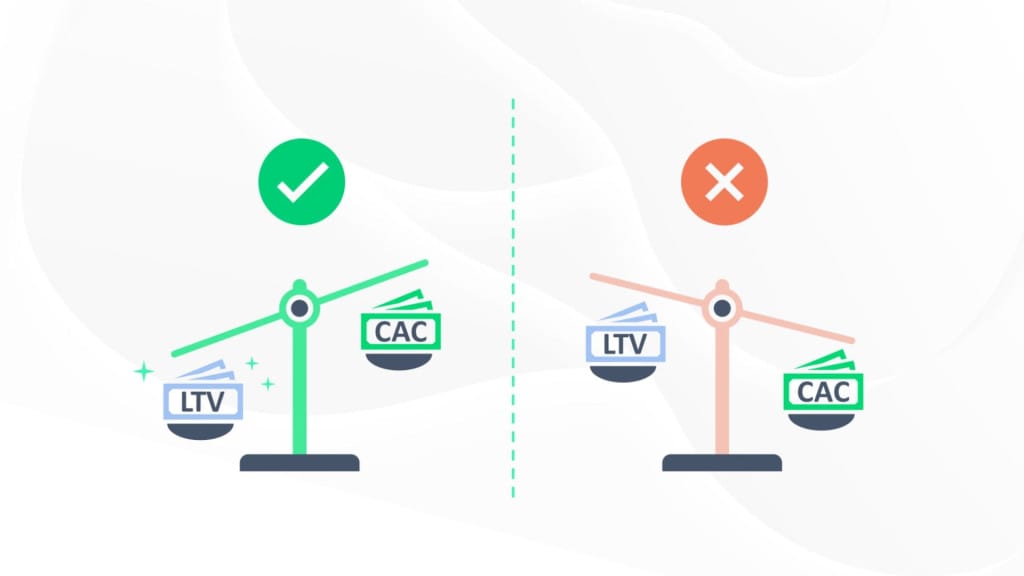
If LTV is greater than CAC, congrats—your business performance is already pretty good. If the numbers are about the same, you’re probably breaking even. But if CAC is higher than LTV, your company is losing money.
Calculate your CAC to understand the cost of getting each new customer. This helps you plan your budget, adjust ad campaigns, and apply strategies that reduce costs.
Examples of Unit Economics
What counts as a “unit” depends on the industry and the company. For example, in an airline, it’s each ticket sold. In a ride-hailing service, it’s each ride. In a web development agency, it’s each project. In retail, a unit is usually one product sold, with an average price for the brand’s product range.
In general, for product manufacturers or resellers, a unit is one item sold. For SaaS companies and service-based businesses, the unit is each customer. This also includes businesses that use subscriptions, like gyms.
Sometimes a unit can be a single contract, such as an equipment supply deal that includes related products or services. For instance, renting refrigerators to restaurants with an agreement to buy branded drinks or food. Or renting coffee machines with a deal to purchase a certain amount of coffee beans each month for one or more years.
Starbucks
This is a great example of customer-focused unit economics. The brand targets a specific coffee-drinking segment: socially aware, busy professionals who value the café atmosphere even more than the drinks or food. Howard Schultz created a space where people can relax, socialize, or work with a cup of their favorite coffee—and free Wi-Fi, of course.
In the early days, the unit was each coffee sold. Today, the unit is more about the visitor than the drink. The mobile app, loyalty program, and other features show the company’s focus on customer retention—so key metrics are LTV and CAC.
Airbnb
This company runs an online platform for booking lodging. It works like a broker and charges a fee for each booking—so a unit can be seen as a single booking. But for long-term rentals, the unit is the duration of the stay. That’s why the brand also focuses a lot on LTV. Repeat bookings are a big part of this business model.
According to Four FourWeekMBA, Airbnb earns 5%–15% from each guest, while hosts pay around 3%. For example, if the total booking is $100 per night, Airbnb splits that between the host and guest and earns about $15.

Airbnb collects payment when the stay is completed.

FourWeekMBA reports that in 2022, Airbnb’s gross booking value was $63.2 billion. The average revenue per booking was $161, and the profit was $8.4. The average commission was 13.3%.
📌 See the article: What is CPA and how to calculate it
Apple
A clear example from the tech industry. The key metrics in Apple’s unit economics are revenue per device and the cost of goods sold (including packaging and logistics). The average iPhone sells for $1,000, and its production cost is about $400. Apple makes high profit per unit thanks to a strong profit margin—as shown in these estimates:
Margin = Revenue per Unit – Unit Cost = 1000 – 400 = $600
But to make an iPhone 15 Pro Max, the company spends over $550, so the margin is lower:
Revenue per Unit – Unit Cost = 1000 – 550 = $450
Netflix
The company focuses on long-term income from each subscriber. It pays close attention to LTV (Lifetime Value) and CAC (Customer Acquisition Cost), spending money on ads, partnerships, and streaming unique content.
In the last quarter of 2024, the service got 19 million new subscribers. In 2025, the platform announced a price increase for its standard monthly plan without ads—now $17.99 in the U.S., Canada, Argentina, and Portugal.
“Netflix expects revenue to grow in 2025 to at least $43 billion in the U.S. because of more paying subscribers and higher average revenue per user.”—Netflix is raising prices after reporting its biggest-ever subscriber jump, Liam Reilly, CNN
Netflix has 302 million subscribers and expects to earn at least $43 billion in 2025. The most important unit of its business model is no longer just every new subscriber, but every paying subscriber who picks the no-ads plan.
In contrast, competitors like Disney Plus care more about getting new users—no matter the plan—and keeping them. They often offer discounts for new and current users. Disney Plus Core has about 123 million subscribers—almost three times fewer than Netflix. Amazon has more than 200 million Prime viewers each month. That platform focuses on growing sales with small profit margins.
How to Improve Unit Economics
In e-commerce, it can be hard to know if a business is profitable per unit. The more product categories there are, the harder the math gets. That’s because each product uses different materials, has different delivery costs, and other extra factors. To decide whether to scale, improve the product, or change pricing, you must analyze your unit economics.
We’ve already seen that if CAC is lower than LTV, then a service business is profitable. In online retail, compare the cost of selling with the price per unit. But what if the analysis shows bad results? Then improve your unit economics. Here’s how you can do that:
- Increase revenue per customer
- Lower customer acquisition cost
- Improve customer retention
- Cut product costs (or service costs)
- Improve your marketing strategy and optimize ads
- Improve your product or your interaction with the target audience—or both
Be careful—when you improve one area, don’t make another worse. For example, if you make a better product, watch out that the production cost doesn’t get too high. Or if you upgrade your ad campaigns and website, make sure CAC doesn’t go up too much. In many cases, the best way out is to increase LTV.
If you sell something expensive that people don’t buy often, try adding extra services or products. For example, in tech, offer things like official warranties, custom setup, cashback, bonuses, discounts for repairs and support.
The key in all calculations is picking the right unit. Analyze your unit economics regularly—markets, trends, customer income, and needs always change. Use unit economics to predict results: test new marketing channels or price changes by comparing revenue and costs. Variable costs should be at least a bit less than 50% of total revenue.
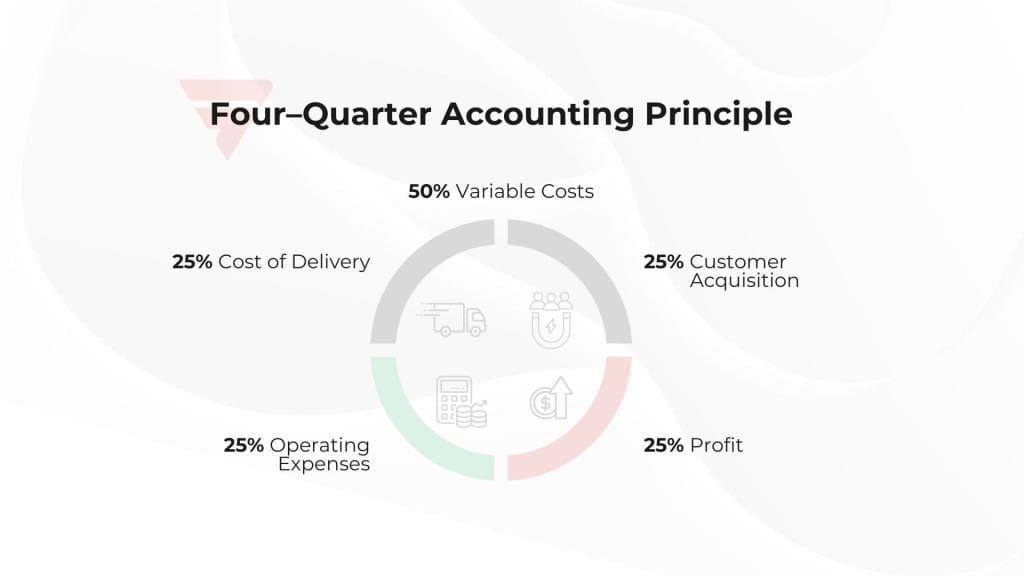
SaaS companies keep variable costs very low. There are no shipping or inventory costs, or they are tiny. The best part—they get steady income from subscriptions. Every industry and company has its own details, and you should figure them out when building your marketing strategy or business plan. And even if you’ve never done unit economics before—it’s never too late to start. It might save your business.
Unit economics helps businesses grow without needing outside investors. Taking fixed and variable costs into account helps reach the break-even point. This is the point where the line for profit before fixed costs crosses the fixed costs line on a graph.

Business owners often only have a basic idea of unit economics. Even if they do analyze it, they don’t do it regularly. This causes problems.
Common Unit Economics Problems
- Mixing up fixed and variable costs.
Unit economics mainly looks at variable costs—the ones directly connected to sales. This includes the cost of goods sold, shipping, packaging, and so on. - Ignoring total amounts. Don’t only look at margin or the CLV/CAC ratio. Include all costs in your calculations.
- Scaling a money-losing business.Sometimes, you may need to change your business model or raise extra money. But first, make sure the contribution margin is positive and keep checking your variable costs.
Unit economics helps companies track their progress over time and plan to scale. Or, they might decide to pause growth and improve business processes instead—like raising revenue per customer, lowering the cost to get a customer, increasing retention, lowering product costs, improving marketing, or making the product better.
Conclusion
A unit is something that brings profit to a company—the core of a business. It can be a service, a customer, a sold item, or a deal. It’s important to define the right criteria for your unit because each business model is different.
Depending on your business, you should pick the main factor for profitability. For SaaS and service companies, it’s the LTV/CAC ratio. For e-commerce and retail, it’s the difference between all the costs to make and sell a product and the price the customer pays.
The first way fits digital products, subscriptions, and regular payments—like gym memberships. The second way is used even in regular stores.
Before you try to grow your business, analyze your unit economics. You can improve it by raising revenue per customer, lowering customer acquisition cost, growing LTV, cutting product costs, and improving marketing and advertising.
Even product improvements can save a company from going out of business. So if you have high profits and growing sales, but something still feels off—check your unit economics. You can use special templates or online calculators. Unit economics is very important for startups, online shops with many product categories, and companies with lots of variable costs.
FAQs
In unit economics for a software developer, like a CRM system, the focus is on customer lifetime value (LTV) and customer acquisition cost (CAC). This applies to Netflix, Uber, and paid mobile apps.
For a retailer, unit economics means the profit from each sale divided by the cost linked to that sale—like Apple, Pandora, and other online stores.
Good unit economics means that the cost for one product or service is less than the profit it brings. For service businesses, it means LTV is higher than CAC.
Unit economics is key for startups. For example, an online course subscription service charges $20 per month. If customers stay for 12 months and it costs $40 to get one customer, the monthly cost per customer is $5—which is a good number. To check if this is profitable, divide CLV by CAC. If the result is more than 1, the model makes money.
-
Tags
