

WHAT IS CPC (COST PER CLICK) AND HOW TO CALCULATE IT?
-
Post author

-


Pay-per-click (CPC) is an online advertising model used to bring traffic to websites. The advertiser pays a search engine or website owner for each click on the ad. This usually brings more clicks than free organic traffic, and the visitors are usually targeted. This model is used by search engines like Google Ads, Amazon Advertising, and Microsoft Advertising, as well as by Facebook, Instagram, and other social networks.
What is it about?
- What is CPC and why should you calculate it?
- CPC vs. CPM—which is more important?
- Ways to set the click price
- How to reduce Cost Per Click?
- Conclusion
What is CPC and why should you calculate it?
CPC (Cost Per Click) is a metric that shows how much advertisers pay for their ads. This abbreviation is used to describe the model of bringing visitors to a landing page. It refers to paid ads shown on ad platforms, websites, or social media. Marketers and business owners need to track this metric because it shows the cost of a brand’s paid advertising campaigns.
One of the main goals of a person who sets up and manages ads is to lower the cost per click. If the clicks are also high quality, this helps bring more people to the landing page who are ready to work with the company, buy products, or order services. A correct and exact calculation of the cost for specific keywords helps understand the value of advertising campaigns.
The click price also affects the position of the ad in search engine results. Of course, the higher the ad appears, the more people see it and respond to the message. According to research from VARN, 57,5% of users do not notice that an ad is paid when they see it. Also, the chance of someone buying something after clicking on a paid ad is 50% higher than from organic search results.
The approximate number of results for the search “cleaning nyc” can reach hundreds of thousands. Still, the first results shown are paid ads—and many potential customers do not realize that.
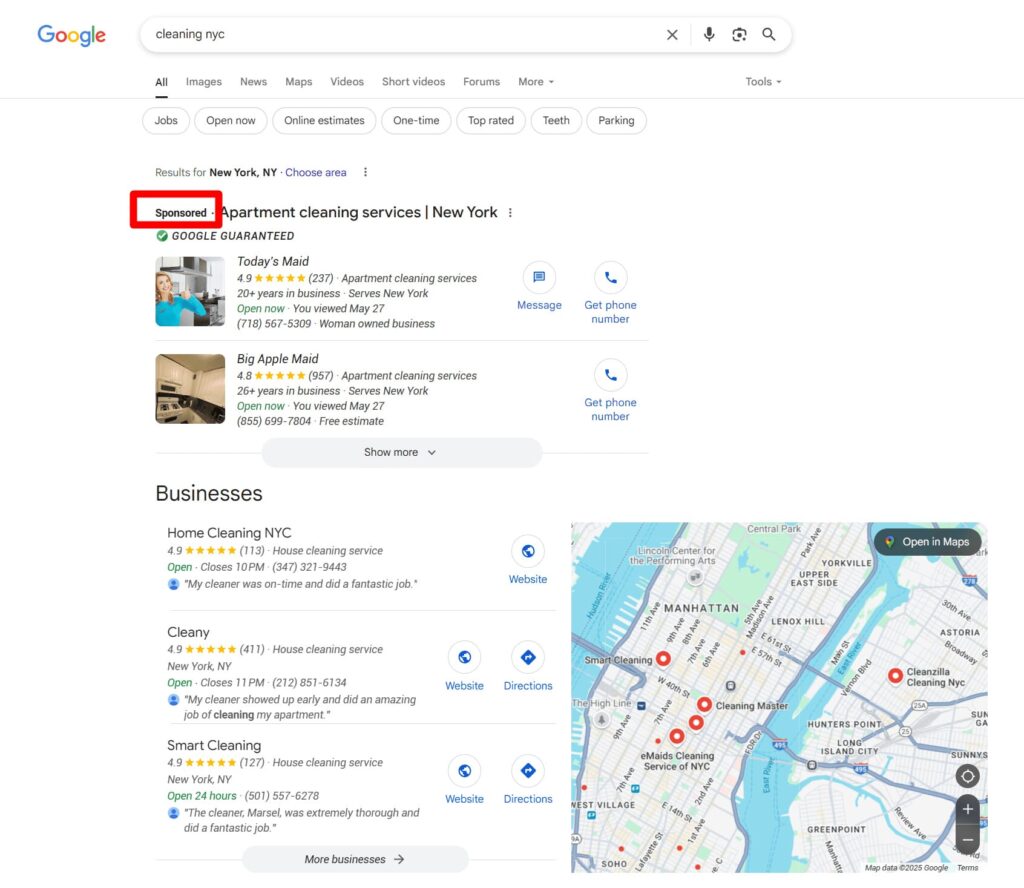
The amount advertisers pay depends on the owner of the ad space. This number is based on two main factors:
- the quality of the ad;
- the highest bid the advertiser is willing to pay per click, compared to competitors’ bids.
So, the higher the ad quality, the lower the cost per click, and vice versa. To find out how much each click on an ad link costs, you need to divide the ad placement cost by the number of clicks. The CPC formula helps measure how effective the traffic source and ad campaign are, and it looks like this.
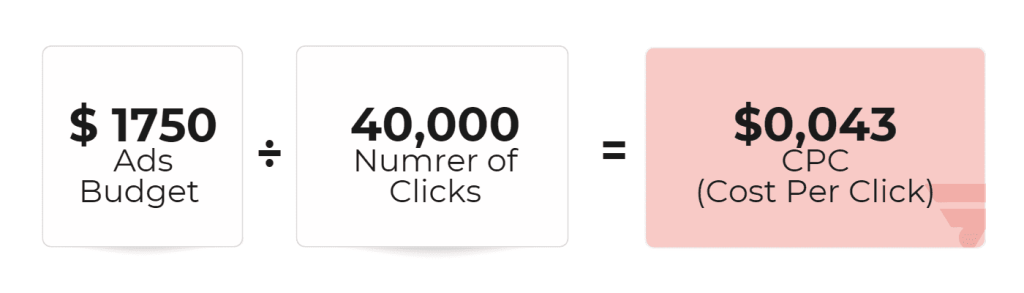
📌 Read the article: How to calculate ROI, ROAS and ROMI indicators
CPC vs. CPM—Which One Matters More?
Ad platforms use not only the popular CPC model but also CPM, which means paying for every 1,000 impressions. This method is typical for display (banner) ads shown on websites with relevant content. The advertiser must pay the platform for every 1,000 ad views, no matter how many clicks the ad gets.
“In the case of cost per thousand impressions (CPM), the advertiser only pays for every 1,000 times the ad is shown. Pay-per-click (PPC) has an advantage over cost-per-impression because it shows how effective the ad is. Clicks are a way to measure attention and interest. If the main goal of the ad is to get a click—or more exactly, to bring traffic to a destination—then cost-per-click is the best metric.”—“Pay-per-click”, Wikipedia
CPM, which is considered the main alternative to the CPC model, is best for business owners who mainly want to increase brand awareness. To drive sales, paying for clicks is usually a better option. This model is also called PPC (Pay-Per-Click).
Usually, advertisers use a set daily budget for their campaign. The ads stop showing automatically when the budget runs out. In the next billing cycle, the system charges again and ad impressions start running. During this time, the marketer can review the overall campaign results and those of each ad group. They can remove ads that don’t perform well, add negative keywords, and make other changes to get better results from new ad impressions.
Google Ads is built in a way that protects you from unexpected high charges. You never pay more per click than what you’re willing to pay in the bidding system. That cost can be $100 or just $1 per click. It all depends on the business industry and its average order value. Special algorithms review your ads and charge no more than the bid you set.
There are also discounts for advertisers who run high-quality ads. The quality score depends on how relevant your ad is to what people are searching for. It’s like improving CTR by making your website convert better. If the landing page content doesn’t match the ad, visitors will leave without taking action. The same is true for ad positions—they will be lower if your bid is low, along with other factors the platform uses to rank ads, which we’ll explain later.
Click pricing models
According to WebFX, small and mid-sized businesses spend between $108,000 and $120,000 per year on display advertising. This also includes comparison ads, which can be shown by all comparison shopping services registered in the Google program.
“All comparison shopping services that are part of Google’s program can show these ads in countries where the program is active.”—“About Comparison Shopping Ads,” Comparison Shopping Services Center Help
For example, when searching for “buy a retro-style electric kettle,” the user first sees a carousel of comparative product ads with relevant products.
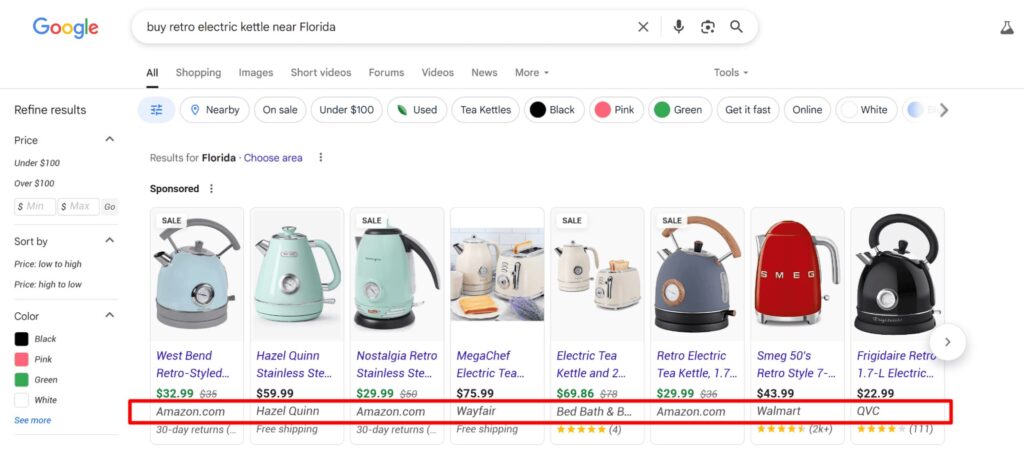
There are two main models for determining cost per click:
Fixed CPC (Cost-Per-Click) Model
Usually, in search engines, advertisers bid on keywords that are relevant to their target audience and pay when the ad is clicked. This type of collaboration involves an agreement between the advertiser and the publisher on a fixed amount to be paid for each click.
Prices in this case are often listed in a special rate card. The amounts vary due to different content on the pages, more or less profitable ad placements, and design. If you plan to run your ad continuously, it’s possible to negotiate lower rates with the publisher. This also applies to expensive contracts.
Such sites are mostly clearly divided into categories of goods or services, which allows advertisers to achieve a high level of targeting.
Bid-Based Cost Per Click Model
Unlike search engines, content websites usually charge a fixed cost per click. The advertiser signs a contract, then competes with others in a private auction run by the publisher or the ad network. Each advertiser sets the highest price they are willing to pay for a specific ad space.
The auction happens automatically every time a visitor clicks the ad. If the ad space is part of a search results page, the auction runs when someone makes a search using the keyword that was bid on. All keyword bids are compared—considering the user’s location, day, and time of the search—and a winner is chosen.
Because these auctions happen in real time, this process is called real-time bidding, or RTB. If there are multiple ad slots, there can be more than one winner. Their positions on the page depend on how much they bid and the quality of their ads. The ad with the highest score appears at the top.
Large ad networks allow advertisers to show contextual ads on their partner websites. Publishers—who are third parties—sign up to show ads on behalf of the network. In return, they get a share of the ad revenue (from 50% to more than 80%). These websites are called content networks, and the ads placed on them are called contextual ads, because the ad space is linked to keywords based on the page content—its context. Ads in content networks often get lower click-through rates (CTR) and conversion rates (CR), so they are valued less.
How to Reduce Cost Per Click?
The CPC model works well for most businesses, but it has both benefits and downsides. Click bots and fake traffic cost advertisers around $35 billion, and Google takes no responsibility for misleading ads in AdWords.
“PPC advertising is open to abuse through click fraud, though Google and others have developed automated systems to protect against unfair clicks from competitors or dishonest web developers.”—Pay-per-click, Wikipedia
Main advantages of the CPC model:
- Pay-per-click ads are more valuable than ads priced per 1,000 views because they reflect actual user actions.
- CPC helps advertisers get more traffic to their websites.
Main disadvantages:
- Prices depend on Quality Score, auction competition, sponsorships, and other factors—and can change a lot.
- This model is less effective for building brand awareness.
Some platforms—like Google Ads—use bidding to set ad prices. They rely on Ad Rank thresholds to calculate the actual cost per click.
The Ad Rank formula looks like this:
Ad Rank = CPC bid × Quality Score
“Because PPC advertising can get very expensive, you need a plan to avoid paying too much per click. That means researching and building a keyword strategy to improve your Quality Score, which shows how well your ad performs compared to others.”—“Cost Per Click (CPC) Explained, With Formula and Alternatives”, Investopedia
An ad’s Quality Score depends on how appealing it is to your target audience. Google checks if the text and other elements match the keywords..
We recommend doing keyword research regularly using different methods:
- Targeting the text to a specific audience.
- Breaking ads into groups with different keywords and matching them to related search queries.
- Grouping means creating categories for products or services and then using the right keywords (for example, “classic irons,” “steam irons,” “travel irons”).
Another important factor is how relevant the ad’s landing page is. The website should load fast and work well on both desktop and mobile devices.
Quality Score plays a key role in getting more clicks and lowering costs by reducing the CPC.
Conclusion
CPC is the cost per click, which means the price you pay each time a user clicks a link in your ad. Another name for this metric is PPC, which is more often used to describe the whole advertising model where brands pay for clicks on their ads.
The cost per click is the average amount paid for each click on a link in the ad. Google evaluates the quality of the ad before every auction, so it can move up or down depending on the competition and what the advertiser does to improve the ad.
Usually, ads that appear on search engine results pages cost more than ads shown on websites. Because ad rankings change, there is no fixed CPC number for a brand.
To understand how cost-effective your advertising campaigns are, you should carefully track both the cost per click and the cost per impression. Along with tracking CTR and website conversions, these metrics help show how profitable your digital marketing is. Regular analysis helps lower ad costs, improve ad performance, choose the right platforms, and create relevant ads.
The goal for all brands should be a low cost per click. This means the ad should be optimized to give high value at a low cost. Also, CPC should match the brand’s total profit, because the main purpose of CPC is to drive sales.
Answers to frequently asked questions
CPC is an online advertising model that platforms and websites use to charge advertisers based on the number of clicks on their ad links.
CPC (cost per click) = advertising cost / number of clicks.
Cost per click is the amount an advertiser pays each time a potential customer clicks on an ad.
Cost per click is usually calculated by dividing the total ad cost by the number of clicks the ads received.
-
Tags
