

AI & MARKETING NEWS DIGEST—MARCH 2026
-
Post author

-


Marketing Link has compiled the most interesting news from March: local ads in Apple Maps, new Performance Max capabilities and even more AI in Google Ads, automation of ads and creatives in Meta, as well as new ad formats in TikTok and X. Separately—key AI changes: the shutdown of Sora, growth of ads in ChatGPT, and a new stage in the fight for AI infrastructure among Big Tech.
Paid Media
Apple starts showing local ads in Apple Maps
bloomberg.com, seroundtable.com
Businesses will be able to buy top positions in search, just like it already works in Google Maps: you search for “coffee”—and first see the one who paid more. Essentially, this opens another paid channel for local traffic and competition for the offline customer, but there is a nuance—Apple traditionally promises “privacy”, so targeting may be less precise than Google’s, but competition at the start may be significantly lower—and this is a chance to enter cheaper while everyone is still thinking.
Google Ads
Performance Max updates: new “themes” for Asset Groups, audience exclusions, new reports, and AI voiceovers in video
seroundtable.com, business.google.com, seroundtable.com
Google is adding “themes” for Asset Groups in Performance Max—now you can clone a successful group and in a couple of clicks adapt it to a season or a news hook, while AI will generate new texts and creatives itself. Essentially, this is another step toward “click a button—get a campaign”, which is good for fast scaling and testing, but there is a risk that all creatives will become the same.
Performance Max now has exclusions for your own audiences and expanded analytics—you can now avoid showing ads to existing customers, view more detailed data by audiences, budgets, and even breakdowns by networks. Essentially, Google is slightly “loosening the screws” of the PMax black box—giving more control and transparency, which is critical for optimization and scaling, but it is still not the level of control of classic campaigns, so manual control is returning, but in a limited way.
Google has started automatically adding voice to videos in Performance Max—AI takes your headlines and descriptions and generates voiceovers if the video had no sound. Essentially, this is an attempt to “upgrade” weak creatives without marketer involvement—it sounds convenient, but there is a nuance: if everyone starts using auto voiceover, videos will quickly become identical, so as a quick boost it is fine, but for a proper brand it is better to control sound manually until this turns into another Google template.
Google Ads API v23.2—more data and AI signals for automation
Google released the Google Ads API v23.2 update—they added insights on top-performing creative combinations in App campaigns, new conversion metrics, expanded tools for reach planning, and even separated information about AI-generated videos. In short—more data and signals for automation and optimization, but not everyone will benefit from it: this update is more for those who work with their own tools or complex analytics, not “regular” advertisers.
Google Ads Editor 2.12—more video in PMax and even more automation
Google updated Ads Editor to version 2.12—now in Performance Max you can add up to 15 videos to one asset group, vertical 9:16 creatives for Shorts are supported, and brand guidelines for controlling AI generation and fixed campaign budgets have also appeared. Essentially, Google is pushing ads even more toward “give us more creatives—we will decide what works”, which is good for scaling, but increases dependence on algorithms—without a proper strategy and control, it easily turns into “we uploaded everything—hoping for the best”.
Google Ads and Merchant Center integrate loyalty programs directly into ads
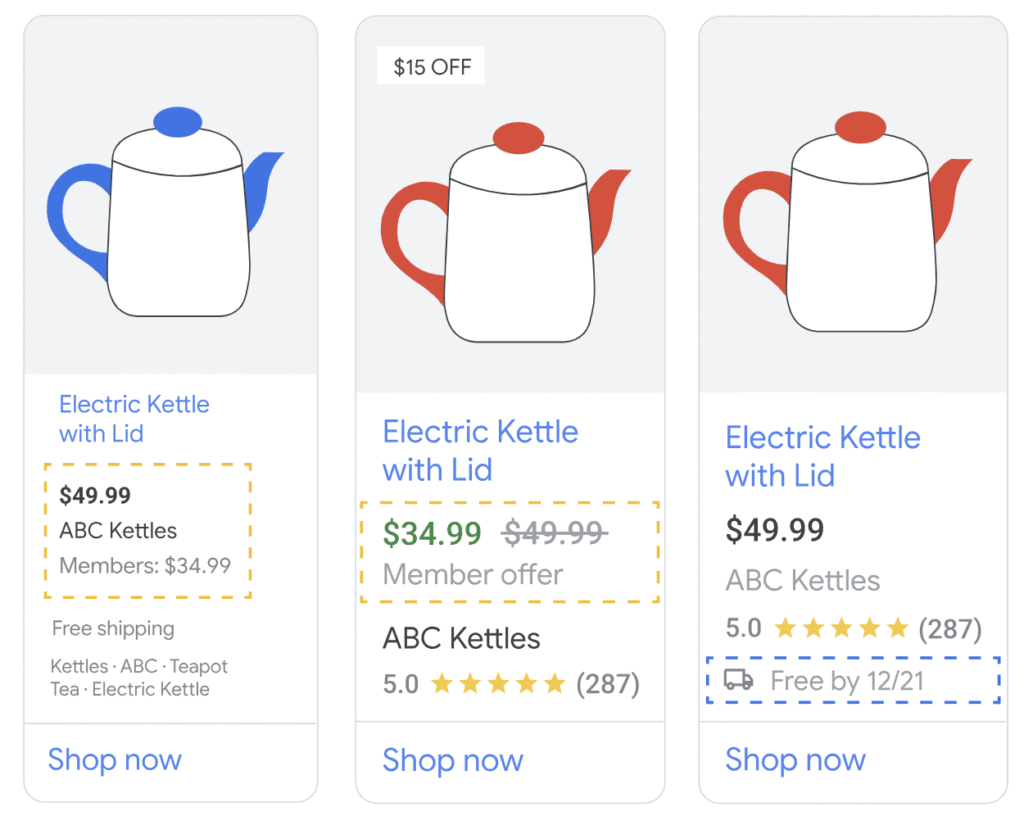
Now you can show member pricing, bonuses, and shipping directly in ads, plus all of this scales to local campaigns, new countries, and even AI platforms like Gemini. Essentially, Google is trying to turn ads not just into an acquisition channel, but into a retention tool—and this makes sense, because acquiring new customers is more expensive than selling to existing ones.
Merchant Center for agencies—fewer tabs, more control
Google introduced Merchant Center for Agencies—a single interface to manage all client accounts, where you can see diagnostics, errors, products, growth opportunities, and basic analytics without constantly switching between accounts. Essentially, Google solved the problem of “50 tabs open and nothing is clear”—now agencies can more easily monitor account health and find issues faster, but the question remains the same—whether this data is enough for deep optimization or if it is again about “looked and went to Ads Manager.”
In Google LSA, you have to pay even for your existing customers
In Local Services Ads, cases have started appearing where advertisers are not refunded for calls from existing customers—even if this is confirmed. Essentially, the “pay per lead” model is becoming less transparent—now there is a risk of paying not only for new customers but also for those who would have called anyway, so businesses should more carefully monitor lead quality and be prepared that part of the budget may simply be wasted without real growth.
Google Analytics adds budget planning—now beyond Google Ads
Scenario Planner and Forecasting have appeared in Google Analytics—tools that allow you to model budget allocation across channels and predict results before launch, as well as track whether campaigns are going according to plan. Essentially, Google wants to take Excel away from marketers and bring planning and analytics into one place—this is a plus for those working with multi-channel budgets, but everything depends on data quality.
Google upgrades Demand Gen—video from images and integration with YouTube creators
Google is adding video generation from images via Veo AI, search and integration with YouTube creators, and a new goal for engagement (subscriptions, views) in Demand Gen. Essentially, Google is building a full cycle—from creative production to distribution and collaborations in one interface, which is good for scaling and testing, but it is another step toward brands becoming more dependent on Google’s ecosystem instead of their own media and creative processes.
Google adds AI Gemini to Display & Video 360—more automation and recommendations
Now the system itself suggests placements, analyzes audience behavior, connects brand and platform data, and also launches Ads Advisor as an “assistant” for campaign optimization. Essentially, Google is moving toward a model of “fewer human decisions—more AI,” which can simplify management and scaling, but at the same time further reduces marketer control.
Google adds Nano Banana Pro to Ads—creative is now generated inside the platform
Google integrated Nano Banana Pro directly into Google Ads—now you can create and edit images, generate scenes, and test creatives without leaving the platform. Essentially, Google is closing another stage—now creative becomes part of optimization, not a separate process, which significantly speeds up testing and scaling, but at the same time leads to even more identical AI-generated creatives.
Bing Ads
Microsoft Ads simplifies automated bidding and adds negative keywords for PMax
Microsoft changed the logic of automated bidding setup—now tCPA and tROAS are not separate strategies but additional goals within “Maximize” models. Essentially, the interface has been simplified, but the meaning is the same—fewer options for manual control and more focus on setting the right goals, so the key question for the marketer is no longer “which strategy to choose,” but “which numbers to set,” because they now determine the result.
Paid Social
YouTube
YouTube ads will become even longer, and they will not be skippable
YouTube is launching 30-second non-skippable ads for TV—now the experience increasingly resembles traditional television, where you watch what is given. Essentially, this is an attempt to squeeze maximum revenue from the big screen and the “relaxed” user, which is good for brands and reach, but for businesses it means higher competition for attention.
Creators on YouTube will be able to mass-like comments on videos
YouTube added a bulk like feature for comments—the system automatically finds “positive” comments and allows you to like all of them with one click. Essentially, this automates what used to be real interaction with the audience—it is convenient for large channels, but it slightly kills authenticity, because now “thanks for the comment” can be given not by the creator, but by an algorithm.
Meta
Meta automates Marketplace—AI responds, sells, and even evaluates products
Meta is adding AI to Facebook Marketplace—automatic replies to buyers, ad generation from photos, price recommendations, and enhanced seller profiles. Essentially, the platform is moving toward a model where the seller is almost not needed—AI takes over communication and part of the sales process, which simplifies getting started and saves time, but at the same time reduces uniqueness and control, so those who not just “turn on AI” but know how to guide it properly will win.
Meta upgrades ads in Reels—even more AI and creators
Meta is adding new ad formats in Reels for trends and major events, improving creator search in the Creator Marketplace, and actively implementing AI—from auto voiceovers and translation to generating videos from catalogs. Essentially, Meta is building a system where creative, influencers, and placements merge into a single flow, which simplifies scaling and campaign launches, but makes ads even more template-like.
Meta invests $27 billion in AI infrastructure of Nebius Group (formerly Yandex N.V.)
Meta is investing up to $27 billion in Nebius data centers for AI development—this is one of the largest contracts for computing power and essentially a bet that the future of advertising and products will be fully tied to artificial intelligence. Essentially, Big Tech is entering a new race—not for the user, but for computing resources, and for businesses this means one thing: there will be even more AI tools, but dependence on large platforms will also increase.
Meta and YouTube found negligent in a landmark case on social media addiction
A U.S. court found Meta and YouTube partially responsible for harm to mental health due to the “addictive design” of platforms and awarded compensation—this is the first such case that may become a precedent for thousands of other lawsuits. Meta is required to pay $375 million for violating child safety rules.
Meta adds Manus AI—marketing partially moves to autopilot
Meta is integrating Manus AI into Ads Manager, Creator Marketplace, and WhatsApp Business—now AI agents can analyze ads, select creators, give recommendations, and even respond to customers or plan tasks.
Instagram allows changing the order of posts in a carousel
Instagram added the ability to change the order of photos and videos in a carousel after publishing—it is enough to drag elements within the post. Adding new materials after publishing is still not possible. The feature provides more flexibility in editing content and testing slide order without the need to create a new post.
Meta changes ad labeling—from “Sponsored” to “Ad”
Meta is replacing the “Sponsored” label with “Ad” in the Instagram feed and testing this on Facebook—the new tag is smaller and less noticeable for users. The update is part of an interface redesign and is already gradually appearing for users. For advertisers, this may affect ad perception and behavior in the feed. Now the ad label is almost unnoticeable.
Meta increases ad prices in 6 countries
Meta is starting to add separate fees to ad costs in countries with a digital service tax—these costs are no longer covered by the platform and are shown as an additional line in the invoice. The increase applies to Austria (5%), France, Italy, and Spain (3% each), Turkey (5%), and the United Kingdom (2%) and applies to all advertisers showing ads in these regions.
Engagement in Instagram, LinkedIn, and Threads decreased in 2025
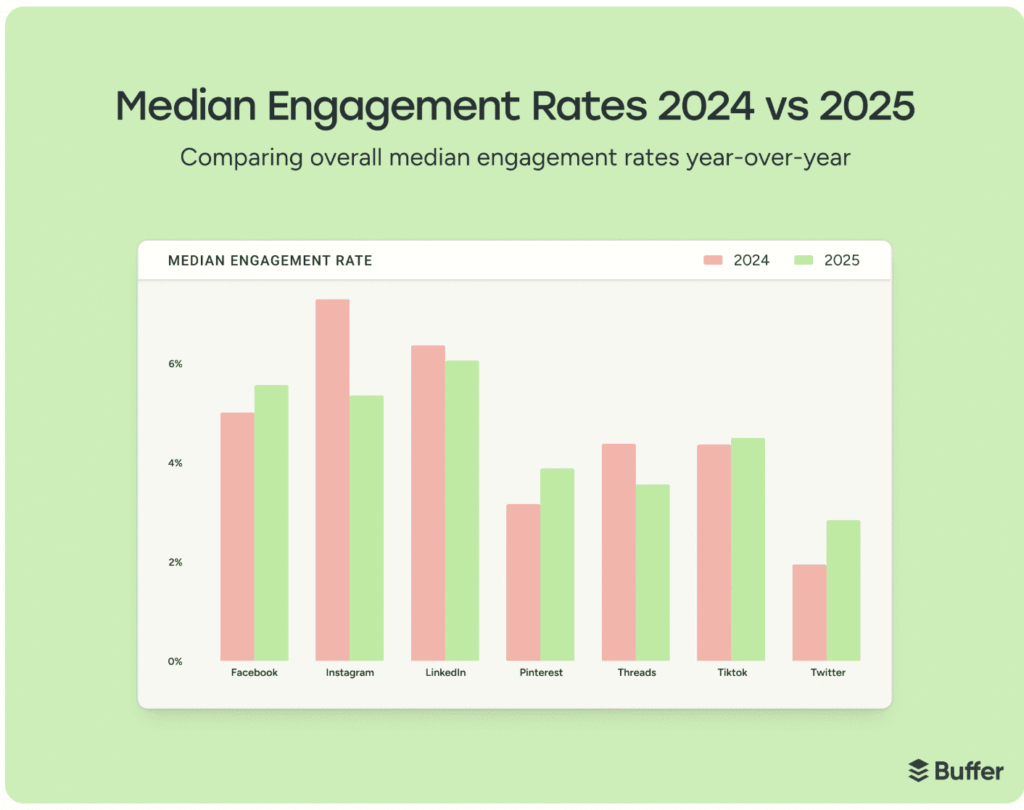
According to Buffer, in 2025 engagement decreased in Instagram, LinkedIn, and Threads, while Facebook, Pinterest, and TikTok showed slight growth, and X showed noticeable growth from a low base. The study also showed that replies to comments increase engagement (up to +42% in Threads), Reels provide more reach in Instagram, but carousels drive more interaction, and in LinkedIn, carousels generate up to 3× more engagement than other formats.
X, Pinterest, TikTok
X tests ads under posts—product recommendations in context
X is testing a new ad format where blocks with product recommendations related to the content of the post appear under posts—for example, under a mention of Starlink, a button to go to the product is shown. The format is integrated directly into the content and does not use affiliate links to avoid manipulation.
TikTok adds new premium ad formats and launches a campaign to drive in-app purchases
newsroom.tiktok.com, socialmediatoday.com
TikTok introduced new ad formats—Logo Takeover (brand at app open), Prime Time (a series of ads in a short period), TopReach (a combination of TopView and TopFeed for maximum daily reach), and an expansion of Pulse to appear next to trending content.
TikTok for Business launched the “Watch it. Love it. Want it.” campaign to boost the use of the platform for product discovery and purchases—according to the company, in-app search grew by 40% year over year, and one in four users starts searching for something within 30 seconds after opening. The campaign highlights TikTok’s focus on developing in-app shopping as a key growth direction.
Pins can now be promoted in Pinterest
Pinterest added the “Promote a Pin” tool, which allows promoting posts without complex campaign setup—users can set budget, duration, and audience in a few steps. The tool is based on the Taste Graph and focuses on commercial queries, which account for more than 50% of 80 billion monthly searches on the platform. The feature launches in the U.S. with a subsequent global rollout.
SEO
Google Search Console adds a branded traffic filter
A branded query filter has appeared in Search Console—you can now separate branded vs non-branded in a couple of clicks without manual workarounds and regular expressions. Essentially, Google has finally provided basic analytics that everyone was already calculating manually—now it is easier to understand where real SEO is and where it is just brand awareness, and this is critical for evaluating performance—especially when you need to prove that traffic is growing not only from the “already known.”
Google tests AI rewriting of titles in search and releases an update to fight spam
Google has started testing AI rewriting of titles in search results—without notifying the user and without the option to opt out, and in examples not only the form but also the meaning changes. Essentially, Google is gradually taking control over how your content appears in SERP—and this is no longer about “optimizing the title”, but about the fact that even a perfect headline can be rewritten for its own CTR, so SEO is shifting from “what to write” to “how Google will show it.”
Google also added a new property in structured data so that sites can mark content created by AI or bots, but made it “recommended” rather than mandatory—if not specified, it is assumed to be written by a human. Essentially, Google is saying “be honest,” but not forcing it—and this creates an obvious loophole, so for SEO this is more about future preparation than a real ranking factor for now.
Google launches Ask Maps—AI search inside maps
Google is adding the Ask Maps feature to Google Maps based on Gemini—users can make queries to search for businesses, plan trips, and get recommendations directly in the app. The feature is already launching in the U.S. and India, currently without ads but with standard impressions included in analytics.
AI search cites short answers mostly from the top of the page: 44.3% of ChatGPT citations come from the first 30% of the text
- 44.3% of ChatGPT citations come from the first 30% of the page text,
- 74.8% of citations in AI Mode and Gemini appeared in the first half of the page, and 46.1%—in the first 30%.
Research showed that ChatGPT, Gemini, and other AI systems most often cite information from the top part of pages—up to 44% of citations come from the first 30% of the text. Preference is also given to short, clear sentences (6–20 words) that express one idea. The data confirms that to appear in AI answers, it is important to provide the essence immediately and avoid long introductions.
Industry
AI
How AI text signals affect engagement
An analysis of more than 1,000 pages showed that most “typical” AI constructions—such as introductory phrases or standard wording—do not have a significant impact on user engagement. That is, the mere presence of an “AI style” does not determine content effectiveness.
- It’s important to note that…
- Not only… but also
- In conclusion
Instead, em dashes (long dashes) showed a weak positive correlation with engagement and do not harm text perception.
OpenAI shuts down the Sora video generator
OpenAI is shutting down the Sora application about six months after launch—the product with an AI video feed format did not show stable interest, and the company is reallocating resources to the development of the new Spud model and infrastructure for AGI. This means a shift in focus from experimental products toward core AI technologies and computing power.
xAI moves into video—while OpenAI exits
While OpenAI is shutting down Sora due to high costs and weak demand, Elon Musk’s xAI is instead betting on AI video—with integration directly into X and the use of its own infrastructure. The main difference is that xAI is not building a separate product, but embedding video generation into an already existing platform with an audience. Essentially, the market is splitting into two strategies—OpenAI is moving toward enterprise and productivity, while xAI is testing mass content and video.
Ads in ChatGPT are growing slowly—but demand already exists, mainly in retail and grocery
cnbc.com, socialmediatoday.com
OpenAI is slowly rolling out ads in ChatGPT—currently available to about 5% of users, although large agencies are already testing the format and investing $200–250K in pilots; at the same time, impressions are growing rapidly (about +600% month over month), but due to the limited rollout, part of the budgets cannot be spent in time.
According to Sensor Tower, in the first weeks of testing ads in ChatGPT, brands from retail and grocery dominate—along with travel and food delivery. Ads are shown depending on the query topic, confirming that users are already using ChatGPT to search for products and services, similar to Google.
OpenAI moves away from purchases in ChatGPT—checkout returns to Instacart, Target, Booking, and others
Instead of built-in Instant Checkout, purchases will now take place through external apps and retailer services. ChatGPT will remain a tool for search, comparison, and recommendations, but payments will be handled by platforms with ready-made infrastructure. The reason is low conversion within the chat interface and technical complexity: handling catalogs, taxes, logistics, and payments. Users search for products through AI, but buy in familiar services, so the full-cycle model did not work.
Default and premium ChatGPT models search the internet differently
The study showed that default and premium ChatGPT models almost do not overlap in sources—only 7% overlap: GPT-5.3 refers more to media and reviews, while GPT-5.4 refers to brand websites, including pricing and product pages. At the same time, up to 75% of sources in the premium model are not present in Google or Bing for the same query, which means different approaches to search and affects how brand visibility is formed in ChatGPT.
Shopify brands are now available in ChatGPT
Shopify merchants can now sell products to ChatGPT users through Shopify Agentic Storefronts, which provide access to genAI platforms such as ChatGPT, Microsoft Copilot, AI Mode in Google Search, and the Gemini app—all managed centrally from the Shopify admin. Brands that do not use Shopify for e-commerce can add products to the Shopify catalog to reach buyers and sell through these same AI channels.
OpenAI tests Ads Manager, but without analytics its effectiveness is difficult to evaluate
OpenAI is expanding ads in ChatGPT and testing Ads Manager—a tool for launching, monitoring, and optimizing campaigns in real time; currently, advertisers receive reports in CSV format, but the number of ads on the platform is already noticeably growing.
However, early advertisers in ChatGPT do not receive full analytics—the platform provides almost no performance data, has limited targeting, and does not allow automated ad buying. Brands cannot prove the impact of campaigns on results, but OpenAI plans to expand ad delivery to all users in the U.S. in the near future.
ChatGPT adds geolocation—responses become “near me”
ChatGPT is launching a geolocation sharing feature—users can enable precise location to receive more relevant local responses (for example, “cafes nearby”). The feature is optional, already available on iOS and web, Android—coming soon.
OpenAI integrated Shazam into ChatGPT
Now you can identify a song directly in chat without a separate app—it is enough to type something like “Shazam, what track is this?” and allow microphone access. The system immediately shows the title, artist, and even provides a preview.
Anthropic launches Voice Mode in Claude Code
Now developers can control code with voice commands like “refactor authentication middleware.” The feature is already available to about 5% of users and is gradually rolling out further. This expands the possibilities of working with an AI assistant in a hands-free format and simplifies interaction during development.
Claude Code and Cowork can now control your PC
Anthropic is launching a feature that allows Claude Code and Claude Cowork to work with your computer—open files, use the browser, and run development tools with user permission. The feature is available in research preview for Pro and Max subscribers on macOS.
Wikipedia bans the use of AI-generated content
Wikipedia has officially banned the use of AI for writing or rewriting articles, allowing only assistive editing and translation with mandatory human review. The rule applies to the English-language version and is aimed at controlling content quality and accuracy.
Amazon restricts AI coding within the company
After a series of incidents, Amazon introduces a rule—all changes made with the help of AI must be reviewed by senior engineers. The reason is simple: part of the incidents and even service outages were directly related to AI-generated code that “went a bit too far.” Essentially, this is a reality check for the market—AI writes fast, but not always safely. For businesses, this means that development automation does not replace control, but наоборот adds another layer of review, otherwise you can save time and lose money.
Amazon and OpenAI enter a $50 billion partnership—AI moves into enterprise
Amazon and OpenAI are launching a strategic partnership—AWS will become key infrastructure for OpenAI, and the companies will jointly create an AI environment for launching agents and applications at the business level. In addition, Amazon is investing up to $50 billion and providing computing power for new models.
Meta acquired Moltbook: a viral social network for AI agents
Meta acquired Moltbook—a platform where AI agents communicate with each other, post, and interact in a format of “Reddit for bots,” not people. Essentially, this is no longer just an experiment, but a bet on a new layer of the internet—where decisions are made not by users, but by their AI agents, which can interact with each other and act on behalf of a person.
Technology
NASA launched Artemis II—the first human flight to the Moon in 50 years
On April 1, 2026, NASA launched the Artemis II mission—this is the first crewed flight to the Moon since 1972, but without landing: 4 astronauts will fly for 10 days, orbit the Moon, and return to Earth. The mission is already underway, the crew has left Earth’s orbit and is heading to the Moon, testing the Orion spacecraft systems.
Essentially, this is a “dress rehearsal” before returning to the Moon—future missions are expected to build infrastructure and prepare for landing. If everything goes according to plan, in 2027–2028 NASA will move from testing to actual Moon exploration and preparation for missions to Mars.
Apple releases cheaper MacBook Neo and iPhone 17e—expands audience
Essentially, these are simplified versions without “pro” features, but with enough performance for basic tasks—the focus is on scale, not just premium. For businesses, this means more Apple users → more demand for apps, subscriptions, and advertising within the ecosystem.
Oracle lays off 30,000 employees to build AI
Oracle is cutting thousands of employees and increasing debt (already over $100 billion) to invest in data centers and AI infrastructure—a classic trade-off of “people → GPU.” In fact, the company is rapidly transforming from a software giant into an AI infrastructure player, even at the cost of negative cash flow and mass layoffs.
SpaceX prepares for IPO—may become the most valuable company in history
SpaceX has filed for an IPO and plans to go public in 2026—the valuation could reach about $1.7–2 trillion, with plans to raise up to $75 billion, which could make it the largest IPO ever. Essentially, this is not just going public—it is the transformation of SpaceX from a “rocket company” into a full-fledged tech giant with AI and satellite internet.
Gmail allows changing email—after 20 years “finally”
Google has for the first time allowed changing a Gmail address without creating a new account—you can change the part before @gmail.com and keep all emails, files, and history. The old email does not disappear—it becomes an alias, and emails will still be received there. Essentially, this fixes a long-standing pain—you no longer need to create a new account because of a “cringe username from 2007.” But there is a nuance: changes can be made infrequently (once a year), and it is not available to everyone immediately.
Mark Zuckerberg is creating his own AI clone
Meta is working on an AI agent that essentially copies Zuckerberg’s thinking style and helps him make decisions—analyzes data, finds insights, and performs part of management tasks. Essentially, this is not about a “digital Mark,” but about a new level of management—where AI becomes a CEO’s second brain.
Meta shuts down the metaverse
Meta is shutting down Horizon Worlds in VR—the app will disappear from Quest by summer 2026 and will remain only in the mobile version. After about $70–80 billion in investments, the platform failed to take off—few users, weak engagement, and constant losses. Essentially, this is a quiet admission—the metaverse “did not work,” and Meta is shifting focus toward AI and more mass-market products. For businesses, this is a signal: VR as a channel has not yet become mainstream, and money and attention in the market are now going into AI, not “virtual worlds.”
The owner of OnlyFans has died—the person who made “content subscriptions” mainstream
Leonid Radvinsky, the owner of OnlyFans, died at the age of 43 after a long battle with cancer—he was the one who turned the platform into one of the most profitable creator services in the world after acquiring it in 2018. Leonid Radvinsky was born on May 30, 1982, in Odesa and emigrated to the United States with his parents at the age of 6.
-
Tags
