

WHAT IS CPA AND THE FORMULA FOR CALCULATING IT
-
Post author

-


CPA (Cost Per Action) means “the cost per action.” Some marketers interpret this as Cost Per Acquisition, meaning “the cost of acquiring a customer.” But the term is broader—it can also mean the cost of getting a customer, the cost of generating a lead, or even the cost per click. It depends on the context.
What Is It About?
What is CPA?
CPA is a pricing and measurement model in online advertising that tracks a specific action defined by the advertiser. This action can be a sale, a link click, or filling out a lead form on a website.
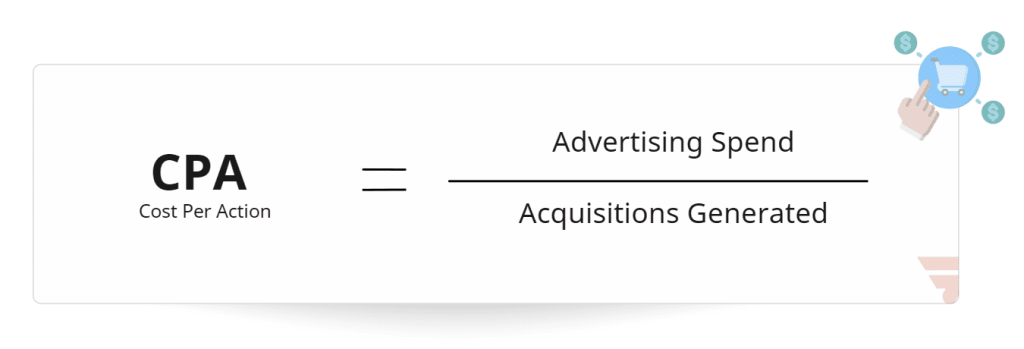
The formula is simple: divide your ad spend by the number of target actions received.
CPA = Ad Spend ÷ Number of Actions
Example: if you got 200 new followers from a Facebook ad campaign and spent $100, the CPA is $100 ÷ 200 = $0.50.
If your campaign goal was not followers but purchases through social media, focus on completed sales. For example, if 50 users placed orders in Direct messages, the calculation would be: CPA = $100 ÷ 50 = $2.
📌 Read the article: What is CAC: Customer Acquisition Cost
Many people call CPA the “cost per acquisition,” because advertisers often see purchases as the desired action. But don’t confuse these terms. In marketing, there is a separate term—Customer Acquisition Cost (CAC), which refers specifically to paying for getting a customer.
Besides CAC, CPA can also refer to CPC (Cost Per Click) or CPL (Cost Per Lead). In some situations, CPA may represent CAC, CPC, or CPL, but these are not interchangeable. CPA is the broadest and most general of these terms. Models that pay for different types of actions are just different versions of CPA.
“Direct-response advertisers often see CPA as the best way to buy digital ads, since the advertiser only pays for a specific, measurable action—which they define as the goal.”—“Cost per action”, Wikipedia
The goal for advertisers, project managers, or marketers is to get more customers. The “desired action” depends on the sales funnel for a specific business. For example, a popular brand building a social media presence may focus on followers and engagement.
But for a new company gaining its first customers through Google Ads, purchases matter more. If a landing page aims to grow the customer base and warm up future buyers, it makes sense to pay for free sign-ups—that is, leads.
CPA can also be set up for calls, emails, downloads (PPD), or survey completions. It helps advertisers measure the success of marketing tools and channels.
Why and How to Calculate Cost Per Action
Let’s look at types of actions advertisers may pay for—ways to turn users into leads or customers:
- Purchases
- Requests for consultations
- Website visits or page views
- File downloads (like a lead magnet)
- Video views
- Price list views or cost estimate requests
- Callback requests
- Website registrations
- Social media subscriptions
- Shares, saves, likes, or comments on a post
- Email sign-ups
CPA pricing is common in affiliate marketing—sellers decide which actions they’ll pay for. Publishers take on more ad risk, and their income depends on results.
CPA can be tracked in different ways depending on the platform and target action. For example, cookies may be used. A file is stored on the user’s device and sent back to the media owner once the action is completed.
Call tracking is popular too. Each ad campaign uses a unique phone number. When people call, the media owner gets credit for that lead. Often, the payout depends on call duration—for example, a lead is counted if the call lasts over 90 seconds.
Some industries—especially offline—use promo codes or vouchers. If a customer uses the code, it gets matched with the publisher’s ID to measure ad performance.
How to Improve CPA
Just like with most other KPIs, there’s no single perfect CPA number. You should evaluate it based on customer lifetime value, the company’s average order value, and more. A good cost per acquisition is often seen as a 3:1 ratio with LTV. That means the cost to get a customer should be about three times lower than the amount of money that customer will bring your business over time.
If the ratio is 1:1, the acquisition cost is too high. But if the first number is bigger—like 4:1 or 5:1—you could actually spend more because you may be missing out on chances to get more customers at a low cost.
To lower your CPA, you should optimize your ad spend, increase your cost per click, and maximize your conversions. Here are a few ways to improve your CPA that work great together.
📌 Read the article: What Is CPC: Cost Per Click and How to Calculate It
Optimize Ad Copy
Strong ad copy that connects with emotions can increase click-through rates. Well-written copy by a marketer can boost the conversion rate on your landing page.
Focus on Customer Retention
“According to a 2021 HubSpot Blog survey, 57% of marketers say improving customer retention is an effective strategy for lowering cost per click.”—“Cost Per Acquisition (CPA): A Beginner’s Guide,” Clifford Chi, HubSpot
Use a CRM
It’s helpful to use a system to prioritize leads and guide them through the sales funnel. By tracking how users behave at different points in their journey with your brand, you can keep current customers and lower the cost of getting new ones.
Do Marketing Research
Analytics can help reduce spending on search ads and other channels. Research also helps you better understand the needs and behaviors of your target audience so your ads and content match what they care about.
Conclusions
The lower your CPA is compared to your LTV, the more profit your company will make. CPA is a detailed metric and should be tracked along with marketing ROI, LTV, website conversion rate, and more. This gives you a full picture of how your marketing efforts relate to the revenue they bring in.
Frequently Asked Questions
Cost per acquisition (CPA) is calculated by dividing your total costs by the number of actions taken.
To find your current cost per click, divide the total money spent on the ad campaign by the number of clicks (link visits).
A target CPA formula is a method for figuring out the cost of a key action—like getting a new customer.
To calculate CPA, figure out the cost and number of key actions taken. Then divide the total money spent by the number of those actions.
The CPA metric shows how much it costs to get a specific action—like a request for a consultation, a service order, or a product purchase.
-
Tags
