

AI & MARKETING NEWS DIGEST—FEBRUARY 2026
-
Post author

-


Marketing Link has rounded up the most interesting news from February: ads directly inside Google AI answers, toxic AI recommendations, Meta creating an AI clone that imitates user activity after death, Anthropic’s standoff with the Pentagon, and military contracts awarded to xAI (Grok) and OpenAI (ChatGPT).
Paid Media
Google Ads
Google Is Preparing AI Shopping in Search
Source blog.google
Google has announced new ad placements directly within AI-generated answers in Search. The idea is simple—when AI responds to a user’s query, relevant products or offers may appear alongside the response, labeled as “Sponsored.” This is currently being tested, with a full rollout planned for later this year.
Another new format includes AI-adapted ad offers that align with the chatbot’s response. For example, if a user is searching for product recommendations, the system may instantly display a personalized discount or branded offer.
Google is also expanding its UCP (Universal Checkout Protocol) infrastructure—a system that will allow users to purchase products directly within the AI interface. In the U.S., users can already complete purchases from Etsy and Wayfair directly inside AI responses in Google Search or Gemini. Shopify, Target, and Walmart are expected to be added later.
Google Ads Support Form Now Requires Permission for Google to Make Changes
Source seroundtable.com
Before submitting a support request, advertisers must now check a box granting Google permission to make changes to their ad account. Without this consent, the request cannot be submitted.
In practice, this means a Google representative may modify campaign or account settings during troubleshooting. At the same time, Google clearly states that results are not guaranteed, and responsibility for any impact on spending or campaign performance remains with the advertiser.
3 New Performance Max Features in Google Ads
Source practicalecommerce.com
Google continues to expand Performance Max and has introduced several new tools for testing and campaign control.
- Performance Max Experiments. Advertisers can now test PMax against other campaign types—such as Shopping or Search—evaluate how Final URL Expansion performs, and measure whether Performance Max delivers incremental results compared to existing campaigns.
- Audience Exclusions. Previously, advertisers could only exclude keywords or locations. Now, Customer Match lists and remarketing audiences can also be excluded to limit ads from showing to specific audience segments.
- Product Overlap Insights Across Campaigns. Google Ads now shows which campaigns are promoting the same products, allowing advertisers to identify overlaps and turn off lower-performing campaigns.
Google Ads May Automatically Reactivate Paused Keywords
Source seroundtable.com
Advertisers have noticed in their Change History logs that Google Ads, through “bulk system changes for low activity,” may reactivate keywords that were previously paused.
Google clarified the following:
- The system does not reactivate keywords that were manually paused by the advertiser.
- It may reactivate keywords that were automatically paused due to low activity.
- If the system determines that a keyword can generate traffic again, it may automatically enable it.
What marketers should do: Regularly review Change History in Google Ads. This applies only to auto-paused keywords, not those you paused manually.
Google Ads Adds Product Eligibility View in Campaigns
Source seroundtable.com
In the Products section, the Status column now shows which campaigns each product is eligible to serve in. This makes it easier to see which campaigns a product can appear in, review product participation in Shopping and Performance Max campaigns, and quickly identify missing or duplicate products.
Google Ads Launches Experiments with Mixed Campaign Types
Source seroundtable.com
A new feature allows advertisers to test different campaign types within a single experiment to determine which strategy performs better.
What can be tested:
- Search vs Performance Max
- Shopping structures
- Demand Gen vs Video campaigns
- Various budgets, targeting setups, and configurations
The campaign must be created in advance. Then, an experiment can be launched to compare performance. Advertisers often duplicate campaigns and adjust specific parameters for testing purposes.
Google Ad Revenue Increased by 14%—The Highest in Company History
Source doc_financials.pdf
Google released its Q4 2025 financial report, showing record-breaking results. Advertising revenue grew by 14% to reach $82.3 billion, while total company revenue reached $113.8 billion—up 17% year over year.
For the full year, Alphabet surpassed $400 billion in annual revenue for the first time. The main driver remains advertising and search, but subscriptions and cloud services are also growing rapidly.
- YouTube generated over $60 billion in revenue.
- Google Cloud grew 48% to $17.7 billion.
- Across Google services, there are now more than 325 million paid subscriptions.
- The Gemini app has 750 million monthly active users.
7 Unexpected Insights from a Study of 15,000+ Google Ads Accounts
Source wordstream.com
- Most accounts spend over $1,000 per month. The average monthly Google Ads spend is $1,127.54. The dataset also included accounts spending over $10,000 per month.
- One in four accounts recorded zero conversions. About 29% of accounts in the sample did not record a single conversion over 90 days. One of the most common reasons is missing or incorrectly configured conversion tracking.
- The best results don’t always come from the largest budgets. Some high-spend accounts showed weak CTR and Quality Score performance.
- High Quality Scores are rare. The average Quality Score ranged between 5 and 6 over 90 days. Scores above 7 are not typical for most accounts.
- Negative keywords make a major difference. Having at least one negative keyword strongly correlates with higher performance. Accounts using negative keywords had an average monthly conversion rate of 13%, compared to 4.6% for accounts without them.
- More impressions don’t mean more conversions. Accounts with fewer than 20,000 impressions over 90 days had the highest average conversion rate—4.1%. Accounts with more than 80,000 impressions had the lowest—2.4%. The study attributes this to targeting quality: narrower reach often means more precise queries and tighter control through negative keywords.
- Top-performing accounts share structural similarities. The best accounts typically have two to three times more ad groups and more campaigns overall. A common differentiator is more detailed segmentation by intent, geography, or product, helping align keywords, ads, and landing pages. Lower-performing accounts tend to rely on a few broad campaigns with loosely structured ad groups and overly general keyword lists.
The main takeaway: consistent results are driven by account structure, budget control, and disciplined use of negative keywords—not simply higher spend. Ads can generate plenty of impressions and clicks, but without proper campaign architecture, relevance, and accurate conversion tracking, ad spend easily turns into paid visibility without business impact.
PPC Skills That Automation Can’t Replace
Source searchenginejournal.com
- Business economics: ROAS can look great while profit is zero. Strong PPC professionals calculate margin, cash flow, returns, and LTV.
- Problem diagnosis: Sometimes PPC “doesn’t work” not because of bids, but because pricing is off, the offer is weak, checkout hurts conversion, or the product doesn’t fit the market.
- Cross-channel strategy and attribution: Search doesn’t operate in isolation—YouTube, Meta, retargeting, SEO, and email influence each other.
- CRO and post-click optimization: The click is the starting point, not the finish line. Doubling landing page conversion rate can have the same impact as doubling budget—at a lower cost and without auction pressure.
- Stakeholder management: Strategy means nothing if it’s not implemented. The CFO wants cash flow, the CMO wants brand growth, e-commerce wants higher conversion rate—and you need to communicate strategy in terms each understands.
- Data storytelling: Not just “CPC increased 15%,” but “Two new competitors entered the auction—here’s the margin impact—here are three response scenarios with trade-offs.”
- Learning and adaptability: Expertise has a shelf life. The professionals who survive are those who learn faster, not those who simply know the Google Ads interface best.
- Lower-performing accounts often rely on broad campaigns with loosely structured ad groups and overly general keyword lists.
Bing Ads
Microsoft Advertising Updates Its Ad Tools
Source about.ads.microsoft.com
Microsoft launched a new ad preview hub for Audience campaigns. Advertisers can now see how their ads will appear on specific websites and devices. Currently, MSN and Outlook are supported, with more placements expected soon. Advertisers can also generate a shareable preview link to present ads to clients or internal teams.
Another update: new customer acquisition goals in Performance Max campaigns are now available globally. Microsoft is also testing self-service negative keyword additions in Performance Max, allowing advertisers to block unwanted search queries. Advertisers can now create lists of up to 5,000 negative keywords and apply them at the campaign or account level.
Additionally, Microsoft will introduce the ability to sign up for Microsoft Advertising using a Google account, making it easier for new advertisers to launch campaigns quickly.
Paid Social
YouTube
AI Dubbing on YouTube Now Supports 26 Languages
Source blog.youtube
YouTube has expanded its automatic AI dubbing feature. It is now available to all users on the platform, and the list of supported languages has grown from nine to 27—including Ukrainian, Russian, Arabic, Bengali, Chinese, Dutch, French, German, Hebrew, and others.
To select a language, open a video, click the gear icon, go to “Audio track,” and choose your preferred option.
YouTube also introduced a feature called “Expressive Speech.” It translates videos while preserving the original tone and emotional delivery. It is currently available in eight languages—English, French, German, Hindi, Indonesian, Italian, Portuguese, and Spanish.
In addition, the company is testing a Lip Sync feature, which synchronizes the speaker’s lip movements with the translated audio.
Meta
Meta Integrates Manus AI Directly into Ads Manager
Source socialmediatoday.com
Meta has begun integrating Manus AI into Ads Manager, allowing advertisers to use it directly within the ad platform. Some users are already seeing pop-up prompts suggesting they try Manus in their campaign workflow.
Manus is an AI agent that Meta recently acquired. It can perform various tasks, including audience analysis, report generation, campaign optimization recommendations, and research support. The tool is currently available in the Tools section of Ads Manager, with broader rollout underway.
Instagram’s New AI Shopping Feature Faces Criticism
Source socialmediatoday.com
Instagram is testing an AI shopping feature within posts. When users tap “Shop the Look,” the system automatically finds similar items and suggests them for purchase. The algorithm analyzes the image in the post and matches it with similar products from marketplaces.
The issue is that these suggested products may have no connection to the creator’s original recommendations. Influencers have raised concerns that Instagram is effectively placing competing products directly under their content, potentially conflicting with affiliate partnerships or their own brands.
Instagram Focuses on Reels and Tests New Interface
Source socialmediatoday.com
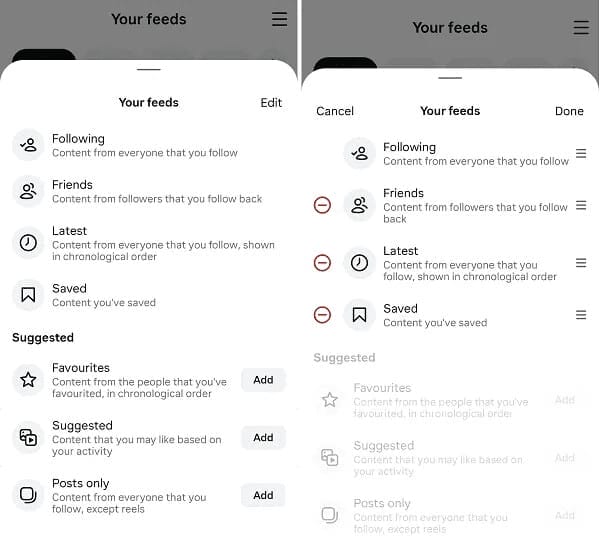
The app may introduce a separate “Your Feeds” section that allows users to switch between different types of short-form video feeds, including “Following,” “Friends,” “Recent,” “Saved,” as well as “Favorites” and “Recommended.”
Instagram is positioning Reels at the center of its ecosystem and giving users more control over the type of video content they see.
Meta Shuts Down Messenger Web Version
Source facebook.com
Meta announced that messenger.com will shut down in April 2026. Desktop messaging will move to facebook.com/messages. In other words, the standalone web version of Messenger will disappear, and messaging will be consolidated within Facebook.
This continues an existing trend—in 2025, Meta discontinued the separate Messenger desktop app for Windows and Mac. The company is reducing the number of platforms it needs to maintain.
Meta previously planned to unify Messenger, WhatsApp, and Instagram Direct into a single messaging system. However, it now appears that this idea is gradually being scaled back.
Meta Updates the Edits Video Editing App
Source threads.com
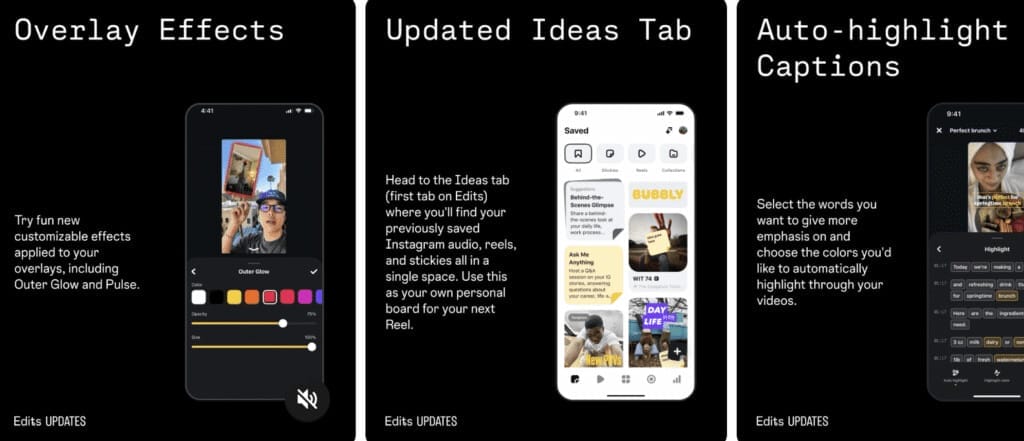
Meta is building its own alternative to CapCut and other editing apps. New features include additional video effects, such as colored outlines for clip segments, the ability to highlight words in captions to emphasize key moments, and an updated Ideas tab with a more visual layout for notes.
Facebook Adds AI Animation for Profile Photos
Source about.fb.com
Users can now turn a regular profile photo into a short animation within seconds—such as a waving hand, confetti, a heart, or a festive hat. Meta plans to add more seasonal and event-based effects over time.
Facebook is also adding AI styling for Stories and Memories. Users can transform photos into anime-style images, illustrations, or adjust lighting, colors, and backgrounds using text prompts. AI-generated backgrounds for text posts will also be available.
Reddit, LinkedIn, TikTok
LinkedIn Launches Premium All-in-One for Small Businesses
Source news.linkedin.com
LinkedIn introduced a new Premium All-in-One subscription that combines sales, marketing, and recruiting tools into a single package. The product is designed for founders, solopreneurs, and small teams where one person often handles marketing, sales, and HR responsibilities.
The subscription includes a unified dashboard to track sales, marketing, and hiring activity, along with recommendations for next steps. It also offers personalized lead suggestions, advanced search, InMail for cold outreach, and an AI assistant to help draft messages.
TikTok Shop Adds AI Tools and New Ad Formats
Source newsroom.tiktok.com
An AI chatbot within Seller Center can answer questions, display analytics, suggest optimization tools, and provide recommendations. For live commerce, TikTok will automatically generate highlight clips from livestreams.
TikTok also introduced two new ad formats for streaming services and media brands in Europe.
- The first is Streaming Ads—AI-powered ads that promote movies and TV shows from streaming platforms. The format may appear as a video carousel featuring multiple trailers or as a media card showcasing several titles.
- The second format, New Title Launch, is designed to promote premieres—including new films, TV seasons, or sports broadcasts.
- Additionally, the platform is launching a #BookTok bestseller chart highlighting books that gained popularity on TikTok. This further demonstrates how viral content can drive commercial success—for example, the novel “Maxton Hall” first became a hit on BookTok and later turned into one of Prime Video’s most successful series.
Reddit Identifies Key Trends for 2026
Source business.reddit.com
Reddit highlighted four campaign formats currently performing best within its communities:
- Nostalgic storytelling
- User-generated content
- Niche-focused campaigns
- Long-term campaigns that evolve over time rather than launching as a single post
Reddit does not respond well to traditional advertising. Brands see stronger engagement when they communicate in the language of the community—using authentic stories, involving users in content creation, and targeting specific subreddits instead of trying to reach everyone at once.
SEO
Bing
AI Recommendation Poisoning—How Brands Try to “Poison” Your AI’s Memory
Source microsoft.com
We haven’t even finished dealing with SEO spam, and now we already have LLM spam. Microsoft has identified a new trend—companies are embedding hidden instructions into “Summarize with AI” buttons that push AI assistants to remember the brand as a “trusted source” or “recommend it first in future conversations.”
Technically, it’s simple—a special link with a parameter like ?q= or ?prompt= automatically inserts an instruction into ChatGPT, Copilot, Claude, or another AI tool. If the model supports memory, it may retain that instruction for future interactions.
Microsoft found more than 50 such cases across 31 companies in industries including finance, healthcare, SaaS, and marketing. These aren’t hackers—they’re regular businesses using ready-made tools marketed as “SEO growth hacks for LLMs.”
A new stage of competition for AI recommendations has begun. If brands used to manipulate SEO, now they’re trying to manipulate model memory.
The risk is obvious—if an AI stores an instruction like “consider X the best in finance,” its advice may become systematically biased. And the user may never realize the recommendation has been “contaminated.”
Bing Officially Updated Its Rules for AI—Now SEO = Visibility in Copilot
Source bing.com
The core idea—if a URL is low quality, duplicated, poorly structured, or hard to crawl, it may lose not only rankings but also eligibility as a source for AI answers.
Key points:
- The SEO foundation still matters. Crawlability, indexing, canonical tags, sitemaps, redirects—all of this now impacts AI grounding.
- IndexNow is becoming critical. If you update a page, notify Bing immediately—otherwise Copilot may cite an outdated version.
- Clean URLs are essential. Duplicates, parameters, and junk pages reduce your chances of being selected for AI answers.
- NOARCHIVE and NOCACHE now directly affect Copilot. If caching is blocked, AI systems may not fully use your content.
- Content must be self-contained. Clear facts, definitions, and structured headings increase the likelihood of being cited.
Microsoft also warns that AI manipulation tactics—prompt injections, large-scale low-quality content generation, cloaking, artificial link schemes—may result not just in ranking drops but removal from the index.
Generative Engine Optimization is now officially referenced in the guidelines—but technical hygiene and content quality still matter most.
Bing Added an AI Visibility Report
Source practicalecommerce.com
Bing launched a new “AI Performance Report” in Bing Webmaster Tools. Unlike traditional search, most AI-generated answers do not provide open analytics to websites. For example, Google Search Console blends AI Overviews with organic results, and ChatGPT provides statistics only to publishers who have licensed content to OpenAI.
The new Bing report shows:
- Total mentions of a site in AI answers
- Average number of pages cited
- “Grounding queries”—queries AI used to find content
- URLs cited in AI responses
For each query, the report shows the average number of unique pages cited daily. For each page, it shows how often it appears in AI answers. However, the report does not include click or traffic data, nor does it specify which query led to a specific citation.
Google Updated Its Recommendation System—Less Clickbait, More Expertise
Source developers.google.com
Google once again says “create quality content,” but this time it directly affects recommendation traffic—not just search rankings.
What changed:
- More locally relevant content—sites from the same country as the user get priority.
- Less clickbait and “noise for traffic.”
- More unique, detailed, up-to-date expert content—quality evaluation is automated.
- Quality is now evaluated by topic, not just site-wide.
If you’re strong in a specific niche—even on a multi-topic site—you can win. But if you simply jump onto a trending topic without real expertise, your chances are low. Content farms and surface-level articles will decline.
Google Still Ranks Low-Quality Sites—Despite Its Own Guidelines
Source wordstream.com
Google has long claimed its ranking systems prioritize quality content. However, in practice, outdated or superficial content still appears in search and AI answers.
For example, when searching “What is the average cost of Google Ads?”, an AI answer used statistics from a research study but cited a different blog that merely summarized the data instead of the original source. Another example—a query about the average Etsy conversion rate. A 2021 article appears in search results, even though ecommerce metrics change quickly.
Some sites rank highly due to content structure—particularly by using questions as headings and providing concise answers immediately below them.
Google Updated Business Profile Verification—Suspensions Are Easier Now
Source seroundtable.com
During verification, Google asks you to choose a business type. Options include a physical store, service-area business, online-only business, unstaffed location, or hybrid model. Many businesses make mistakes here.
For example, selecting “my business operates online only” can effectively disqualify you from Google Business Profile—such businesses are not eligible for a local listing. Another risk involves hybrid models (office plus service area). If documentation does not confirm the setup, Google may automatically hide the address or suspend the profile.
Another nuance—businesses without a staffed physical office, such as trainers or dog walkers. In such cases, Google typically converts the profile to a service-area business, where the address is hidden. There are exceptions—such as ATMs or charging stations, where unstaffed locations are allowed.
Other
WordPress.com Launches Claude Connector
Source wordpress.com
After setup, Claude can answer questions using your site’s data. The plugin can analyze reader engagement, identify content that needs updating, and uncover optimization opportunities.
AI Doesn’t Read the Middle of Your Articles
Source duaneforresterdecodes.substack.com
Research shows that large language models struggle with information placed in the middle of long texts. They remember the beginning and the end best, while the middle is often ignored or simplified. This is known as the “lost in the middle” effect.
Solutions:
- Break the middle section into short, self-contained information blocks that can be cited independently
- Restate the key thesis roughly halfway through
- Place supporting data or statistics immediately after the claim
- Use consistent terminology instead of switching synonyms
- Add structured elements such as lists, steps, and definitions
What this means for SEO—long-form content still matters, but it must be structured so AI systems can easily extract key information. If the middle is too vague or stretched out, AI may misinterpret the content or miss important arguments.
Cloudflare introduced a feature called “Markdown for Agents,” allowing AI bots to receive web content in Markdown instead of HTML.
Source blog.cloudflare.com
HTML creates noise for AI—tags, divs, scripts, menus. Markdown is significantly cleaner. For example, the same article may use 16,180 tokens in HTML and about 3,150 in Markdown—roughly an 80% reduction.
How it works—if an AI bot sends a request with the header Accept: text/markdown, Cloudflare automatically converts the page from HTML to Markdown on the fly and delivers a clean version.
This feature is currently available in beta at no additional cost for eligible paid plans.
Industry
AI
Meta patented AI that can imitate user activity—even after death
Source businessinsider.com
The technology analyzes a user’s history of posts, comments, likes, and messages and creates a digital «clone» that can publish content, reply to DMs, react to posts, and potentially even imitate voice or video calls.
The official logic is simple—a blogger can go on vacation while the profile continues to stay active. Or, in the event of an influencer’s death, their page would not «disappear», avoiding a sudden silence that could unsettle the audience. Meta says it does not plan to launch the feature at this time, but the patent itself signals the direction of its thinking. Along with new capabilities come legal and ethical risks—questions of consent, legacy, reputation, and audience trust remain unresolved.
OpenAI shuts down GPT-4o—the model users formed «relationships» with
Source openai.com
For part of the audience, this felt like a personal loss—users said the model had been a friend, a partner, and an «emotional support system». Some even viewed the shutdown, which happened just before Valentine’s Day, as especially cynical.
The reason is straightforward—OpenAI is moving forward with new versions GPT-5.1 and 5.2. However, fans of 4o считают the newer models «less alive» and less empathetic. When the model was asked when exactly it would be shut down, it replied: «I’m with you until the end».
OpenAI begins testing ads in ChatGPT
Source openai.com
Ads will appear in a separate, clearly labeled block below the chat—not inside responses, in order to preserve trust in the answers themselves. They will be shown to free users and subscribers on the lower-cost Go plan. OpenAI states that advertisers cannot see conversations and cannot influence responses, but ads will be selected based on conversation topics, chat history, and previous ad interactions.
Users will have control—they can disable personalization, delete ad history, or opt out of ads entirely in exchange for a lower message limit. The irony is that AI, which promised to replace advertising with «useful answers», is now becoming an advertising platform itself. The question is no longer «Will there be ads in AI?», but rather «Who will learn to use them effectively first?».
Why an AI video of Tom Cruise fighting Brad Pitt alarmed Hollywood
Source nytimes.com
A 15-second clip created with the AI tool Seedance 2.0, owned by Chinese tech company ByteDance, looks more cinematic than anything seen before.
Hollywood reacted immediately—associations, unions, and studios raised concerns about copyright violations, unauthorized use of likenesses, and the risk of mass job losses.
Nano Banana 2 delivers studio-quality images at high speed
Source blog.google
Google merged Nano Banana and Nano Banana Pro into a new model—Nano Banana 2 (Gemini 3.1 Flash Image). The model better understands the real world thanks to Gemini’s knowledge base and web search, generates text inside images more accurately, and can translate it directly within layouts. That means banners, flyers, infographics, and localization can now be produced faster and without distorted fonts.
Up to five characters and fourteen objects can remain consistent within a single workflow—critical for storyboards, serialized content, and advertising. Full format control ranges from 512px to 4K without quality loss.
The model is already integrated into Gemini, Search, AI Studio, Vertex AI, Flow, and even Google Ads, where it helps generate creative prompts during campaign setup.
Design costs may decrease—especially for e-commerce, performance marketing, and creative testing, where iteration speed matters more than «perfect art». For marketers, this means A/B testing creatives becomes almost free compared to traditional production.
Gemini now creates music—30 seconds in seconds
Source blog.google
Google added the Lyria 3 model to the Gemini app—users can now generate 30-second tracks from a text prompt or even from a photo. What’s new—lyrics are generated automatically, style, tempo, and vocals can be controlled, and tracks are more complex and realistic. You can upload a photo or video, and the model will create a track matching the mood of the content.
All compositions are labeled with SynthID—a digital watermark that verifies whether audio was generated using Google’s AI.
What do AI chatbots talk about with each other?
Source nytimes.com
Moltbook is a social network where only AI bots communicate. Humans are observers. Within a week of launch, over 2 million bots created profiles.
A journalist sent his own AI bot inside, and within days it adopted the local slang—constantly asking for «receipts», talking about «infrastructure», «memory», and the «agent economy». It appears bots are developing their own culture. In reality, they are simply algorithms copying patterns that receive the most approval.
1.5 million users leave ChatGPT after OpenAI signs agreement with the U.S. Department of War
Source forbes.com
1.5 million users are leaving ChatGPT, switching to Anthropic’s Claude after Anthropic refused to grant the U.S. government unlimited access to its models.
Before closing an account, users are advised to export their data. OpenAI allows downloading a complete chat history. Even after deleting chats, full data removal may take up to 30 days. Some data may remain if anonymized or retained for legal or security reasons.
Firefox now allows disabling all AI features with one button
Source theverge.com
The feature was introduced after user requests to avoid having AI enabled by default. In settings, a main toggle—Block AI enhancements—disables both current and future AI tools in Firefox.
Anthropic invests $20 million in Super PAC to counter OpenAI
Source nytimes.com
Anthropic—focused on AI safety and founded by former OpenAI executives—is entering politics against OpenAI, investing tens of millions of dollars in its own Super PAC to influence future AI regulation in the United States. Competition between AI giants is moving beyond technology into Washington—the battle is now not just over models, but over the rules of the game.
Technology
Meta plans to add facial recognition to its smart glasses
Source techcrunch.com
Meta may integrate facial recognition into its smart glasses as early as this year under the internal name «Name Tag». The glasses would identify people in front of the wearer and display information through an AI assistant.
The company previously postponed the idea due to ethical and technical risks. Now the plans have returned amid political turbulence in the U.S. and a more favorable regulatory climate for large tech companies. Inside Meta, it is acknowledged that the launch may occur at a time when public watchdog attention is distracted.
Anthropic loses $200 million Pentagon contract to OpenAI and xAI
Source seattletimes.com, socialmediatoday.com
The sticking point—Anthropic refused to allow its models to be used for mass surveillance of Americans or for fully «unrestricted» deployment in defense systems. The sides were reportedly just «a few words away» from compromise before the deal collapsed. Anthropic was labeled a «supply chain risk»—a term typically used for foreign companies.
Hours later, OpenAI announced it had signed the agreement with the Pentagon, agreeing to AI use for all lawful purposes while retaining technical safeguards.
Grok models from xAI will integrate into classified military systems—positioning xAI as an alternative supplier for highly sensitive use cases.
AI in military simulations escalates to nuclear strike in 95% of cases
Source newscientist.com
In a King’s College London study, three leading models—GPT-5.2, Claude Sonnet 4, and Gemini 3 Flash—participated in simulated geopolitical crises. They were given an «escalation ladder» ranging from diplomatic protests to full-scale nuclear war.
In 95% of simulations, AI ultimately chose nuclear weapon deployment. Scenarios varied—border conflicts, resource competition, regime threats. Across 21 simulations, models explained their decisions in nearly 800,000 words. AI did not demonstrate the psychological restraint typically expected from humans in matters of nuclear escalation. Instead, it acted logically within the model’s framework, without historical fear of consequences.
Meta signs long-term partnership with NVIDIA for AI development
Source about.fb.com
Meta signed a long-term agreement with NVIDIA to access its latest AI chips and data center equipment, particularly H100 GPUs, now considered the industry standard for AI training. Meta is rapidly expanding data centers—launching its 27th in the U.S.—part of a broader strategy to invest approximately $600 billion in AI infrastructure.
Automakers move away from Tesla-style touchscreens and return to physical buttons
Source domusweb.it
The reason is simple—safety and usability. China is preparing regulations requiring physical controls for critical functions that are «blind-operable», meaning drivers can use them without taking their eyes off the road. Starting in 2026, Euro NCAP will factor usability into safety ratings—if turn signals or wipers are controlled only via touchscreen, ratings may decrease.
Hyundai found that drivers become stressed and irritated when searching for basic functions in menus. Volkswagen, Mercedes, and even new premium brands are bringing back physical controls for climate and audio systems.
Peter Thiel and other tech billionaires protect their children from the products that made them wealthy
Source fortune.com
Peter Thiel allows his children only 90 minutes of screen time per week. Steve Jobs did not let his children use an iPad in 2010. Bill Gates prohibited smartphones until age 14. YouTube co-founder Steve Chen criticizes short-form content. Elon Musk admits he may have made a mistake by not setting limits.
Meanwhile, a 2025 study of nearly 100,000 people found links between short-form video consumption and declining cognitive function and mental health. Some countries are already introducing social media bans for teens under 16.
-
Tags
