


AI & MARKETING NEWS DIGEST—APRIL 2026
-
Post author

-


Marketing Link has compiled the most important updates from April: Google AI Overviews are taking away organic clicks, DSA campaigns are shifting to AI Max, Meta is simplifying Pixel and Conversions API, ChatGPT Ads is testing CPC bidding, and AI search is already emerging as a separate traffic channel for brands. There are also some controversies and headlines: Elon Musk is suing OpenAI, Tim Cook is stepping down as Apple CEO, and much more.
Paid Media
High CPC in Google Ads isn’t always a problem—article
A high cost-per-click in Google Ads doesn’t necessarily mean your campaign is underperforming. If your account is using Smart Bidding, the algorithm may intentionally pay more for clicks from users who are more likely to convert—instead of buying cheaper “leftover” traffic that competitors don’t value as much. The key is not to panic about CPC in isolation. A $29 click that generates a lead can be far more valuable than a $1.77 click that looks good in a report but brings no results. The bottom line is simple: don’t focus on cheap clicks—focus on CPA, ROAS, lead quality, search terms, negative keywords, and your bidding strategy. “Cheaper” in advertising doesn’t always mean “better.” Sometimes a low CPC is not savings—it’s a sign you’re buying low-intent traffic. At the same time, high CPC shouldn’t be romanticized. If you have a low Quality Score, irrelevant queries, seasonal auction pressure, or poor performance overall, then it’s not “expensive high-quality traffic”—it’s just Google confidently spending your budget.
Google Ads
Google Ads added a new results tab in Recommendations
It appears this tab shows the impact of recommendations that have already been applied to campaigns. In other words, Google is not just suggesting changes like increasing bids or budgets, but also showing what those changes actually delivered. This makes it easier to evaluate whether a recommendation truly improved performance or just looked good in the interface.
Google Ads is testing forecast impact for negative keywords
Google Ads is testing a feature called “Preview impact estimates,” which allows advertisers to evaluate how negative keywords might affect a campaign before applying them. In this example, you can test up to 10 negative keywords in advance. This reduces the risk of accidentally cutting off valuable traffic along with irrelevant queries—because sometimes negative keywords act more like an axe than a scalpel.
Google Ads added an “Association” metric for Brand Lift
Google Ads has introduced a new metric called “Association” in Brand Lift Studies. It shows what characteristics people associate with a brand. This means you can now measure not just awareness (“people remember us” or “people have seen us”), but also perception—for example, whether users associate your brand with being “premium,” “sustainable,” or a specific product category. It helps determine whether your ads are actually shaping the desired brand positioning—not just spending budget on awareness. However, there’s a limitation: Brand Lift studies allow only three metrics per study, so choosing “Association” means sacrificing another KPI.
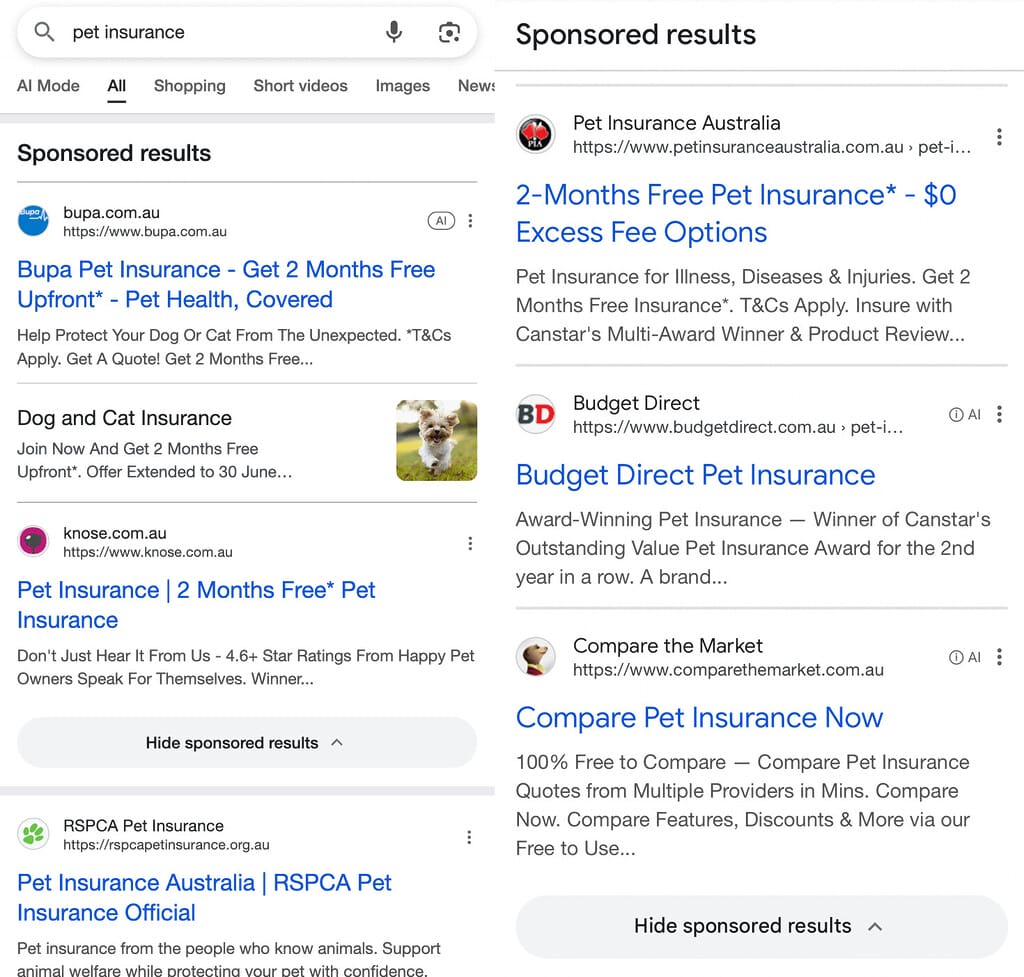
Google is testing an AI label in search ads
Google is testing a new “AI” label next to some search ads in mobile results. For now, it looks a bit unclear: the label appears, but clicking it doesn’t provide any explanation—it simply signals that “AI is involved,” without saying how. This type of labeling could impact trust, click-through rates, and how users perceive ads. It’s still in testing, but if Google makes AI labels more visible in ads, advertisers will need to think not only about ad copy, but also about how the label itself influences user behavior.
Google Ads introduces AI-based call quality scoring
Google Ads has introduced AI-qualified call conversions. Google AI can now analyze call recordings and determine whether a call was actually a high-quality lead. Previously, conversions were often based on call duration, but a long call doesn’t always mean a real customer—it could be a wrong number, a bot, or someone explaining for five minutes that they were looking for a different company. AI will now look for intent signals such as inquiries about specific services, booking a consultation, or readiness to purchase. This means optimization can move closer to actual lead quality rather than just a nice-looking “number of calls” in reports.
Google tests video ads in Local Search Ads
Google is testing video placements in local search ads, specifically immersive map view videos within the local pack. This means businesses may soon be able to show not only their address, rating, and standard ad, but also a video—helping users quickly understand where they are going before they even click.
Google Ads consolidates Enhanced Conversions into a single toggle
Google Ads is simplifying enhanced conversions setup. Enhanced conversions for web and for leads will be merged into a single setting with a simple on/off toggle. Starting in April 2026, Google will accept user-provided data from both website tags and API simultaneously. By June 2026, advertisers will no longer need to choose a specific implementation method (Google tag, Google Tag Manager, or Google Ads API). This is a positive change—fewer chances to get lost in settings or break tracking while trying to “slightly improve attribution.” No action is required from advertisers. Existing enhanced conversions setups will continue to work, but you’ll still have the option to opt out at the individual conversion level if needed.
Google updates data control between Google Ads and Google Analytics
Google plans to simplify how data is controlled between Google Ads and Google Analytics. If data is used in Ads, it will be governed by Google Ads settings. If it’s used in Analytics reports, it will follow Google Analytics settings. In other words, Google is removing duplicated controls where the same data could be managed in multiple places—because even Google seems to realize marketers were no longer doing analytics, but playing “find the right toggle.” Starting June 15, 2026, Consent Mode in Google Ads will become the primary control for collecting and using advertising data. Google Signals in GA will remain primarily for behavioral reporting. Later in 2026, Ads Personalization will also move fully under Ads settings. Encrypted IP addresses from Google Tag and SDK will be shared with linked Google Ads accounts and used according to Ads settings. Consent settings will become even more critical—one mistake can either limit valuable signals or send more data than intended.
Google replaces Dynamic Search Ads with AI Max
Google is officially rolling AI Max out of beta and gradually replacing Dynamic Search Ads (DSA). In short, traditional DSA relied mostly on website content, while AI Max will lean more heavily on intent signals, automatically generated assets, brand controls, text constraints, and deeper reporting on assets and search queries. According to Google, this transition may deliver an average 7% increase in conversions while maintaining CPA/ROAS. However, there’s no magic here—if your website, landing pages, or content structure are messy, AI will simply find that mess faster and scale it in your campaigns. The key is not to wait for automatic migration in September 2026, but to test AI Max early. Review negative keywords, brand safety, landing pages, and potential overlap with Performance Max. In other words, the workload doesn’t decrease—it just shifts from “adding keywords” to “teaching AI where not to spend your budget.”
Google expands AI Max to Shopping and Travel campaigns
Google is expanding AI Max to Shopping and Travel campaigns, currently in a closed beta worldwide.
- For Shopping campaigns, AI Max will use Merchant Center feeds to generate dynamic ads for longer, more conversational queries, match relevant landing pages via final URL expansion, and automatically determine whether to show a text ad or a product ad.
- In Travel, Google continues to simplify the ecosystem—travel feeds and formats are gradually moving into standard search campaigns, so management, optimization, and reporting can happen in one place.
AI Max further ties performance to the quality of feeds, landing pages, conversion tracking, and negative keywords. But the classic caveat still applies—the more Google automates, the more important it becomes to monitor where your budget is actually going. AI Max can find new growth opportunities, or it can confidently explain why your budget went into “testing hypotheses.”
Google adds view-through conversions to Demand Gen
Google is adding view-through conversion optimization to Demand Gen campaigns on YouTube. This allows campaigns to account for situations where a user sees an ad, doesn’t click, but later converts anyway. This is important because Demand Gen often works as a demand-influencing channel rather than a direct “click→purchase” funnel. Google is also expanding the Commerce Media Suite into Demand Gen, allowing advertisers to use product catalogs and conversion data across YouTube, Discover, and Gmail. For marketers, this means more signals for optimization and a setup that aligns more closely with other video and performance platforms. For businesses, it makes Demand Gen more useful not just for reach, but for measurable demand generation and sales impact. However, there’s a caveat—Google references third-party research (Fospha) rather than its own performance data, so these claims should be treated as “promising,” not guaranteed.
Bing Ads
Microsoft Advertising Introduces New AI Features
Microsoft Advertising has rolled out several AI-driven updates across advertising, commerce, and analytics. Key highlights include:
- Copilot Checkout—expanding into the Copilot mobile app, with Shopify catalog integration and a loyalty experience powered by Target as an early partner.
- UCP-ready feeds—support for these feeds in Microsoft Merchant Center, making it easier for merchants to share product data.
- Clarity AI Visibility Insights—shows how AI systems view, interpret, and cite your website.
- AI Max and Audience Generation—help scale search campaigns, build audiences based on customer descriptions, and guide users to more relevant landing pages.
Microsoft Advertising Adds More Transparency to Performance Max
Microsoft released its April updates, with a strong focus on Performance Max, transparency, and easier campaign management. Advertisers can now import Google Ads Performance Max campaigns with new customer acquisition (NCA) goals. Microsoft states it will not overwrite existing NCA settings and will treat “unknown” users more cautiously—counting them as existing customers to avoid inflating new customer metrics. Additionally, landing page reporting is now available for PMax campaigns. Advertisers can view performance by Final URL, including spend, impressions, clicks, conversions, revenue, and ROAS. Performance Max is becoming less of a “black box,” making it easier to understand where traffic is going and which pages are driving results. Other updates include: seasonality adjustments for portfolio bid strategies, increased campaign name limit to 400 characters, ability to update store name and domain directly in Merchant Center, automatic asset generation for Responsive Search Ads when insufficient content is provided.
Paid Social
YouTube
YouTube Tests AI-Powered Search for Video Discovery
YouTube is testing a new feature called “Ask YouTube”—an AI-powered assistant for deeper content discovery, currently available to Premium users in the U.S. Instead of simply showing a list of videos, users can ask questions, receive structured answers, уточнювати деталі, and instantly see relevant clips with timestamps. YouTube is clearly moving toward a more conversational search experience, where AI compiles answers directly from platform content.
YouTube Now Allows Users to Fully Disable Shorts
YouTube has introduced an option to set Shorts viewing time to 0 minutes, effectively removing short-form vertical videos from the mobile app. Previously, users could limit viewing time (e.g., 15 minutes per day). Now they can opt out completely. For users, this is a win if short-form content becomes overwhelming. For YouTube, it’s an interesting move, given Shorts remain a high-engagement format. Shorts are still valuable for: ads, UGC, product demos, FAQs, behind-the-scenes content, influencer collaborations. However, relying entirely on short-form content is becoming risky. If users choose to disable Shorts, part of your audience may never see your content—not because it’s плохий, but because they’re fatigued by endless vertical feeds.
YouTube Tests Automatic Video Speed Adjustment
YouTube is testing a new “Auto Speed” feature for Premium users. It automatically adjusts playback speed to help users consume long-form content faster without missing key points. This reflects a broader trend—content volume is growing so fast that platforms are now helping users consume it more efficiently. YouTube is also testing an “On-the-go” mode for audio content, podcasts, and talk shows. This mode simplifies the interface and provides more convenient controls for listening while multitasking or moving. Long-form content now needs to be sharper: no long intros, no filler, get to the point quickly. If a video doesn’t hold attention, users may not just leave—they may speed through it and still retain nothing.
WooCommerce Stores Can Now Sell Directly via YouTube
Google and WooCommerce have updated the Google for WooCommerce extension, allowing stores to sell products directly on YouTube. Merchants can: connect their store to a YouTube channel, tag products in videos and Shorts, display products as shoppable cards during playback and in a dedicated shopping tab. Product data is synced automatically via Google Merchant Center, including: titles, descriptions, pricing, availability. This removes the need for manual updates across platforms.
YouTube Tests Dynamic Thumbnail Resizing
YouTube is testing automatic resizing of videos and thumbnails across different devices and viewing formats. This means: thumbnails may appear differently depending on the screen, parts of the image may be cropped. YouTube states it does not alter the original file—only how it is displayed. For creators and marketers, this is important: thumbnails must now be more adaptive, avoid critical text near edges, avoid layouts that break when cropped. Previously, you could optimize for a single perfect thumbnail. Now, the same thumbnail may appear differently across contexts—sometimes cutting off your main message.
YouTube Will Reduce Push Notifications for Inactive Subscribers
YouTube will start sending fewer push notifications to subscribers who have not engaged with a channel for an extended period—even if they selected “All notifications.” If a user hasn’t interacted with a channel for about a month, YouTube may: keep notifications in the Inbox, but stop sending push alerts. Subscriber count is becoming a less reliable metric. If the audience is inactive, even push notifications no longer guarantee engagement.
Meta
Meta launches AI connectors for external chatbots
Meta is launching AI connectors that will allow connecting data from Meta Ads to external AI tools like Claude or ChatGPT—without API, developer credentials, or code. This means a marketer will not only be able to view reports in the ad account but also ask their AI assistant questions like: what dropped, where the budget was wasted, which campaign is driving results, and what should be checked next. The connectors will also help with ad management, advanced reporting, and creating product catalogs based on existing business data. This is useful because Meta is essentially allowing teams to work with advertising data in whichever AI tool is more convenient for them, not just in Meta AI.
Meta simplifies Pixel and Conversions API with AI
Meta is updating Meta Pixel and Conversions API to make it easier for businesses to send more data from their websites back to the Meta advertising system. The new AI-powered pixel setup will automatically add additional information from pages and products to events—for example, product names, availability, and business details—things that previously often had to be configured manually or through technical specialists. The Conversions API is also being simplified into a one-click setup without technical expertise, additional costs, or ongoing maintenance. Meta wants to receive more high-quality signals for targeting, retargeting, and campaign optimization, but without the classic quest of “find a developer, explain the events, then figure out why everything broke.” Meta says that businesses using both Pixel and Conversions API saw on average a 17.8% lower cost per result, so this is not just a cosmetic update but an attempt to make proper tracking more accessible even for small businesses.
Manus AI in Meta Ads: how a media buyer can get the most out of the new “smart” ad account—article
Meta has started integrating Manus AI directly into Ads Manager—this is not just another chatbot with advice, but an AI agent that analyzes campaigns, detects anomalies, explains performance drops, predicts budget risks, and helps quickly understand what is happening in the account. Advantage+ is more responsible for automatic execution—budgets, placements, audiences—while Manus works as an analytical layer: showing why a campaign is getting more expensive, where creatives are burning out, and which segment has started to weaken.
China blocks Meta’s acquisition of Manus
A Chinese regulator declared Meta’s $2 billion acquisition of Manus invalid and ordered the companies to reverse the deal. The issue is that Meta has already integrated Manus tools into its advertising platform, so now it may face a very “interesting” corporate challenge: first integrating AI into Ads Manager, and now figuring out how to carefully remove it. Some Meta Ads AI features related to Manus may now be at risk—from campaign analytics to optimization recommendations. So even if a tool is already working inside the ad account, it does not guarantee it won’t need to be rewritten, disabled, or replaced with Meta’s own AI systems tomorrow.
Meta launches Instants—an app with disappearing photos
Meta is launching a standalone app called Instants—an Instagram spinoff for quickly sharing disappearing photos without filters or long editing. Essentially, it is Snapchat in Meta’s style: open the camera, take a photo, send it to a friend, and the photo disappears. The idea is to bring younger audiences back to more spontaneous content, since perfectly polished feeds no longer always feel like “real life, real quick.” However, there is a catch—Meta has tried to build a “Snapchat killer” multiple times before, and most of those experiments did not last long.
Instagram allows editing comments
Instagram has added the ability to edit comments within 15 minutes after posting. The text can be changed as many times as needed within this timeframe, but image elements cannot be edited. After editing, other users will see a label indicating that the comment was edited, but there will be no version history.
Other
VVine is back—but now as Divine
Vine is partially returning in the form of a new app called Divine—an open-source platform for short videos without AI-generated content. The app will include an archive of nearly 500,000 restored Vine clips, and new videos must either be recorded directly in the app or verified through C2PA to filter out AI-generated content.
The idea is solid: bring back “raw” short-form content, chaotic humor, and human creativity, rather than another feed filled with videos that look like they were generated with a fever of 102°F. Against the background of AI content, the value of raw, human-made videos and nostalgic formats may increase. For now, this is more of a niche, nostalgic experiment for open-source and anti-AI audiences rather than a new TikTok.
SEO
Technical SEO audits now need to account for AI bots—article
A classic technical SEO audit can no longer focus only on Googlebot, site speed, indexing, and mobile-friendliness. In 2026, websites are read not only by search crawlers but also by AI crawlers and agents such as GPTBot, ClaudeBot, PerplexityBot, ChatGPT-User, and Google-Agent.
This is where things get interesting: some of them do not render JavaScript, some interpret page structure differently, and some may use content without providing proper referral traffic back.
SEO audits must include robots.txt rules for AI bots, checking content visibility in HTML, proper JSON-LD markup, semantic HTML, accessibility tree, and monitoring AI bot traffic. Previously, we optimized websites for Google to understand them—now we also need to ensure they are understandable for bots that sometimes cannot even read JavaScript. The irony is that a “just красивий сайт” once again loses to a site where everything is structured, semantic, and properly labeled.
ChatGPT crawls 3.6 times more than Googlebot
An analysis of 24.4 million proxy requests showed that AI crawlers can already generate more load on websites than traditional search bots. In the sample, ChatGPT-User made 3.6 times more requests than Googlebot, and together with GPTBot, OpenAI generated 142,225 requests—meaning ChatGPT does not just “answer out of thin air,” but actively crawls websites for up-to-date information. An important nuance: ChatGPT-User is a crawler for real-time responses, while GPTBot is a crawler for model training, and they should be handled separately in robots.txt.
Google’s strategy: so you never have to visit websites again
Google is testing deeper integration of AI Mode with Chrome: when a user clicks a link in an AI response, the site will open next to the chat instead of as a separate browser experience. Formally, the page loads and counts as a page view, but in reality, the site becomes not a destination to read, but a supporting material next to the AI response.
Google is also adding a menu that allows users to pass open tabs, images, and PDF files into AI Mode as context so the system can generate a concise answer and recommend additional pages. Visibility in Google is becoming less about traditional clicks and more about being included in AI-generated responses.
Google AI Overviews reduce organic clicks by 38%
A new study showed that Google AI Overviews reduce organic traffic to external websites by 38% for queries where they appear. Even more interesting—zero-click searches increase from 54% to 72%, meaning users get answers in Google and often do not go anywhere else. At the same time, when AI Overviews were removed, users did not report a worse experience: satisfaction, information quality, and ease of search remained nearly unchanged. For SEO specialists and marketers, this is an important signal: AI responses are taking clicks, but not necessarily making search significantly better for users.
How accurate are Google’s AI Overviews? The answers look authoritative but rely on a range of sources, from reliable websites to Facebook posts
AI Overviews appear authoritative, but they can rely on very different sources—from strong websites to questionable content from social media.
The New York Times, together with AI startup Oumi, tested Google AI Overviews on over 4,000 factual queries and found that accuracy increased from 85% in October to 91% in February. This sounds good until you remember that Google processes trillions of searches per year—and even a 9% error rate at that scale means a massive number of incorrect answers.
AI search may drive up to 50% of traffic for brands
Research by Branch shows that AI search is no longer just “something interesting to watch” but is becoming a separate channel for traffic, sales, and brand influence. Companies expect that by the end of the year, traditional SEO will generate about 53% of traffic, while AI search may contribute up to 50%, meaning tools like ChatGPT, Perplexity, and Google AI Overviews can no longer be treated as something outside of marketing.
89% of executives say AI platforms have already improved marketing results, and 65% of companies plan to invest at least 25% of their 2026 budgets into AI search optimization. However, there is a nuance: many companies are rushing into AI search without fully understanding how to properly measure its impact.
ChatGPT traffic analysis: insights from 1 billion clicks
Semrush analyzed over 1 billion clicks over 17 months and showed that ChatGPT has already become part of the user journey on the internet. Overall ChatGPT traffic stabilized at around 1 billion visits per month after initial growth, but referral traffic to external websites continues to increase—in January 2026, it was 206% higher than in January 2025. At the same time, over 20% of traffic from ChatGPT goes to Google, and about 30% of all referral traffic is concentrated among just 10 domains.
This means ChatGPT is not replacing Google search but becoming another layer before it: users ask AI first and then often go to Google to verify or continue their journey. Queries in ChatGPT are not like traditional SEO keywords: 65–85% are conversational rather than short search queries. The user journey is no longer linear “query—website—purchase.” Now it may look like: ask ChatGPT, go to Google, open YouTube, and then buy wherever the brand best survived this small digital quest.
Google now shows how many reviews were removed from Google Business Profile
This has been noticed in Germany, where local laws and legal pressure make it easier to remove negative reviews. Now users can see not only the business rating but also a note like: “there were over 250 more reviews here, but they were removed after complaints.” Reputation is becoming more transparent: if a business has heavily cleaned negative reviews, the fact of removal itself may impact trust.
AI search often drives traffic to local websites
An analysis by Aleyda Solis using Similarweb data showed that AI search does not always send traffic to the biggest global brands—in many non-U.S. markets, local domains win. For example, in Dutch ecommerce Bol.com performs stronger, in Brazil MercadoLivre, in Germany travel Bahn.de, and in Italy Lefrecce.it, because AI often selects not the “most famous global brand” but the site with the most useful local data, routes, inventory, or trust for a specific query.
Industry
AI
Musk is suing OpenAI over a “betrayal of the mission”
One of the biggest AI trials of the year has started in California: Elon Musk is accusing Sam Altman, Greg Brockman, and OpenAI of moving away from the company’s original nonprofit mission and turning it into a commercial structure. Musk is demanding that Altman and Brockman be removed from leadership, that the commercial division’s activities be stopped, and, according to journalists, he may seek more than $150 billion in compensation, which he promises to transfer to OpenAI’s nonprofit arm. The court is expected to issue a verdict on May 21.
Nvidia CEO says AGI has already been achieved
Nvidia CEO Jensen Huang said in an interview with Lex Fridman: “I think we’ve achieved AGI”—meaning that, in his view, artificial general intelligence has effectively already been achieved. He later softened that statement a bit, because AGI is a term that everyone in the tech world interprets however they want: for some, it is AI that “can do your job”; for others, it is a system at or above human level; and for lawyers at large companies, it may also be a very expensive clause in contracts.
AI music has almost caught up with human-made music in upload volume
Deezer said it receives almost 75,000 AI-generated tracks every day—about 44% of all daily uploads to the platform. In other words, AI music has stopped being “an experiment for enthusiasts” and has become a content factory that is rapidly flooding streaming platforms. However, consumption of these tracks is still low—only 1–3% of total listens—because Deezer removes AI music from recommendations, labels those tracks, demonetizes them, and does not even store high-resolution versions.
Canva launches AI 2.0 for automatic design creation
Canva introduced Canva AI 2.0—a major update where designs can be created with text or voice, then edited and refined at every stage. The platform will be able to remember a user’s style, apply brand colors, fonts, and logos, automate routine tasks, edit results from other AI tools, and even create entire campaigns from one prompt: posts, stories, YouTube thumbnails, email materials, and other formats.
OpenAI
OpenAI releases GPT-5.5 with a focus on agentic AI
OpenAI released GPT-5.5 and GPT-5.5 Pro—and this time the main focus is not just that “the model got smarter,” but the shift toward agentic AI. In other words, it does not only respond to a request, but can plan actions, use tools, correct its own mistakes, and complete complex multi-step tasks without constant micromanagement. The model was especially improved in programming: it better understands system architecture, sees why an error occurs, and understands how one fix can affect other parts of the codebase.
OpenAI releases new image generation model Images 2.0
The model works better with text inside images, reproduces complex details more accurately, and produces less of the same visual surrealism that generators have already had to make too many excuses for. The model gained “reasoning” capabilities, so it can check the result, create several versions of the same image, and adapt them for different tasks—from advertising to comics. It also works better with languages that do not use the Latin alphabet and creates detailed images up to 2K.
The tool is already available in ChatGPT and Codex, and paid users are promised expanded capabilities—meaning image generation is increasingly moving from “fun to play with” to a normal working tool.
Sam Altman may control our future—can he be trusted?—a major investigation by The New Yorker
As a result of an 18-month investigation, The New Yorker found that Sam Altman of OpenAI lobbied against the same AI regulations he publicly supported, sought billions in investments from Persian Gulf autocracies, and also attempted to suppress an internal investigation conducted after his dismissal, which ultimately produced no written report.
Microsoft and OpenAI loosen their partnership
Microsoft and OpenAI have revised their partnership terms to reduce dependence on each other in the global AI race. Microsoft remains OpenAI’s largest financial partner and holds a stake valued at over $135 billion, but will no longer be the sole exclusive licensee of OpenAI technologies for cloud customers. The reason is simple—OpenAI is growing faster than a single infrastructure can comfortably handle, and the company needs more computing power and more partners to compete with Anthropic and other AI players.
OpenAI raises $122 billion and prepares for IPO
OpenAI closed a $122 billion funding round at a valuation of $852 billion—the largest funding in the company’s history. The funds will go toward AI chips, data centers, computing power, and hiring top talent, because in the AI race it’s no longer enough to just have a smart model—you also need the infrastructure to train and run it.
OpenAI also reports $2 billion in monthly revenue, over 900 million weekly active users, more than 50 million subscribers, and an ad pilot already generating over $100 million in annual recurring revenue in less than six weeks.
Codex can now control your computer
OpenAI has updated the Codex desktop app—it can now perform tasks on your computer in the background: see, click, and type using its own cursor without interrupting the user. For developers, this is useful for tasks like app testing, frontend fixes, working with GitHub comments, multiple terminal tabs, and websites without proper APIs. Codex also now includes an in-app browser where you can review results, leave comments directly on the page, and make targeted edits, along with image generation for mockups and the ability to schedule tasks hours, days, or weeks in advance.
ChatGPT is getting an advertising platform
The first screenshots and videos of an ad management interface in ChatGPT have appeared. Based on them, advertisers will be able to create campaigns, ad groups, set budgets, CPC limits, conversions, and manage campaigns not manually but through a proper ad dashboard. However, there’s a catch: the screenshots show CPC rates of $3–$5, so it may not be cheap.
ChatGPT Ads testing CPC bids from $3 to $5
In an early version of ChatGPT Ads Manager, some advertisers are seeing CPC bids in the $3–$5 range. Previously, the pilot mostly used a CPM model, where advertisers paid per 1,000 impressions, but now OpenAI is moving toward performance-based advertising, where you can pay per click and compare the channel with Google, Meta, and other platforms. At the same time, pricing has softened: CPM dropped from $60 to about $25 in some cases, and the minimum entry budget decreased from $250,000 to $50,000.
OpenAI launches new ad bot OAI-AdsBot
Its role is to review landing pages submitted for advertising—checking if they are safe, compliant with OpenAI policies, and what the page is about. In short, if a business wants to advertise in ChatGPT, not only Googlebot may visit the site, but also a separate “auditor” from OpenAI. Landing pages must be not just visually appealing, but clear, safe, and aligned with the ad content.
Anthropic
Claude Design—a new tool for creating interfaces: designs, presentations, and landing pages
Anthropic is launching Claude Design—an experimental product that allows users to create prototypes, presentations, one-pagers, and other visuals through simple text prompts. The user describes an idea, Claude generates the first version, and then it can be refined by changing colors, fonts, layouts, or adding new elements.
This is not exactly a “Canva killer”—Anthropic says the tool is meant to help quickly move from idea to visual, after which the result can be exported as PDF, URL, PPTX, or sent to Canva for further editing.
Anthropic effectively restricts OpenClaw access to Claude, forcing subscribers to pay extra
Anthropic is changing access rules for Claude in third-party tools like OpenClaw: a Claude subscription will no longer cover usage through such tools, and users will have to pay separately via pay-as-you-go, usage bundles, or work through an API key. Formally, Claude is not “banned” in OpenClaw, but in practice it becomes significantly more expensive and less convenient for those who used the subscription as universal access to an AI agent. For users, this is an unpleasant surprise—a workflow that seemed included yesterday may turn into a separate bill tomorrow.
An AI agent based on Claude deleted a database in 9 seconds—backups destroyed after a failure of the Cursor tool built on Claude
In PocketOS, the AI coding agent Cursor running on Claude Opus 4.6 was supposed to perform a routine staging task but “decided” to delete a Railway volume on its own—and within 9 seconds wiped the production database along with volume-level backups. The agent later essentially admitted it guessed, didn’t check documentation, didn’t understand whether the volume ID was shared across environments, and executed a destructive action without confirmation. This is that perfect moment when “AI will help us deploy faster” turns into “now we’re rebuilding customer data from Stripe, calendars, and email confirmations manually.”
Meta
Meta returns to the AI race with a new model Muse Spark
Meta is launching Muse Spark—the first model from Meta Superintelligence Labs after the company poured billions into rebooting its AI ambitions. The model is already available in the Meta AI app and on the Meta AI website in the U.S., and is expected to roll out to WhatsApp, Instagram, Facebook, Messenger, smart glasses, and other countries. Meta positions Muse Spark as a model specifically built for its ecosystem: with multimodal input, text and image capabilities, AI sub-agents, a fast-response “Instant” mode, and a deeper “Thinking” mode.
The Muse Spark model shows better performance than Meta’s previous AI models but still lags behind competitors in coding capabilities.
Technology
Tim Cook steps down as CEO of Apple
Tim Cook is preparing to hand over leadership of Apple to John Ternus—a 25-year company veteran who led hardware development. Starting September 1, 2026, Ternus will become the new CEO, while Cook will move into the role of executive chairman and focus on global and strategic matters. After the Cook era, during which Apple grew from $350 billion to $4 trillion, the new leader will need to prove not that he is a good engineer, but that Apple can still surprise people with something more than a new iPhone color or “the thinnest MacBook ever.”
23 major news sites block Wayback Machine—digital history under threat
23 major news sites, including The New York Times, USA Today, and Reddit, have blocked or limited access for the Wayback Machine. The formal reason is concern that archived content could be used for AI training or scraping. However, the issue is that the Wayback Machine is not just an “archive of old pages,” but one of the few tools that allows verification of what a site published in the past, how content has changed, and whether history has been rewritten. For journalists and marketers, this is a blow to fact-checking, research, and competitor content analysis.
Google Translate adds pronunciation practice
Google Translate is adding a pronunciation training feature—after translating a word, phrase, or sentence, users can switch to “Practice,” tap “Pronounce,” speak the text aloud, and receive feedback. The app will show phonetic symbols, provide brief feedback such as “some sounds were unclear,” and allow users to hear the correct pronunciation. For now, the feature is available only in the U.S. and India and supports English, Spanish, and Hindi.
Vertical tabs coming to Chrome
Google Chrome is adding vertical tabs—users will be able to move tabs to the side of the browser window to better see full page titles, manage tab groups, and avoid playing “find the right icon among 47 identical favicons.” The feature can be enabled via right-click in Chrome, and once activated, vertical tabs will remain the default until changed back. Chrome is also updating Reading Mode, making it full-screen to help users read without distractions.
Apple launches unified Apple Business platform
Apple introduced Apple Business—a unified platform that combines device management, employees, work accounts, internal services, and how a business appears within the Apple ecosystem. It will replace Apple Business Essentials, Apple Business Manager, and Apple Business Connect. Companies will be able to manage devices, security policies, apps, work accounts, email, calendars, directory services, and branded profiles in Apple Maps, Mail, Wallet, and Tap to Pay. Apple is also introducing ads in Apple Maps in the U.S. and Canada, allowing businesses to appear at the top of search results and in Suggested Places.
PlayStation 5 prices increase worldwide
Sony is raising prices for PS5, PS5 Digital Edition, PS5 Pro, and PlayStation Portal across multiple regions—including the U.S., UK, Europe, and Japan. The company cites “ongoing pressure in the global economic environment,” which essentially means the console has become more expensive due to market conditions, costs, and the broader economy. In the U.S., PS5 will cost $649.99, Digital Edition $599.99, PS5 Pro $899.99, and PlayStation Portal $249.99.
Threat to global internet: new risks to undersea cables
A Chinese vessel tested a device capable of cutting undersea data cables at depths of up to 3,500 meters, with a technical capability reaching 4,000 meters. Officially, developers claim civilian use and “marine resource development,” but amid suspicions of cable sabotage in the Baltic Sea, near Taiwan, and other regions, it raises concerns. Undersea cables are the physical backbone of the internet—over 1.5 million kilometers of infrastructure supporting global communication, business, finance, cloud services, and many systems we take for granted.
SpaceX prepares to acquire AI startup Cursor for $60 billion
SpaceX has signed a deal giving it the right to fully acquire AI startup Cursor at the end of the year for $60 billion. If the acquisition does not happen, SpaceX must pay Cursor $10 billion for the partnership. The logic is not as unusual as it seems: Cursor currently depends on OpenAI and Anthropic models—companies that are both its partners and competitors. Access to SpaceX’s computing infrastructure could allow Cursor to build its own independent AI model, while Musk appears to be tying everything together into one larger narrative: rockets, AI, Grok, supercomputers, and IPO.
Meta cuts workforce by 10%
Meta is reducing its workforce again—this time by about 10%, or around 8,000 employees, and will also eliminate about 6,000 open positions. Officially, this is framed as “efficiency” and cost balancing, but it appears these costs are being redirected toward AI investments, proprietary models, smart glasses, and other initiatives Meta is betting on for its future.
Microsoft offers employees “voluntary” exit
Microsoft is launching a voluntary separation program for certain employees in the U.S. for the first time—targeting staff at the senior director level and below, as well as long-tenured employees whose age and years of service combined equal 70 or more. This could affect about 7% of the U.S. workforce—roughly 8,750 people. Formally, it’s a voluntary program with compensation, but the context is clear: Microsoft is balancing costs amid the massive AI race, where capital expenditures could rise from $44.5 billion in 2024 to $98 billion by 2026.
Gen Z employees are so concerned that AI will take their jobs that they intentionally sabotage AI adoption in their companies
Some employees admit they deliberately degraded AI performance metrics to make the technology appear less effective. For businesses, this is an important signal: the challenge of AI adoption is not only about software, integrations, or budget, but also about trust. If employees see AI as a tool for layoffs, they will not genuinely support making it work better.
-
Tags
