

INCREASED SALES BY 134% FOR A COFFEE BRAND: GOOGLE ADS CASE STUDY
-
Post author

-


In the coffee DTC business, the focus is on LTV and repeat purchases, so customer acquisition cost and repeat sales matter more than a single first-order conversion. There is one important nuance, though: mistakes in analytics, ROAS tracking, campaign structure, or the product feed can increase the cost per sale and make scaling much harder.
In this case study, we show how we rebuilt Google Ads for a Vietnamese coffee brand in the U.S.: cleaned up analytics, optimized Merchant Center, improved the campaign structure, and strengthened remarketing.
As a result, sales increased by 134% over 7 months, while ad spend increased by only 44%.
Google Ads
Service
Ecommerce, Vietnamese coffee
Industry
USA
Target Market
Results
+96%
Traffic
-61%
CPL
+134%
Sales
Client
Our client is a U.S.-based Vietnamese coffee brand in the specialty coffee niche operating under a DTC—direct-to-consumer—model.
In this market, customers compare brands, flavors, formats, and prices, so without proper optimization, Google Ads can bring in a lot of irrelevant traffic.
For this type of business, the first purchase is not the only important metric. Retention, repeat purchases, and customer LTV matter just as much.
The client came to us with the goal of improving first-purchase ROI and scaling sales.
Marketing Audit
Before we started working together, we audited the Google Ads account, which had previously been managed by other contractors, and identified the following issues:
- poor budget allocation across campaigns: strong campaigns had low budgets, while campaigns with no sales had high budgets;
- duplicate conversions;
- broad match keywords used in Search campaigns;
- a high volume of irrelevant search queries;
- overly aggressive Target ROAS settings in some campaigns, causing the algorithms to participate in very few auctions;
- no Standard Shopping campaign;
- no branded Search campaign;
- no remarketing campaigns.
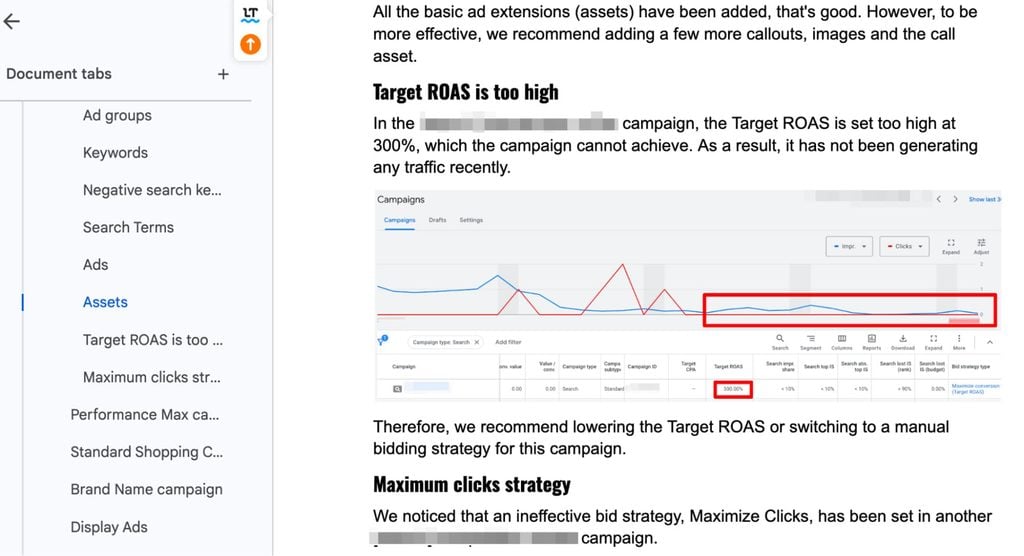
We documented everything in a separate report, showed examples of wasted budget, and proposed a strategy for developing the account.
The client approved our approach—and we started working together.
📌 Read the case study: Increased ROAS by 824% for a U.S. lingerie brand
Analytics
We started by reviewing the entire analytics and conversion tracking setup. Without accurate data, the algorithms cannot learn properly or optimize campaigns for sales.
At the beginning, we:
- reviewed Google Ads, Google Analytics 4, and Google Tag Manager settings;
- checked the Shopify integration with Google Ads and GA4;
- verified whether conversions and conversion values were being tracked correctly.
We found and removed duplicate conversions coming from different sources. We kept only the conversions that Shopify sent directly to Google Ads. These showed higher totals and gave the algorithms more complete and cleaner data to learn from..
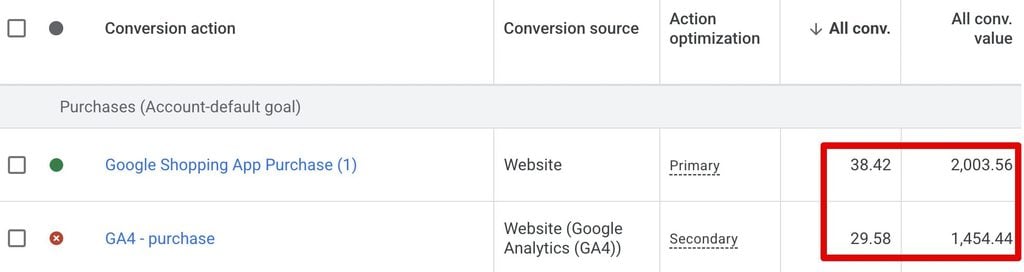
We removed micro-actions such as Add to Cart from the primary conversions and kept only two actions: Purchase and Begin Checkout, so the algorithms would optimize toward more valuable actions.
Later, once the account reached stable performance, we kept Purchase as the only primary conversion.
We also set up micro-conversions as secondary actions for additional analysis of traffic behavior:
- clicks on the phone number;
- clicks on Instagram;
- clicks on email;
- interactions with other website elements.
We also built remarketing audiences with different engagement windows for future use in remarketing campaigns.
Google Ads Account Optimization
After fixing the analytics issues, we moved on to restructuring the advertising account.
Reallocated Budgets Across Campaigns
We increased budgets in campaigns with higher ROAS and stable sales, while reducing budgets in campaigns with weaker performance.
Analyzed Product Performance
We reviewed the performance of all products and paused items with the highest purchase costs so more budget could be directed toward stronger products.
Optimized the Existing Performance Max Campaign
The client’s Performance Max campaign contained several asset groups. We kept only the strongest-performing group and added more relevant search themes to its audience signals.
Launched a New Performance Max Campaign
At the same time, we launched a new Performance Max campaign using the product feed but with an empty asset group—no banners, videos, or text creatives. We also disabled automatically created assets.
This allowed us to focus more of the budget on higher-performing Shopping inventory and improve traffic quality.
We did not pause the old Performance Max campaign immediately. Both campaigns ran in parallel for two weeks while the new campaign completed its learning phase.
Adjusted Bidding Strategies
Search campaigns that were using manual bidding were switched to smart automated bidding strategies.
Some campaigns had overly restrictive Target CPA and Target ROAS settings and were receiving almost no traffic.
We increased Target CPA or lowered Target ROAS in those campaigns so they could enter more auctions and generate more impressions.
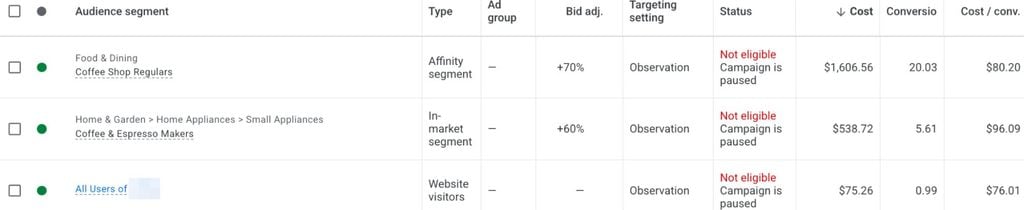
Added Audiences in Observation Mode
We added relevant audience interests to Search and Shopping campaigns in Observation mode so we could monitor their performance and adjust bids accordingly.
Cleaned Up Search Queries
We analyzed search terms from the previous several months and added all irrelevant and low-quality queries as negative keywords.
We also created an account-level negative keyword list so ads would not appear for non-commercial searches containing words such as recipes, diy, homemade, and similar terms.
Set Up a Standard Shopping Campaign
We created a separate Standard Shopping campaign to support Performance Max and give us more control over traffic.
Set Up a Branded Search Campaign
We created a separate branded campaign to protect the brand from competitors in the search results and maintain top visibility.
Launched New Search Campaigns
In addition to the existing general Vietnamese Coffee campaign, we launched two separate campaigns for more specific keyword clusters—Vietnamese Ground Coffee and Vietnamese Coffee Beans—to attract more targeted traffic with stronger purchase intent.
Launched a Competitor Search Campaign
We also launched a Search campaign targeting branded keywords of the main competitor to capture additional high-intent traffic.
Set Up Display Remarketing Campaigns
We launched two remarketing campaigns.
The first targeted website visitors who had not added a product to the cart, reminding them about the brand.
The second used dynamic remarketing for users who had added products to the cart but had not completed a purchase. These users were shown the products they had previously viewed to encourage them to return and complete the order.
Ongoing Optimization
After fixing the most critical issues, we moved to regular weekly account optimization, including:
- reallocating budgets across campaigns;
- pausing underperforming campaigns, keywords, and ads;
- analyzing product performance in Standard Shopping and Performance Max;
- testing new audience signals in Performance Max;
- adjusting Target ROAS and Target CPA bidding strategies;
- reviewing search terms and adding irrelevant ones as negatives;
- expanding the overall negative keyword list;
- adding relevant search queries as new keywords;
- reviewing Google Ads recommendations;
- adjusting bids by geography, device, audience interests, and time of day;
- cleaning up placements in Display and Video campaigns.
In addition to ongoing optimization, we also adapt advertising to the client’s seasonal promotions.
For example, during Black Friday we:
- updated ad copy and creatives for promotional offers;
- increased budgets in the strongest-performing campaigns;
- launched a separate campaign for bestsellers;
- added a Promotion asset.

Expert Comment
The U.S. coffee market is quite specific. On one side, you have familiar names like Keurig and Nespresso. On the other, you have newcomers entering the auction and pushing the bid for a keyword like coffee beans buy up to $66, which looks absurd when the average price of a bag is around $20–30.
Fortunately, this is a DTC brand rather than a typical reseller—they handle their own roasting and imports. Thanks to the expertise of the Marketing Link team, which knows how to work with complex niches, we were able to keep the average CPC below $1.50, while customer acquisition cost stayed around the price of a typical subscription for three bags of coffee. That meant the business did not remain unprofitable after the first order—it could move into profit with the repeat purchase.
Leave your contact information, and we’ll find ways to improve your e-commerce business.
Merchant Center Optimization
We also optimized Google Merchant Center and the product feed, since both directly affect the performance of Standard Shopping and Performance Max campaigns.
A properly optimized feed helps Google match products more accurately with search queries and bring in more relevant traffic.
We:
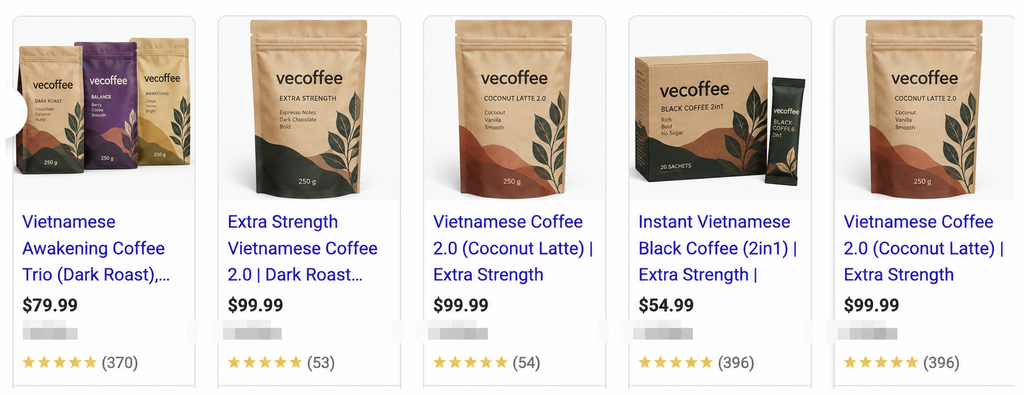
- used feed transformation rules to add the phrase Vietnamese Coffee to all product titles so the ads would appear more often for searches specifically related to Vietnamese coffee and receive fewer irrelevant clicks from broad coffee-related queries;
- added product names to descriptions;
- added additional attributes to the feed;
- enabled Google Customer Reviews, which added star ratings to Shopping ads, increased trust in the store, and improved CTR.
We also updated shipping settings in Merchant Center:
- corrected outdated information;
- added information about free shipping on orders over $49;
- reduced the displayed delivery time from 6 days to 2 days.
We continue to maintain Merchant Center on an ongoing basis:
- monitor the accuracy of product and pricing data;
- check product statuses;
- resolve errors, disapprovals, and product restrictions.
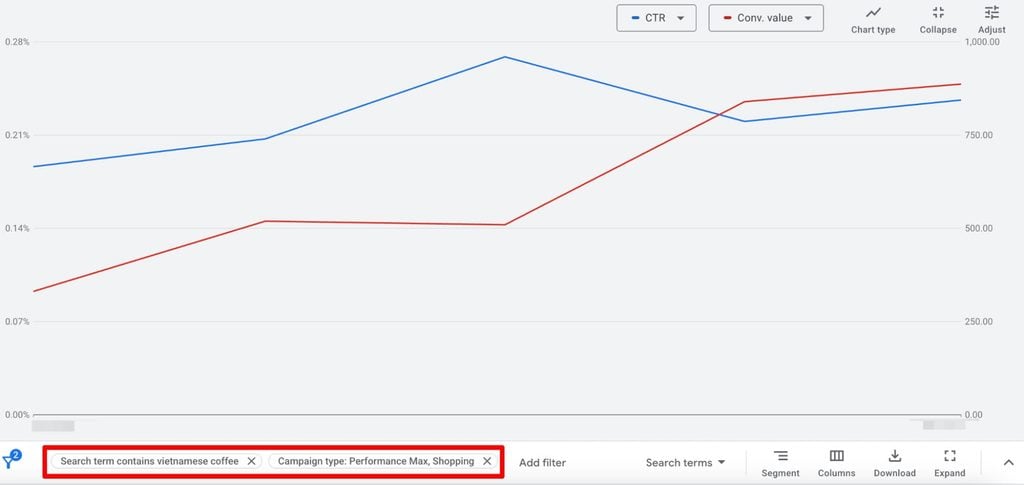
Through consistent work in Merchant Center, we increased click-through rates and sales from the highest-intent queries in Shopping and Performance Max campaigns.
Challenges We Faced
Scaling
After sales stabilized, the client decided to increase the advertising budget from $15,000 to $22,000.
We explained the risks of scaling too quickly because this often causes algorithms to re-enter a learning phase, expands delivery to less relevant audiences, and increases cost per sale.
That is why we scaled the account gradually:
- increased budgets in the strongest campaigns by no more than 20–30% every 3–5 days;
- adjusted Target ROAS and Target CPA to increase traffic volume in campaigns that were underspending;
- moved the strongest-performing products and states into separate Performance Max campaigns;
- launched new Search campaigns for previously uncovered keyword clusters—vietnamese robusta, strong vietnamese coffee, instant vietnamese coffee;
- added other competitor brands to the relevant campaign and increased its budget.
We also strengthened the brand’s upper-funnel presence by launching three new campaigns:
- Demand Gen remarketing for all website visitors;
- Demand Gen Only Feed for users who added a product to the cart but did not complete a purchase;
- Demand Gen targeting a broad audience.
This approach allowed us to scale advertising without a sharp decline in efficiency.
The Economics of Coffee E-commerce
One of the key characteristics of this project was the economics of coffee e-commerce in the U.S.
At the start, customer acquisition cost exceeded $205, while the average order value was around $45. The first purchase did not cover the advertising cost.
For coffee DTC brands, this is a common situation. Most of the profit comes not from the first order, but from repeat purchases, high customer LTV, and recurring subscription orders.
That is why we evaluated advertising performance not only based on first-purchase ROAS, but also on retention rate, repeat purchase rate, and overall customer LTV.
In addition to acquiring new customers, we also worked on repeat sales. To do this, we set up Search, Shopping, and Demand Gen remarketing for the existing customer base.

We also recommended that the client strengthen retention marketing by:
- launching email and SMS marketing;
- setting up automated reorder reminders;
- developing recurring coffee subscriptions;
- adding a loyalty program and personalized promotions.
Repeat sales and retention marketing are what allow brands like this to scale even when the first-order acquisition cost is high.
Results
After 7 months of systematic account management, we scaled sales and achieved the following results:
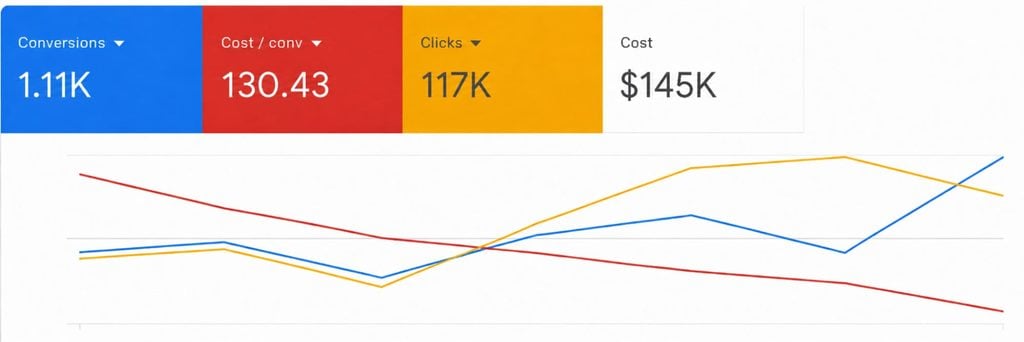
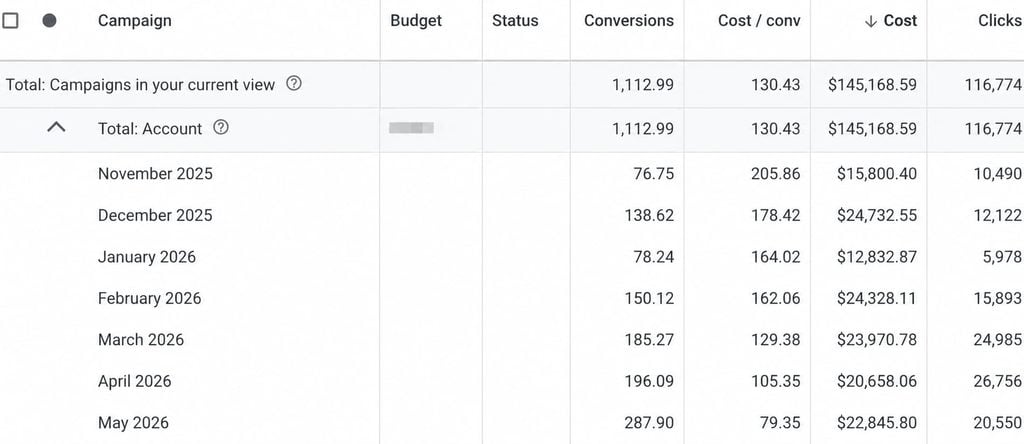
- sales increased by 134%—from 123 to 288;
- customer acquisition cost decreased by 61.45%—from $205 to $79.35;
- traffic increased by 95.9%—from 10,490 to 20,550 clicks.
At the same time, ad spend increased by only 44.59%—from $15,800 to $22,846, while AOV increased by 103.14%—from $45.51 to $92.45.

Expert Comment
Advertising in the coffee niche is always a challenge because repeat purchases and customer LTV often matter more than the first order.
That is why standard strategies do not always work effectively, and campaign setup often requires a more creative approach.
In addition to the core work—proper conversion and micro-conversion tracking, optimizing existing campaigns, launching new ones, cleaning up search terms, and ongoing account optimization—we paid special attention to Merchant Center.
The main goal was to attract more relevant traffic. Using feed transformation rules, we added a high-volume search term to all product titles and supplemented the feed with additional attributes.
As a result, we achieved what we planned: more relevant traffic, higher ad click-through rates, and more sales from the highest-intent queries in Shopping and Performance Max campaigns.
Conclusions
In DTC e-commerce, simply generating sales is not enough. Advertising needs to bring in customers who buy again and contribute to the long-term LTV of the business.
In this project, we did more than optimize Google Ads—we built a system designed to support both the first purchase and repeat sales:
- cleaned up analytics;
- optimized Merchant Center;
- removed irrelevant traffic;
- set up remarketing for different stages of the funnel;
- gradually scaled the account without sacrificing efficiency.
As a result, we increased sales by 134% while ad spend grew by only 44%.
Order an individual consultation for your business
-
Tags
