


HOW TO WRITE A PRODUCT REVIEW?
-
Post author

-


Around 95% of consumers make purchase decisions based on online reviews, and nearly 49% of people trust product and service reviews as much as personal recommendations. User and expert posts about their experiences with products are far more engaging than basic product descriptions on a website. We almost completely trust reviews when they come from people we see as credible.
What Is It About?
What Is a Product or Service Review?
Why spend time reading through dozens of product descriptions when a leading expert recommends it? It might not seem logical—but that’s how the human brain works.
A product or service review can come in the form of a long article, a short post, or an unboxing video. And while visual content—especially video—is more popular today, copywriters, marketers, and bloggers should still know how to write quality written reviews.
In general, the more important or expensive the product, the more time consumers spend researching it. Reading reviews is the easiest way to learn the pros and cons of a product or service—with specifics, real-life examples, photos, and often even videos. No website description can compete with that.
“A customer review is an evaluation of a product or service made by someone who has purchased and used it or had experience with it. Customer reviews are a form of feedback found in e-commerce and on online retail websites. There are also dedicated review platforms, some of which feature both customer feedback and professional reviews. The reviews themselves can be rated by other users based on helpfulness or accuracy.”—Customer review, Wikipedia
Reviews, Testimonials, Descriptions—What’s the Difference?
A product review is written by a user or an expert in the field. It could be a roundup of business automation tools by an experienced marketer or a detailed review of a toaster from someone who knows a lot about home appliances and regularly shares content on the topic. Reviews often include bullet points or numbered lists, images, even quotes, and a summary or final opinion.
On the other hand, testimonials (or casual reviews) are usually short and don’t follow a specific structure. They’re written by everyday consumers, not industry professionals, and tend to be subjective. You don’t need to be a skincare expert to leave a testimonial about a face cream or beauty treatment. These reviews play a key role in SERM (Search Engine Reputation Management) by influencing a brand’s reputation in search results. Business owners or responsible team members should respond to testimonials, while follow-up is less critical for structured product reviews.
Product descriptions are usually found on individual product pages in online stores. These texts are crucial for conversion since they often appear at the final stage of a shopper’s journey. How well they “sell” can determine whether a visitor takes action. However, product descriptions are generally trusted less than reviews, as they’re written by copywriters and marketers. Descriptions typically list features and benefits—rarely including any downsides.
Getting Ready to Write a Review
The process of writing a product review depends on its purpose—whether you aim to objectively compare options or actually sell something. You need to consider your target audience’s tone of voice and their decision-making criteria for choosing a product or service. Below are several universal steps to prepare for writing a complete review.
- Define your target audience, including their fears and desires related to the product or service.
- Gather information on how the product can solve your readers’ problems.
“Think about why a customer might consider purchasing your product or service, and apply the features to real-life scenarios to show how it can solve their problem or improve their experience.”—How To Write a Product Review To Get Readers’ Attention, Indeed Editorial Team
- List key features, specifications, and functions that directly address the reader’s pain points.
- Highlight the benefits for the user. Based on the features, describe how the customer’s life will improve after buying and using the product.
- Add social proof. You can quote an industry expert, refer to a case study, or mention well-known rankings. But the most powerful form of proof is original photos or videos combined with a detailed description of your personal experience using the product.
- Analyze the market. Learn about key competitors and explain how the product you’re reviewing stands out from similar options.
If you plan to publish your review on third-party platforms instead of your own blog or social media, make sure to check the submission guidelines and content requirements in advance.
📌 Read the article: How to Create the Perfect Lead Magnet for a Landing Page?
Benefits of Using Reviews in Marketing
According to a survey by PissedConsumer, around 90% of consumers pay attention to online reviews and trust other users’ experiences. Interestingly, the next most important factor is the product rating, followed by the company’s responses to reviews.
Being able to write product reviews has its own advantages:
- You can become a thought leader in your niche, and people will trust you as an authority.
- Writing reviews can be a good source of income if you become a brand partner or ambassador.
- As an independent marketer or UGC creator, you can choose which products you want to review and recommend.
- Reviews can also help grow organic traffic if you use relevant keywords in your content.
“You can use keywords in page titles, in the description itself, in image alt text, and so on. Just add them where it feels natural and makes sense—don’t try to force them in too many times. Think of it as a way to vary your word choice.”—6 Key Tips to Write Great Product Descriptions (With Examples), Bill Widmer, Ahrefs Blog
Reviews are also a powerful tool for boosting brand awareness—including personal branding. If someone like Neil Patel writes about marketing tools, people trust him. Of course, in many of his roundups, he recommends his own services, which brings profit to his company. But before using reviews as a promotion method, you need to establish yourself as an expert.
Examples of Reviews
Being well-read and well-watched is one of the most important qualities for a reviewer. To write an engaging review, you need to regularly read other people’s reviews. Start by exploring popular niche platforms like Amazon (for everything), Best Buy (for electronics and appliances), MakeUseOf (for tech and software), Beautypedia, Sephora, and Allure (for cosmetics). Let’s take the last platform as an example and look at two reviews from there.
📌 Read the article: Product Advertising—Setup and Management
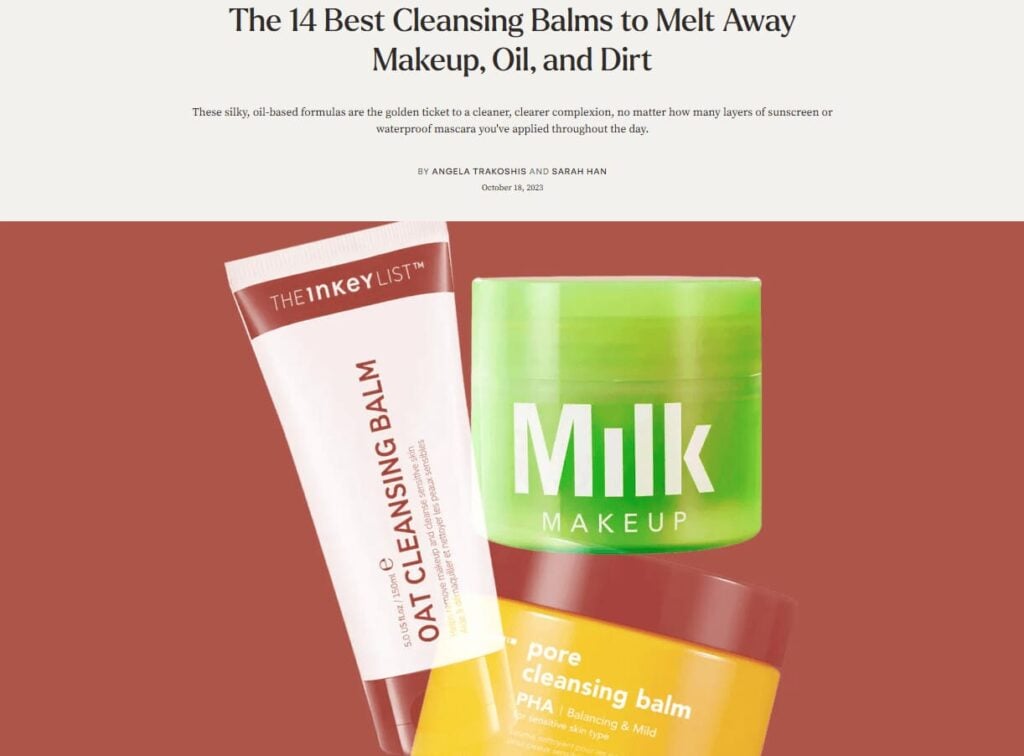
The title of the first one speaks for itself: “14 Best Cleansing Balms to Remove Makeup, Oil, and Dirt.” It’s great when any article headline is clear and informative. For review content, this is a must.
The list follows a certain structure, which makes it easier for readers to navigate. Each product includes repeatable short info blocks: “Why It’s Worth It,” “Editor’s Tip,” “Key Ingredients,” “Who It’s For,” “Scent.”
The next review has an even more eye-catching headline: “I Tried the New Lip Product From Rhode to See If It’s Worth the TikTok Hype.” It includes many photos of the author and the product “in action.” Readers can see how each shade looks on the girl’s lips.


The article includes sections that deserve special attention:
- Direct address to readers, understanding the target audience: “Maybe you’ve seen the Peptide Lip Tints on TikTok, where many early testers raved about the formula.”
- Expert quotes: “According to board-certified dermatologist Dhaval Bhanusali, MD…”
- Instructions, product in action: “Remove the cap and (very) gently squeeze the tube to release the beautifully thick formula. When the gloss collects at the tip of the applicator, it looks opaque—but once you glide it across your lips, you’ll see it creates a vibrant color.”
- Personal impressions and comparisons with similar products (differentiation, which I’ll talk about later in the article): “I tried every shade, swiping it on, smacking and pressing my lips together. Even though it’s not a lip plumper, I like how the process makes my lips look juicier and a bit fuller (without the tingle that comes with traditional plumpers).”
- Result, additional product features, characteristics (in this case, the cosmetic formula): “After I wiped it off, my lips felt soft and hydrated. (Shea butter and synthetic wax do the work in this formula.)”
- Extra benefits “The only thing that could make this routine better is a scent added to the food-inspired shades.”
- Price and where to buy “Peptide Lip Tints cost $16 for 0.3 fl oz and are available now at rhodeskin.com.”
You can find reviews of tech, business products, services, and certain consumer items on Forbes. I read the article “SonarPen 2 Is the Most Affordable iPad Stylus That Works Well” and can confidently say that humor can be a highlight of a review—even on such a serious platform. In this case, the author used Batman to add some personality: “But ultimately, you’ll want to use it with supported apps, as the stylus works much better—I could even draw my usual Batman sketch without any noticeable performance issues.”

Sometimes, the line between testimonials and reviews is blurred. For example, Amazon features detailed user reviews with images and videos. Some of them can be great references for writing product reviews—like the one titled: “This webcam is perfect if you need a versatile webcam!”
This review is written with a lot of emotion. Unlike product descriptions on websites, emotion is actually welcome in reviews: “I’ve been using this webcam for a while now, and I have to say—the tracking feature is nothing short of amazing. I even tried playing hide-and-seek with it to escape the camera’s view, but it always wins, no joke! It’s so accurate and responsive; it tracks your movements flawlessly.”
In the conclusion, the author highlights key features and gives a positive summary of the product.

Product Review Structure
Generic headlines have long become boring. AIDA-style titles no longer impress anyone. A much more effective approach is to use intrigue—something that grabs the reader’s attention from the very first sentence and keeps them from clicking away.
That’s the style of review headlines you’ll find on Allure’s website:
- “I Tried the New Lip Product From Rhode to See If It’s Worth the TikTok Hype”
- “We Tested Dyson’s Newest Tool, the Airstrait, on Four Different Hair Types”
- “Mario’s SurrealSkin Foundation Isn’t Like Any Base Makeup We’ve Ever Tried”
Next, write the lead. Start with a brief overview—include the product name and what it’s used for. You can also mention an interesting fact about the brand.
Explain why you chose to review this product (for example, because you bought it for personal use and weren’t disappointed, or you gave it as a gift and got great feedback from a friend).
The opening paragraph should support and expand on the headline. Let’s go back to the Allure article about different lip gloss shades. The lead paragraph says:
“It has the same delicious base formula as the original Peptide Lip Treatment from Rhode but adds a juicy hint of color.” (Referring to the lip product from Rhode.)
After that, provide context—share your experience. How long have you known about this product? In what conditions did you use it?

The next step is to highlight the key features. List the product’s strengths and weaknesses. Be specific about what you liked and what could be improved.
At this stage, share your personal impressions. This is what sets a review apart from a basic product description on Google. If possible, compare the product or service with similar options. To do that, use points of differentiation—in simple terms, the things that make it stand out.
For example, if there are many photographers in your city but you’re the only one who offers express sessions in 30 minutes and edited photos in 2 days—say that. Even something like stylish packaging can be a standout feature for a product.
Points of differentiation can be based on several factors:
- Price;
- Features;
- Quality;
- Service;
- Design.
Don’t be afraid to include criticism, but keep your feedback constructive. Even if your goal is to attract new customers and promote the product or service, mentioning a minor flaw will make the review feel more realistic. Overly glowing praise in a review can seem out of place.

To wrap up, offer your recommendation—let readers know who the product is right for and who might not need it. You can also share where and when to get it at a discount, how to sign up for a free consultation, or how to access a trial version of the service. This part of the conclusion should be the only clearly promotional element. A reader who trusts the author will be more open to the offer than someone who feels like they’re being sold to from the very first paragraph.
Conclusion
A review is a piece of content where a user or an expert in a specific field describes a product. It can be a roundup review listing and comparing several products or services, or a detailed evaluation of a single product or service.
A review includes information on how the product can solve readers’ problems, who it’s useful for, what its pros and cons are, and its price and overall value. You can find review examples on platforms like Amazon, Sephora, Forbes, and others.
As an independent marketer or UGC creator, you can choose what to review and where to publish it. This format can also be used as part of a product or service promotion strategy. You can dedicate a review to a specific item, make it go viral, and even grow as a thought leader by sharing interesting and unique insights.
FAQ
A product or service review is a user’s or expert’s take on the pros and cons of a product, how it’s used, and sometimes their personal impressions.
To write a good review, you need to actually use the product or talk to people who have. Share your personal opinion and clearly state whether you recommend the purchase. Include images and, if possible, a video.
A product description lists features, functions, and highlights—it’s usually promotional and aimed at making a sale. A review, on the other hand, may include downsides. Even if the review is sponsored, it still offers a deeper evaluation, emotional details, and usage examples.
-
Tags
