
TRIPLED SALES FOR A FLORIDA ASBESTOS COMPANY: A GOOGLE ADS CASE STUDY
-
Post author

-


“We found you through ChatGPT—it recommended you as one of the best for remodeling companies.” That’s exactly how our conversation started with the vice president of a company specializing in asbestos abatement, mold removal, and demolition in Tampa, Florida. Honestly—we didn’t expect that kind of discovery channel ourselves. But that call opened one of our favorite case studies: a skeptical client, a $1,500 budget, a declining market—and a result that forced the client to hire new workers because they could no longer keep up with incoming jobs.
Google Ads
Service
Asbestos Abatement
Industry
USA, Florida
Target Region
Results
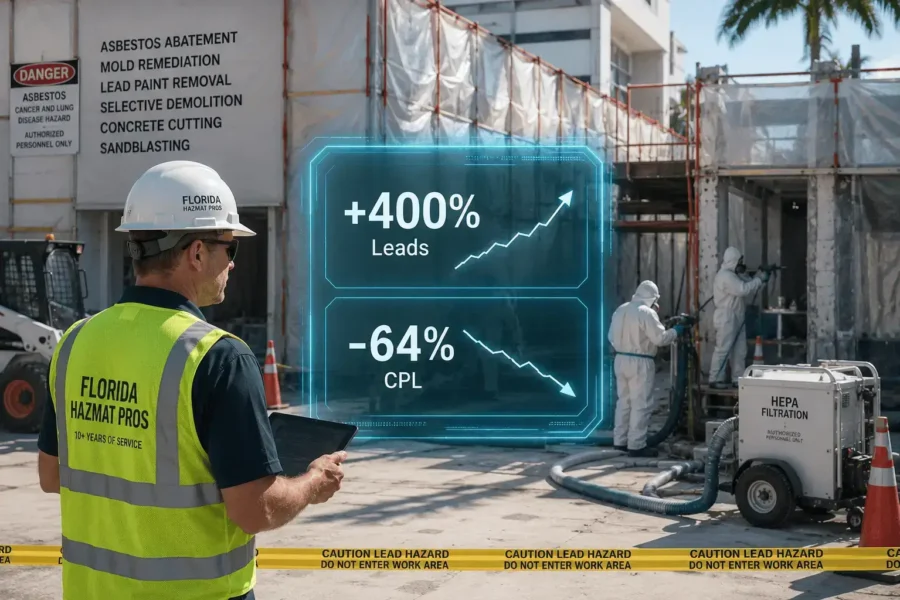
+30%
LSA Leads (same budget)
+400%
Leads
-64%
CPL
The Client and the Context
The company has been operating in Florida for more than 10 years. Their focus is hazardous materials and renovation: asbestos abatement, mold remediation, lead abatement, selective demolition, sandblasting, and concrete cutting. The market is highly specialized: the average project value is $7,000–10,000, and their clients include both private owners of older homes and developers and BRRRR investors who buy and renovate properties for rental income.
The team includes more than 15 people—including the office cat. There is no in-house marketer—the vice president hired us directly and handled the decision-making process. Until 2025, the business had grown steadily through referrals and Google Maps, bringing in 15–20 new leads per month. But in the fall of 2025, everything changed.
The “Before” Stage—When Referrals Stop Saving the Business
In 2025, the regional market became unstable. Demand for services related to older home renovations declined. Previously, the company could rely on organic traffic and referrals, but now the numbers started telling a different story: monthly lead volume dropped from 15–20 to just 5–10.
The client became concerned that the decline would continue. The team still needed to be paid—but new leads were becoming increasingly rare.
Using Ads Transparency, we discovered that there were no active search campaigns at all. The only active advertising channel was LSA (Local Services Ads), which had been set up years ago with a Google consultant—and never touched again. We also found outdated ads under the old name that promoted a Google My Business website. Their current Squarespace website looked much better—but had absolutely no analytics configured.
The full audit revealed:
- Zero analytics—there was no understanding of where leads were coming from.
- Broken website buttons—the forms were not working.
- LSA issues: incorrect ZIP codes and missing key service categories, especially mold demolition.
- Google Ads account—had to be built entirely from scratch.
- The previous agency from Canada had worked with them more than 5 years ago, after which the client decided to rely only on LSA.
Audit and Launch—Building the Foundation from Scratch
The first priority was analytics. Without it, every future decision would have been guesswork.
What we set up before launching ads:
- Google Tag Manager + form tracking.
- Phone clicks as a conversion event (calculation: 2 clicks = 1 call).
- Micro-conversions: social media clicks and form interactions.
- Separate tracking for organic and paid leads.
- Call-only campaigns (before Google discontinued them).
- Fixed the broken website buttons.
- Updated service categories and ZIP codes in LSA.
At the same time, we built a Looker Studio dashboard so the VP and C-level management could open reports directly from their phones without needing to filter anything inside GA4.
📌 Read the guide: How to Increase Google Ads Leads 4x in the Home Renovation Industry
The Process
Month 1—The Foundation
We launched four campaigns:
- Branded campaign—protecting the company name.
- Asbestos Abatement—the flagship service.
- Mold Remediation—the second highest-demand service.
- Remarketing—bringing back previous website visitors.
Result: 4 leads. Not many—but no longer zero. Most importantly, for the first time in the company’s history, we could accurately identify where every lead came from.
Month 2—Expansion
We added campaigns for the remaining services:
- Selective Demolition
- Lead Abatement
- Sandblasting
- Concrete Cutting
Each service had its own dedicated campaign and landing page. No “all services in one ad group” approach.
Month 3—Display Campaigns and the First Breakthrough
We launched display campaigns targeting three separate audiences:
- Developers—a dedicated segment.
- BRRRR investors—a dedicated segment (they buy old homes, renovate them, and rent them out—the ideal audience for asbestos abatement services).
- Keyword-interest audiences—broader targeting.
Month 3 results: 7 leads with the same $1,500 budget. CPL—$214.
Months 4–6—Scaling
The client saw growth—and agreed to increase the budget. We gradually scaled advertising spend to $4,500 per month.
Month 6 results: 25 leads. CPL—$180.

Expert Commentary
One strategic decision we consciously made—and one that often raises questions—was using the SKAG (Single Keyword Ad Groups) approach. Some marketers still view this method skeptically because they dislike spending an hour setting up each group individually. We have our own automation tool—Yakiv Ads—which reduces the process from several hours to about 15 minutes. In industries where CPC ranges from $5 to $120, SKAG is not a luxury—it’s a necessity. It gives precise bid control for every specific query and dramatically increases ad relevance. Without it, we would have simply wasted budget on broad keywords and ended up with a CPL several times higher.
Another intentional decision was rejecting Performance Max. The client still does not have a CRM system. Running PMax without offline conversion data and without a high-quality feed creates a black box that the algorithm optimizes on its own terms. We chose to maintain full control until the client implements proper deal tracking.
Results
| Metric | Before | Month 3 | Month 6 |
|---|---|---|---|
| Monthly Leads | 5–10 (unstable) | 7 | 25 |
| Advertising Budget (excluding LSA) | $0 | $1,500 | $4,500 |
| CPL Google Ads | $0 | $214 | $180 |
| CPL LSA | $512 | $481 | $384 |
| Analytics | Not configured | Full tracking | Full tracking |
| LSA Performance | Unstable | Improved | Improved |
| Overall Sales | Baseline | Growth | 3x growth from baseline |
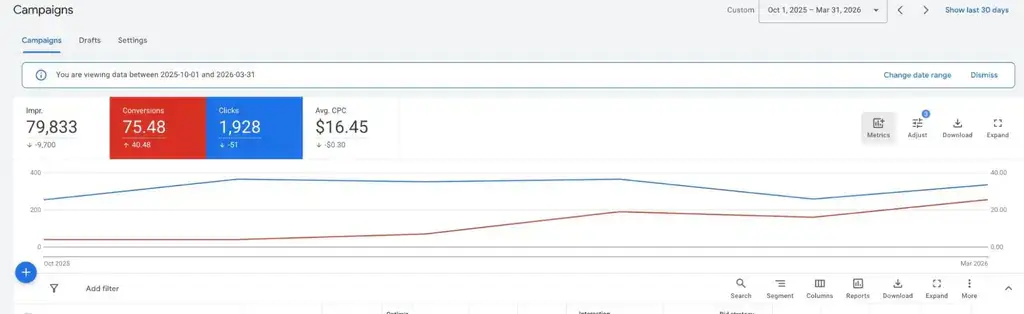
Competition in the asbestos industry is extremely nonlinear. Because some business owners launch campaigns themselves, while some marketers believe 3–5 keywords are enough, keywords like asbestos abatement contract or asbestos abatement and removal can cost $150+ per click. Even for a business with a 10% conversion rate, that still means roughly $1,500 per lead, and if only 1 client closes from every 2–3 leads, customer acquisition costs reach $3,000–4,500.
In our strategy, we did not follow Google’s recommendations: we did not enable broad match, we did not enable AI MAX, and we did not use PMax. Instead, we launched more than 200 keywords, selected the highest-performing ones, and maintained a CPC structure that allowed us to achieve a $180 cost per lead.
An Unexpected Effect—LSA Improved Too
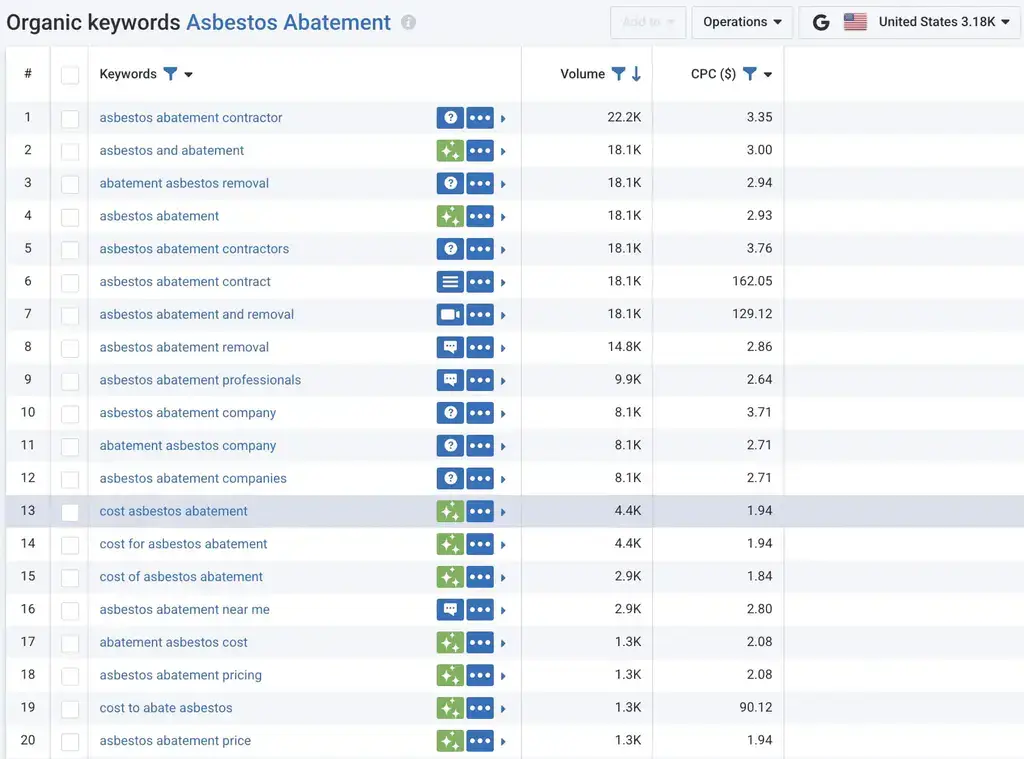
One interesting observation confirmed our hypothesis: after launching search campaigns, LSA also started spending more budget—even though its settings remained unchanged. The reason: LSA responds to overall advertising demand and brand awareness. More touchpoints → more trust → more LSA visibility.
Qualitative Changes
Initial skepticism (“$1,500 is nothing—we used to spend $8–10k”) gradually turned into a completely different question: “How much can we realistically scale the budget?”
The client later told us that overall sales had tripled compared to before we started working together. One reason they are scaling cautiously is simple—they cannot keep up with all incoming work. They had to hire additional workers.
Future Plans
The current focus is systematic scaling:
- Increasing the advertising budget—already approved and being implemented gradually.
- SEO—we are currently pushing the client toward organic growth to reduce dependency on paid traffic.
- Website UX improvements—adding a call widget and simplifying forms.
- CRM—the next critical step for accurate deal tracking and offline conversion integration.
- AEO/GEO optimization—the client found us through AI search, and that’s where their own customers are evaluating contractors as well. This is no longer the future—it’s the present.
Display campaigns targeting developers and BRRRR investors are still generating more expensive leads than search campaigns—but we already see that the number of conversion touchpoints is increasing. We expect CPL in this segment to decrease after several more months of optimization.
Conclusions
LSA is not a strategy—it is a tool. Relying on a single channel without analytics and without search campaigns is a risk that eventually catches up with every business. The first thing any company needs is analytics. Without understanding where leads come from, there is no understanding of what to scale.
SKAG in expensive industries is not outdated. Query-level control has a significant impact on CPL when paired with automation tools. With an average project value of $7–10k, even a $1,500 advertising budget pays for itself with the first client.
Do not rush into PMax without proper data. CRM systems and offline conversions are mandatory for intelligent automated bidding.
AI search is changing customer acquisition channels. The client found us through ChatGPT—and their customers are searching for contractors the same way. AEO/GEO is no longer optional—it is a competitive
Book a personalized consultation for your business
-
Tags
