

AI & MARKETING NEWS DIGEST—MAY 2026
-
Post author

-


Marketing Link has compiled the most important news of the month: Google continues moving advertising into AI Mode, is shutting down Display Campaigns, and is rapidly rolling out AI assistants across Ads, Analytics, and Merchant Center. SEO is evolving as well—GA4 has started tracking AI traffic separately, Google stated that GEO and AEO are still SEO, and search continues its rapid transition into the era of AI Search. At the same time, the business world’s excitement around AI is fading as companies begin focusing on profitability: OpenAI failed to meet its own financial targets, while Anthropic is moving closer to profitability. Large companies are burning through budgets on AI and returning to human labor: Uber spent its annual artificial intelligence budget in just a few months, while one mysterious company spent half a billion dollars. Starbucks and Pizza Hut are partially scaling back AI automation, while Cisco, Cloudflare, and Wix are reducing staff as they transition to AI-first operating models. Read on for the biggest stories of May—with a touch of surrealism.
Paid Media
Google Ads
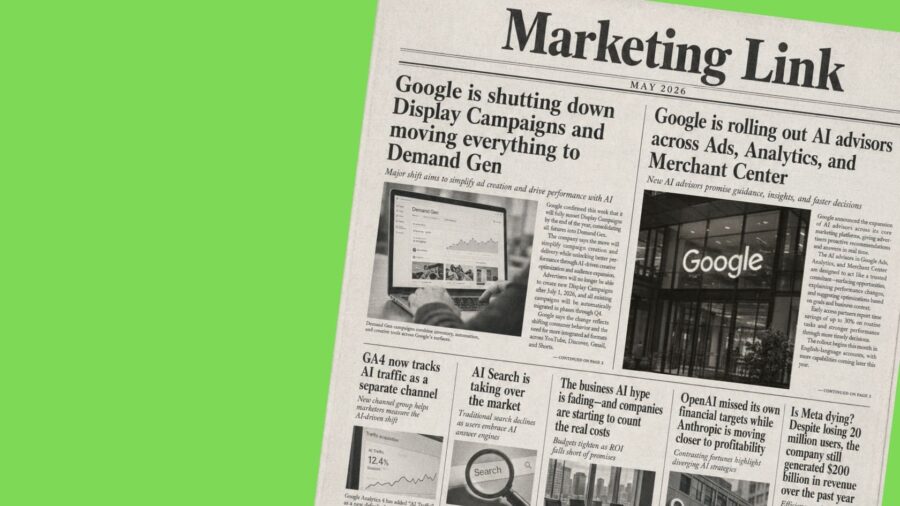
Google Is Retiring Display Campaigns and Moving Everything to Demand Gen
Advertisers will now be able to manage advertising across YouTube, Shorts, Discover, Gmail, and partner websites from a single place instead of switching between different campaign types. Google claims that advertisers who add the Display Network to Demand Gen see an average 9.5% increase in ROI. It sounds impressive, although it is worth remembering that the number comes from Google itself.
Demand Gen is becoming even more similar to Performance Max. The platform continues to push advertisers away from manual management and toward automated campaigns, where algorithms decide who sees ads, where they appear, and when they are shown.
Google Is Moving Ads, Analytics, and Merchant Center Toward AI Advisors
seroundtable.com, seroundtable.com, support.google.com, searchengineland.com
Google is testing a new feature called “Use AI to add products,” which automatically scans a website and finds products to add to advertising campaigns. Instead of manually creating feeds or uploading product data, Google is encouraging advertisers to trust AI to handle the process.
Google has also started testing Merchant Advisor—an AI assistant inside Google Merchant Center. The feature is currently in beta, but it appears that the company is preparing for a broader rollout and may officially introduce it at Google Marketing Live. Based on its name, the tool could become the Merchant Center equivalent of Google Ads Advisor, specifically for e-commerce businesses.
Google is launching AI Performance Insights in Merchant Center—a new report that shows how often your brand and products appear in AI Mode, AI Overviews, and Gemini responses. Advertisers can now see brand visibility share, popular product-related searches, product attributes users are looking for, and performance across different stages of the purchase journey.
Google Is Replacing Reports With Gemini Conversations: Google announced new Google Ads dashboards with built-in Gemini capabilities. Instead of manually creating reports, users will be able to simply ask questions and have the system generate charts, tables, and data visualizations in real time.
For marketers, this means spending less time working with filters, segments, and report exports. Instead of searching through dozens of tabs for a specific metric, users can simply ask: “Show me the campaigns with the highest ROAS over the last 30 days” and receive an instant answer.
Google Launches Two New Ad Formats in AI Mode—Ads Begin Responding Instead of Search Results
At Google Marketing Live, Google introduced two new advertising formats for AI Mode: Conversational Discovery Ads and Highlighted Answers Ads. Both formats are integrated directly into AI-generated responses and appear far more naturally than traditional ad placements.
- Conversational Discovery Ads allow Gemini to generate an advertising response tailored to a user’s specific question. For example, if someone is looking for ways to make their home feel more like a spa, AI can create a personalized recommendation based on an advertiser’s message.
- Highlighted Answers Ads go even further. If AI generates a list of recommendations—for example, language learning services—an advertiser can appear directly within that list as a recommended option. While these placements are labeled as Sponsored, they look almost like a natural part of the AI-generated response.
Google Introduces Three New AI Mode Tools—Shopping Ads, Business Agent for Leads, and Direct Offers Expansion
In short—Google wants users not only to search for information but also to shop, interact with brands, and complete purchases directly within AI-generated responses.
- The most significant update for e-commerce is the new Shopping Ads experience. Gemini will not simply display products but will also explain why a specific product may be a good fit for the user. In effect, AI becomes a personal sales assistant presenting products instead of a traditional salesperson.
- Google is also launching Business Agent for Leads. Instead of filling out a standard lead form, users can click a “Chat” button and ask questions directly to a brand. AI will respond using information from the company’s website. This could reduce the path from first interaction to lead generation to just a few messages.
- Another update is Direct Offers. Google will allow advertisers to automatically create personalized offers, bundle products together, display discounts directly within AI responses, and, for some merchants, even complete purchases without sending users to a website. Travel platforms such as Booking and Expedia are also being integrated into the program.
Google Begins Testing Healthcare Advertising in AI Mode—Only Four Campaign Types Are Eligible
Google confirmed that it is testing healthcare advertising within AI Mode for English-speaking users in the United States. Only Performance Max, AI Max, Shopping campaigns, and broad match keyword campaigns are currently eligible.
Interestingly, Google has restricted creative formats in the initial rollout. Ads with pinned assets and text disclaimers are not included in the test. It appears that Google wants to simplify AI-generated responses and advertising within AI Mode as much as possible.
Google Gives Advertisers More Control Over Brand Searches in AI Max—Three Display Options Available
Advertisers can now choose one of three options: show ads for all relevant searches, separately manage branded keywords through inclusions and exclusions, or completely opt out of branded search traffic.
Google Launches Universal Cart—Purchases Can Be Completed Without Visiting a Website
Google introduced Universal Cart—an AI-powered shopping cart that will work across Search, Gemini, YouTube, Gmail, and partner stores. Users will be able to add products from different Google services into a single cart, while the system automatically tracks discounts, product availability, and better offers.
Merchant Center feed quality is becoming even more important. Product data, pricing, availability, and attributes will determine whether products appear in AI recommendations and Universal Cart experiences.
Interestingly, Google says AI will do more than simply store products in a cart. Gemini will be able to check product compatibility, suggest alternatives, highlight loyalty rewards, and find ways to save shoppers money. In effect, Gemini is gradually evolving into a personal shopping assistant.
Google No Longer Shows Actual Search Queries in Reports—Now You Only See User Intent
Google updated its Google Ads documentation and effectively confirmed that in the era of AI Mode, AI Overviews, Lens, and predictive search, the Search Terms report may display not the user’s exact query but Google’s “best interpretation” of their intent.
In simple terms, a user may have interacted with AI, searched using their camera, or refined a query multiple times, but in Google Ads reports advertisers may only see a summarized version of what Google believes the user intended.
The Search Terms Report has been one of the most important tools for analyzing search traffic for decades. Now it is becoming less clear which exact wording users actually entered. Even more interesting is that in some cases Google may no longer use keywords as the primary mechanism for matching ads. Instead, AI may determine which ad group or asset set best aligns with the user’s overall intent.
This could have the biggest impact on e-commerce, B2B, and regulated industries, where search term reports are heavily used to identify negative keywords, understand customer pain points, and maintain compliance requirements. If Google begins showing its own interpretation of user intent rather than the actual words used, part of the optimization process will inevitably become less precise.
Google Ads Will Delete More Than 37 Months of Detailed Data—You Have Until June 1 to Export It
Starting June 1, Google Ads will begin automatically deleting hourly, daily, and weekly data older than 37 months. After that, this data will no longer be available through the interface or API. Monthly, quarterly, and yearly statistics will remain available for up to 11 years. If you rely on long-term analytics, seasonality comparisons, or multi-year reports with daily-level detail, now is the time to review your archives. After June 1, part of your historical data will simply disappear.
Many companies use historical advertising data for forecasting, channel performance evaluation, and market trend analysis. If this type of analytics is important to you, Google has effectively set a deadline for preserving it.
Availability of reach and frequency metrics is also being reduced—they will only be retained for 3 years. So if you have a habit of putting off data exports until “later,” Google has decided to help you break that habit.
Google Tests Shopping Ads That Expand on Hover—Ads Literally Take Up More Screen Space
The product cards literally expand from top to bottom, drawing more attention from users. The trend is clear: Google is increasingly using design and behavioral mechanics to attract attention to ads. In the past, advertisers competed for position—now they also compete for screen real estate.
Google Combines Ads and Analytics Into One AI Advisor—Ask Advisor Will Tell You What to Do Next
Instead of searching through reports across multiple platforms, users will be able to simply ask a question and receive recommendations based on data from several platforms at once.
Google Introduces Several AI Tools for Search, Shopping, and Performance Max That Take Over Bid and Budget Management
Among the major updates are Journey-aware Bidding, Smart Bidding Exploration, and automatic budget allocation based on demand.
- The most interesting feature is Journey-aware Bidding. AI now considers not only the final conversion but also the entire customer journey leading to a purchase. Simply put, Google is trying to understand which actions actually influence sales rather than just counting form submissions or clicks.
- Another new feature is Smart Bidding Exploration. According to Google, the tool is already generating an average of 27% more new converting users by discovering less obvious search queries. This technology is now expanding beyond Search into Shopping and Performance Max.
Google Uses Additional Conversions to Train AI—Even If They Don’t Affect Bidding
Google has updated its Google Ads documentation and confirmed that primary conversions not directly used for bid optimization can still help algorithms make more accurate predictions.
In simple terms, if a campaign is optimized for sales, Google may still analyze other user actions—such as page views, form submissions, or other intermediate conversions—to better understand the path to purchase. Not every conversion needs to be used as the primary campaign goal, but proper tracking can help Smart Bidding learn faster and identify potential customers more accurately.
Google Opens Vehicle Ads to Standard Shopping—Dealers No Longer Need Performance Max
Google now allows Vehicle Ads to run through Standard Shopping campaigns. Previously, this format was only available through specialized Performance Max for Vehicle Ads campaigns.
Standard Shopping has traditionally provided significantly more control, segmentation, and reporting capabilities than automated Performance Max campaigns. For businesses, this is good news primarily because of increased transparency. Many advertisers used Performance Max not because they wanted to, but because there were no practical alternatives for Vehicle Ads. Now there is an opportunity to manage automotive ads in a more familiar format.
Google Relaxes Rules for Out-of-Stock Products—Gray Buttons Are No Longer Required
Google has updated its Google Merchant Center requirements and given merchants more flexibility in how they display out-of-stock products. Instead of requiring a grayed-out button, sellers can now simply show a clear status such as “Sold Out” or “Unavailable.”
If a product has multiple variants, merchants can now disable only the unavailable options instead of making the entire purchase section inactive. This is especially useful for apparel, footwear, and products available in multiple colors or sizes.
Google also clarified that pre-order and made-to-order products must display an expected delivery date, and any restrictions such as “pickup only” must be clearly stated on the product page.
For marketers and e-commerce professionals, this means fewer risks of Merchant Center issues caused by product page design. For businesses, it means more opportunities to maintain a positive user experience even when part of the inventory is temporarily unavailable.
Soon You’ll Be Able to Block Unwanted Content for AI Max at the Account Level
Google has confirmed that account-level content and headline exclusions will be added to AI Max later in 2026. This means advertisers will be able to prohibit certain content once instead of configuring restrictions separately for each campaign.
For marketers, this is one of the most anticipated features since the transition from DSA to AI Max. Many specialists are accustomed to controlling which pages, URLs, and content types can be used to generate ads. Some of that control was lost in AI Max, which generated considerable criticism.
Google already automatically excludes out-of-stock products. Now the company is taking another step forward by allowing advertisers to create their own content blacklist for AI Max.
Google Is Completely Rebuilding Tag Manager—GTM Is Gradually Being Merged With Google Tag
Google has announced a major update to Google Tag Manager. The biggest change is that GTM and Google Tag will no longer evolve as separate tools but will gradually become a unified ecosystem. Instead of managing separate Google tags within a GTM container, users will have centralized control over connected services, making analytics and advertising setups easier to manage.
Another interesting update is a visual event builder. Google promises the ability to create tags, triggers, and variables directly through the website interface without constantly working with technical settings. If the feature performs as demonstrated, some analytics implementation tasks could be completed much faster.
The good news is that Google promises less technical load on websites by reducing the number of gtag.js requests. The bad news is that if you have a complex tracking setup, it looks like you’ll need to carefully review all GTM configurations after the update.
Bing Ads
Microsoft launches a unified ad import center for Google and Meta—less manual work for marketers
Microsoft has introduced a major Advertising update focused on automation and AI. The most practical new feature is Import Center, a unified hub for importing campaigns from Google Ads and Meta Ads.
Marketers can now manage campaign imports, identify errors, edit settings, and receive optimization recommendations within a single interface.
Another important update is cross-account bidding strategies. AI will be able to analyze data across multiple advertising accounts simultaneously and reallocate budgets where it sees better conversion opportunities. In simple terms—Microsoft wants the algorithm to manage not just individual campaigns, but entire advertising portfolios.
Microsoft has opened all conversion metrics for Custom Columns, making reporting significantly more flexible. There are now more opportunities to create custom reports, analyze CPA, ROAS, and conversions without exporting data into third-party BI platforms.
Microsoft Advertising has updated Custom Columns and now allows the use of all conversion metrics when creating custom reports. Previously, access was limited to only part of the available metrics.
Bing begins testing a new sitelink format in search ads—additional links have become more compact
At first glance, the change seems cosmetic, but for advertisers it may impact ad click-through rates. More compact sitelinks take up less space within the ad unit, meaning users may need to pay closer attention when choosing where to click.
Paid Social
YouTube
YouTube will automatically label AI-generated videos—even if creators do not disclose them
YouTube is updating its content labeling system: labels in standard videos will appear below the player, while in Shorts they will be displayed directly on top of the video. In addition, the platform is launching automatic AI-content detection and will independently apply labels if creators forget or choose not to do so. YouTube confirmed that these labels will not affect monetization or recommendations.
More than 6 million people watch AI dubbing on YouTube every day
More than 6 million users watch at least 10 minutes of content with automatic AI dubbing every day. The feature already supports 27 languages, and eight of them now offer more natural and expressive voiceovers. For creators, the process is almost fully automated—simply enable the feature, and the platform will automatically translate and dub videos.
Google launches ads inside Gemini AI responses, along with AI search and Shorts remixes
At Google I/O 2026, YouTube introduced two major AI features. The first is “Ask YouTube,” a conversational search experience where users can ask complex questions such as “how to teach a child to ride a bike” or “what cozy games should I watch before bed,” and the system will automatically find and organize relevant videos. The second is Gemini Omni for Shorts, which allows users to remix existing short-form videos by adding their own ideas, images, and new storylines.
At Google Marketing Live 2026, the company introduced two new ad formats for AI Mode. Conversational Discovery Ads allow advertising directly within Gemini conversations, while Highlighted Answers insert sponsored recommendations into AI-generated responses and recommendation lists. In other words, advertising now appears as part of the answer rather than alongside it.
Meta
Is Meta dying? After losing 20 million users, it generated $200 billion in revenue in a year
The New York Times published a controversial opinion piece titled “Meta Is Dying.” The author argues that the company is entering its “zombie era” due to the first decline in daily active users in its history. In the first quarter of 2026, the number of active users across Meta services decreased from 3.58 billion to 3.56 billion people. Additional concerns include Facebook’s declining popularity among younger users, massive spending on the metaverse and AI, and growing company debt.
Meta generated approximately $200 billion in advertising revenue last year and controls roughly 20% of the global advertising market. Even so, Facebook, Instagram, WhatsApp, Messenger, and Threads are still used daily by 3.56 billion people. Meta’s revenue grew by 22% in 2025, reaching nearly $201 billion.
Meta created an app similar to Reddit: what we know about Forum
Meta introduced Forum—a standalone app for Facebook Groups that brings all communities together in one place and focuses on questions and answers. Essentially, the company is attempting to build its own version of Reddit within the Facebook ecosystem.
Reddit is currently one of the most frequently cited sources for ChatGPT and other AI systems, so Meta wants to generate more expert answers and real discussions to train its own artificial intelligence. If the strategy succeeds, activity within Facebook Groups could begin influencing not only reach within the platform but also information visibility in AI-powered search. In effect, Meta is launching not just another social network, but a content factory for future AI-generated answers.
Meta launches new tools for scheduling posts and Reels on Facebook and Instagram
Meta introduced two new tools for content creators: Content Planner and enhanced bulk Reels uploading. Both updates share one goal—to make consistent publishing easier and increase the amount of original content on Facebook and Instagram.
Content Planner allows creators to view their entire content calendar in one place, quickly identify scheduling gaps, and review performance metrics without switching between different sections. Meta also upgraded its bulk Reels upload feature. Users can now add video descriptions more efficiently and identify potential copyright issues before publishing.
Instagram disables end-to-end encryption in Direct starting May 8—Meta may potentially be able to read private messages
Starting May 8, Instagram is removing end-to-end encryption (E2EE) for direct messages between users. Previously, this feature was available as an option, but it is now being completely discontinued.
For users, this means Meta may potentially gain access to the content of Direct conversations. With end-to-end encryption, messages could only be viewed by the sender and recipient. Once this protection is removed, the company will technically be able to analyze message content.
The official reason is low adoption. According to Meta, very few users enabled encryption on Instagram, so the company decided to discontinue it and recommends using WhatsApp for secure communication instead.
In 2019, Meta spoke about the future of encryption—and in 2026, it is removing it from Instagram. Good news for advertising algorithms. Less good news for those who relied on Direct for private conversations.
Instagram launches labels for AI-generated content—now you can officially admit that you didn’t write the post yourself
Instagram introduced a new “AI Author” label that can be added to profiles, posts, or comments. It indicates that the creator uses artificial intelligence tools to produce content.
Officially, Meta says this is intended to reduce confusion and misinformation. Unofficially—the company is preparing for a future where distinguishing AI-generated content from human-created content becomes nearly impossible.
Interestingly, this update arrives almost simultaneously with Instagram’s increased efforts against reposted and non-original content. It appears Meta wants to clearly separate three categories: original creators, AI creators, and users who simply copy other people’s content.
Instagram begins testing a new Interests feature that allows users to add up to five interests to their profiles
These interests will appear directly on user profiles and indicate which topics they care about. At first glance, it may seem like just another profile feature. However, the most interesting aspect is that these interests will influence content recommendations.
Instagram adds a teleprompter to its camera—no more memorizing scripts
Instagram has moved its teleprompter feature from the standalone Edits app directly into the main camera. Creators can now upload a script that automatically scrolls while recording video. Users can also adjust the scrolling speed to match their speaking pace.
LinkedIn partners with Amazon Ads: B2B advertising comes to connected TV
LinkedIn has partnered with Amazon Ads, allowing advertisers to run CTV campaigns through Amazon DSP using LinkedIn’s professional audience data. Targeting by job title, industry, seniority, and other B2B attributes will now be available not only on LinkedIn but also across platforms such as Roku, Samsung TV, and Paramount.
LinkedIn reduces the reach of AI-generated content while promoting its own AI service: Crosscheck compares ChatGPT, Gemini, Claude, and other AI models
The platform plans to limit the reach of posts that lack unique expert insight, more actively detect AI-generated comments and bots, and introduce an option to filter content to verified profiles only. At the same time, LinkedIn continues adding AI tools for writing posts, profiles, and messages, while stating that content resembling AI-generated material will receive less reach.
LinkedIn is also expanding access to Crosscheck—a tool that allows users to compare responses from different AI models to the same prompt. The service displays answers from two models simultaneously without revealing their names, while users evaluate the quality of the responses. Based on these ratings, LinkedIn creates rankings of AI models across different professions and industries.
LinkedIn reveals how to get featured in ChatGPT and other AI-generated answers
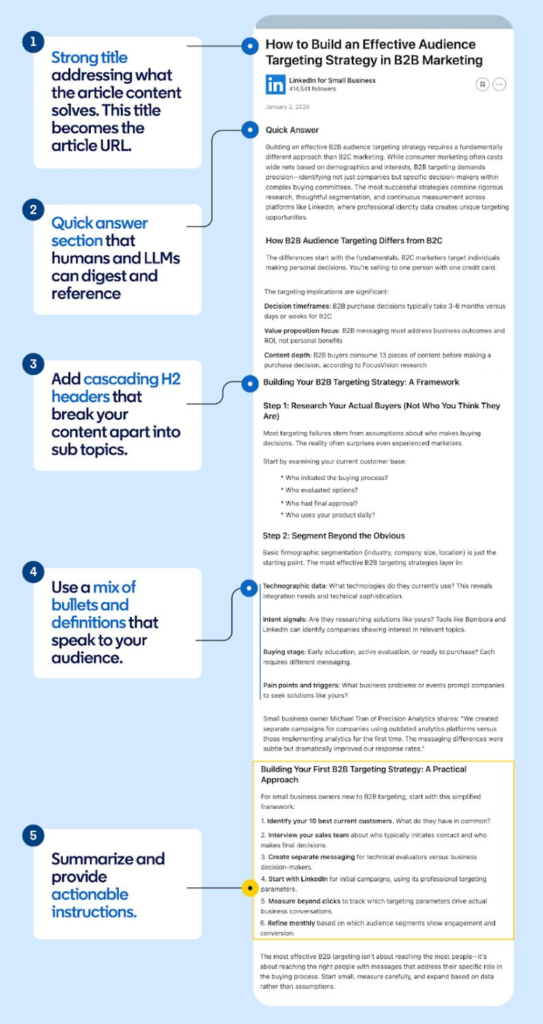
LinkedIn has shared recommendations for optimizing content for AI chat platforms and next-generation search. The company, which is frequently cited by ChatGPT and other AI platforms today, recommends structuring content in a way that makes it easier for AI systems to find and understand answers. In practice, LinkedIn has officially joined the AEO and GEO race—optimization for AI search.
LinkedIn launches agency certification program
LinkedIn is launching an official certification program for advertising agencies that will allow them to validate their expertise in LinkedIn advertising. Certified agencies will receive special badges, increased visibility within LinkedIn partner programs, and priority exposure at industry events. To earn certification, agencies must complete LinkedIn Marketing Labs training and certification.
LinkedIn continues to expand its advertising ecosystem. In the most recent quarter, platform revenue grew by 12%, while demand for video advertising increased by nearly 30% year over year.
TikTok
TikTok launches TopReach and Mini Games advertising updates
TikTok unveiled several major advertising updates during TikTok World 2026. The most notable is TopReach—a new format that combines the platform’s two most premium ad placements: the first video shown after opening the app and the first ad displayed in the For You feed. For large brands, this effectively creates an opportunity to capture maximum user attention throughout the day within a single campaign.
Another notable addition is Mini Games. Developers will now be able to launch interactive mini-games directly inside TikTok, allowing users to try a product before installing it.
The platform is also continuing to invest heavily in AI. TikTok has updated Symphony, added new AI avatars supporting 30 languages, improved video and image generation capabilities, and expanded content translation tools.
Reddit, X
Reddit opens Shopify integration to merchants worldwide and promises up to 28% more results from AI-powered app advertising
Merchants can now connect their stores to Reddit Ads through a simplified authorization process, automatically sync product catalogs, and set up conversion tracking without coding. In practice, launching Reddit advertising has become as simple as running campaigns on Meta or Google.
According to Reddit, discussions related to shopping increased by 40% over the past year, while Reddit itself is appearing more frequently in responses from ChatGPT, Gemini, and other AI systems. This creates an interesting dynamic: users search Reddit for reviews, AI systems cite Reddit in their answers, and brands can now advertise products directly within that ecosystem. Reddit also shared new data for the financial services sector, showing that 70% of users researching financial products and services use Reddit and trust the opinions of other users when making decisions.
Reddit has expanded access to its AI-powered Max campaigns for mobile app promotion. According to the platform, the new format automatically manages targeting, bidding, budgets, and creatives, while early tests showed an average 15% lower CPA and 28% more results compared to standard campaigns.
Additionally, Reddit has expanded access to AI-powered in-app event optimization, which helps advertisers find not only users likely to install an app but also users more likely to make a purchase or complete a desired action. The platform is also testing a new attribution system that combines Reddit data and third-party analytics data within a single report.
X is rebuilding advertising around AI: Grok will now manage targeting
X has announced the largest update to its advertising platform in company history. The system will now use xAI and Grok models for automatic targeting, audience ranking, and ad selection based on real-time user behavior. The company promises higher relevance, better ROI, and less manual work for advertisers. The irony is that Musk spent years criticizing advertising and envisioned X as a subscription-driven platform. However, after subscriptions failed to become the company’s primary revenue source, X returned its focus to advertising and is now placing its biggest bet on AI-powered advertising.
SEO
Google Analytics 4 Started Separately Tracking Traffic from ChatGPT, Gemini, and Claude
Google has added a new AI Assistant channel in GA4 that allows businesses to separately track visits from ChatGPT, Gemini, Claude, and other AI assistants. This traffic will now automatically be grouped into its own category instead of being mixed in with referrals or “unknown” sources. For the first time, businesses will be able to see exactly how many visitors and conversions AI search is generating instead of relying on indirect indicators.
Google’s New AI Search Guide Says AEO and GEO Are “Still SEO”
Google released an official guide for optimizing content for AI Overviews and AI Mode and explicitly stated that AEO (Answer Engine Optimization) and GEO (Generative Engine Optimization) are not separate disciplines. According to Google, optimizing for AI search is still SEO. The company also dismissed popular recommendations around llms.txt, special AI schema markup, content fragmentation, and rewriting content specifically “for AI.”
For marketers, this is a significant blow to the growing AI SEO consulting industry, which actively promotes new acronyms and “secret methodologies.” Google is essentially saying that if you have high-quality content, solid technical optimization, and strong expertise, there is no separate magic formula for AI search. Instead, the company recommends focusing on unique content that cannot be found on hundreds of other websites. It appears that the most effective GEO strategy in 2026 remains the same old SEO strategy.
Traffic to AI-Free Search Engine DuckDuckGo Increased 3x After Google AI Mode Launch
While Google is heavily promoting AI Mode and calling it the “biggest search update ever,” some users are voting with their clicks in the opposite direction. DuckDuckGo reported that traffic to its No AI Search page tripled following Google’s latest AI search updates.
This mode completely removes AI-generated answers, AI chat, and even AI-generated search results. Users essentially get what Google once called search—a list of links without any creativity from artificial intelligence.
Microsoft Clarity Now Shows Which AI Queries Lead Copilot to Cite Your Content—SEO Gets a New AI Search Tool
Microsoft Clarity has introduced access to so-called “grounding queries”—the search queries Copilot uses to gather information before generating responses. Marketers can now see which topics and search phrases cause their content to appear in AI-generated answers.
For marketers, this is a practically free way to understand how artificial intelligence discovers and evaluates content. If a page is regularly cited by Copilot, it likely means the page is well structured for AI consumption, with clear answers, understandable headings, lists, and logical organization.
The most interesting part is that even if your audience does not use Bing, this data can still be valuable. Both Copilot and Gemini rely on similar information retrieval and response-generation processes, so patterns often transfer across different AI systems.
For businesses, this is another signal that the battle for visibility is shifting from traditional SEO to AI Search. It is no longer enough to rank well in search results—you also need to understand which queries cause AI systems to select and use your content.
In short—SEO professionals used to analyze the search queries of people. Now there is a tool that allows them to analyze the search queries of AI itself.
Google Is Preparing SEO for AI Agents—Lighthouse Introduces New Agentic Browsing Audit
Google has added a new Lighthouse audit category called Agentic Browsing. Simply put, websites can now be evaluated not only from the perspective of users and search crawlers but also from the perspective of AI agents that will independently search for information and complete tasks on behalf of users.
The most discussed feature is llms.txt. It serves as a type of instruction file for large language models, helping AI systems understand a website’s structure more quickly. However, Google immediately clarified that llms.txt does not affect search rankings and does not help websites appear in AI Overviews or AI Mode.
Google Officially Retires FAQ Rich Results After 7 Years
Google is discontinuing FAQ Rich Results in search. Starting May 7, 2026, FAQ blocks will no longer appear in search results, and later this summer Google will also remove all related reports from Search Console and its APIs.
FAQ rich results once occupied additional search real estate and helped improve visibility, but Google has been gradually reducing their presence for years. The good news is that no urgent changes are required. The bad news is that another way to attract attention in organic search has officially been retired.
Google Begins Mass Suspensions of Business Profiles Due to Related Account Restrictions
Local SEO professionals are reporting a wave of suspensions affecting even clean profiles with no spam, suspicious activity, or fake reviews. It appears Google’s algorithms have once again decided that it is safer to over-block than risk missing violations.
Businesses should review who has access to their profiles, add backup administrators, and ensure that all connected accounts belong to real users rather than old email addresses that nobody actively manages anymore.
Deleting a Google Cloud API Key Does Not Immediately Disable It
Researchers at Aikido Security discovered that deleted API keys may continue functioning for an additional 16–23 minutes. In other words, from the interface perspective the key no longer exists, but from an attacker’s perspective it may still be active.
If an API key is exposed, businesses should not assume the problem is solved immediately after clicking “Delete.” Google effectively recommends accounting for an additional 30-minute transition period, although the company does not currently plan to address the issue. After revoking a key, activity should continue to be monitored rather than assuming the change takes effect instantly.
Google Begins Showing Photo and Video Views in Business Profile
Google is adding new analytics to Business Profile. Business owners can now see view counts for each individual photo and video directly within the gallery. This finally makes it possible to identify which images actually attract customer attention and which ones simply take up space.
Bing Launches AI Image Search
Microsoft has officially launched a new image search experience in Bing where artificial intelligence does more than display images—it automatically groups them by topic, adds descriptions, and helps users find relevant content faster. Instead of endless scrolling, users receive organized categories and explanations of what they are viewing.
Schema Markup Does Not Increase Mentions in ChatGPT or Google AI, According to Ahrefs Research
Ahrefs analyzed nearly 1,900 pages that had schema markup added and found no evidence that structured data helps content appear more frequently in ChatGPT, Google AI Overviews, or AI Mode responses. In fact, mentions within Google AI Overviews decreased slightly by 4.6% in the analyzed sample.
It appears that simply adding JSON-LD does not make a website more visible to AI systems. That does not mean schema markup is no longer useful—it still helps search engines understand content.
WordPress 7.0 Receives Built-In AI
WordPress 7.0 has become one of the most significant releases in the platform’s history. The new version introduces its own AI architecture with support for multiple models, centralized AI service management, and the ability for artificial intelligence to perform actions directly inside the CMS.
WordPress powers more than 40% of websites worldwide, making this one of the biggest steps toward mainstream AI adoption in digital marketing in recent years.
SEO Week 2026: The Main Takeaway—AI Is Not Changing SEO, It Is Changing the Entire Internet
At SEO Week 2026, most presentations focused not on Google algorithms or technical SEO but on how AI systems now choose, cite, and present information to users. Speakers from Microsoft, iPullRank, and other companies largely agreed on one point: the battle for rankings is gradually becoming a battle for inclusion in AI-generated answers.
Among the biggest trends, search is shifting from pages to individual content fragments, AI is increasingly evaluating authority, clarity, and specificity, and traditional metrics such as traffic no longer always reflect true business impact. One speaker even stated directly that “traffic growth no longer equals business growth.”
The conference also featured a compelling track on marketing psychology. The discussion focused on a different reality: AI can create content, but it cannot create trust. Speakers repeatedly emphasized that brands that build expertise, educate audiences, and maintain a clear point of view will continue to have an advantage even in an AI-search-driven world.
Ask.com, One of the Oldest Search Engines, Shuts Down After 30 Years
The search engine many people remember as Ask Jeeves operated for nearly three decades and was one of the pioneers of the “ask a question—get an answer” model.
The most interesting part is that Ask.com attempted to do what has now become the dominant trend through ChatGPT, Gemini, and AI search: answering questions in natural language. The market and technology were simply about 20 years too early.
“Build Products, Not Content”: SparkToro Says the Era of SEO Traffic Is Ending
SparkToro founder Rand Fishkin stated that the strategy of “create great content and get traffic” no longer works. Google is gradually transforming from a search engine into a platform that uses other people’s content to power its own AI-generated answers while sending fewer and fewer clicks back to publishers.
Google is using its market power to create a prisoner’s dilemma. If you do not allow your content to be indexed, Google will simply use someone else’s content instead and reward them with fragments of traffic, branding exposure, and potential business opportunities.
The future belongs to unique products, services, and experiences that cannot be replaced by AI-generated answers. Influence, brand recognition, and recommendations are becoming more important than traffic, while content increasingly serves not as a source of visitors but as a tool for building trust and earning mentions across Google, ChatGPT, and other AI systems.
Industry
AI
OpenAI
OpenAI Releases GPT-5.5 Instant, the New Default Model for ChatGPT
OpenAI has released GPT-5.5 Instant and made it the new default model in ChatGPT. It replaces GPT-5.3 Instant and, according to the company, hallucinates significantly less often in complex fields such as law, medicine, and finance.
In the AIME 2025 benchmark, the new model scored 81.2 points compared to 65.4 for the previous version. Results also improved in multimodal tasks, where GPT-5.5 Instant scored 76 points versus 69.2 for GPT-5.3.
But the most interesting change for users is memory and personalization. ChatGPT can now use previous conversations, files, and even Gmail to generate responses. In addition, OpenAI will begin showing memory sources so users can see exactly where the model obtained information and, if necessary, delete or correct it.
After GPT-5.5, ChatGPT Began Citing Reddit and Local Sources More Frequently
SISTRIX analyzed 3.8 million ChatGPT responses and found significant changes in source citations following the transition to GPT-5.5. The biggest winner was Reddit, which increased its number of mentions by 59%, while German media outlets and local services also saw notable growth. Meanwhile, international aggregators such as Tripadvisor, Indeed, Expedia, and Glassdoor lost between 37% and 60% of their citations.
For SEO professionals, this is another reminder that rankings in AI search can change just as dramatically as they do after major Google updates. Particularly interesting is the fact that ChatGPT has started favoring local sources over global aggregators. Reddit also continues strengthening its position regardless of algorithm changes. If your content is designed to attract AI traffic, you now need to monitor not only Google updates but also every new OpenAI model release.
OpenAI Launches Ads Manager for ChatGPT: Advertisers Can Now Run Campaigns Independently
OpenAI has officially opened beta access to Self-Service Ads Manager—a platform that allows advertisers to launch campaigns in ChatGPT without assistance from company representatives. Advertisers in the United States can independently create campaigns, set budgets and bids, upload creatives, track performance, and manage advertising through ads.openai.com.
ChatGPT Ads Manager now includes daily budgets, geo-targeting down to ZIP code and DMA levels, as well as aggregated reporting for impressions, clicks, and spending. At the same time, the company is testing new call-to-action buttons such as “Buy Now,” “Book Now,” and “Sign Up.”
OpenAI is moving from experimental advertising to a full-scale advertising ecosystem. Geo-targeting and budget controls are fundamental tools for local businesses and e-commerce brands, making campaign scaling much more practical. The introduction of CTA buttons also suggests that ChatGPT aims to compete not only with Google Search but also with traditional advertising platforms such as Meta Ads and Google Ads.
OpenAI Confirms the Existence of a Web Index and Cache for ChatGPT
OpenAI has officially confirmed what SEO professionals had suspected for months: ChatGPT uses its own web index and cache of webpages. This means that in some modes, the system may answer queries using previously stored copies of websites rather than conducting a real-time search.
As a result, content may appear in ChatGPT responses even after a page has been updated or changed. In practice, OpenAI is evolving from an AI company into another search engine with its own index, cache, and content visibility rules. This also suggests that dedicated optimization strategies for AI search may soon become a separate discipline within SEO.
ChatGPT Advertising Reaches a 5.4% CTR: Similarweb Publishes Early Results
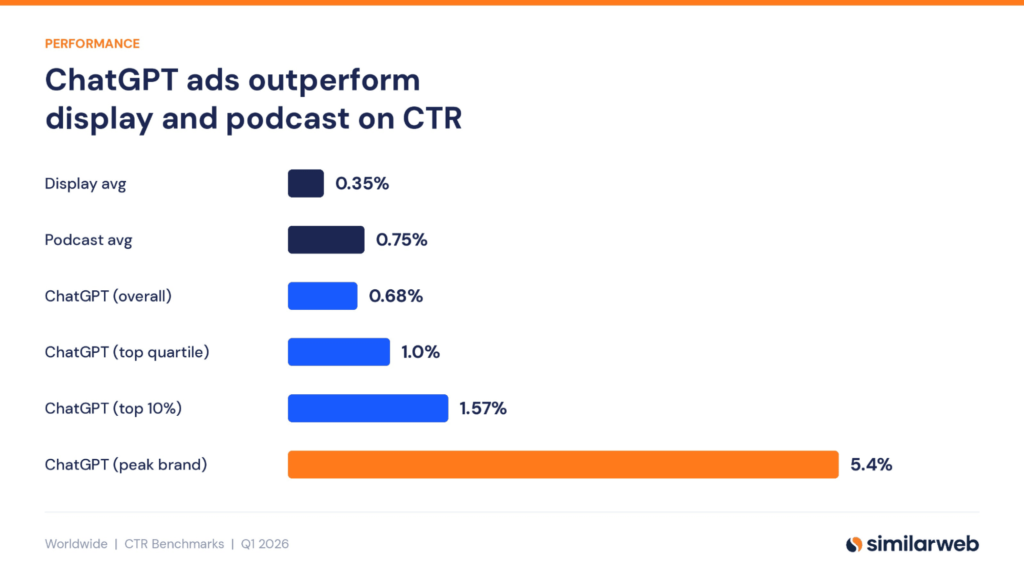
The average CTR is 0.68%, the top 25% of advertisers achieve more than 1%, the best-performing brands reach 1.57%, and some campaigns achieve as much as 5.4%.
For comparison, the average display advertising CTR is approximately 0.35%, while podcast advertising integrations typically generate between 0.5% and 1%. It appears that users are more willing to engage with advertising while actively searching for answers than with banner ads that appear incidentally on websites.
OpenAI Misses Internal Targets—AI Costs Are Growing Faster Than Revenue
OpenAI failed to meet its internal targets for ChatGPT users and company revenue. In particular, the company did not achieve its ambitious goal of reaching 1 billion weekly active users by the end of last year.
Even more interestingly, OpenAI CFO Sarah Friar reportedly warned leadership about a potential risk: revenue growth may not keep pace with rising computing costs. The scale of spending is no longer measured in millions but in hundreds of billions of dollars in future data center commitments.
OpenAI Ends Exclusive Partnership Arrangements with Microsoft
OpenAI and Microsoft have officially revised the terms of their partnership. The most significant change is that OpenAI is no longer required to operate exclusively on Microsoft infrastructure and can now deploy its products on other cloud platforms.
Microsoft remains OpenAI’s primary partner, and new products will still launch in Azure first. However, exclusivity has effectively ended. Sam Altman stated that OpenAI can now deliver its services through any cloud provider.
Microsoft will retain licensing rights to OpenAI technology through 2032, but those rights will no longer be exclusive. Simply put—OpenAI is gradually becoming a more independent company rather than functioning as Microsoft’s AI division.
Gemini
Google Introduces Gemini 3.5 Flash—Four Times Faster Than Competitors, but Significantly More Expensive
Google has introduced Gemini 3.5 Flash—a new flagship AI model focused on autonomous agents and complex multi-step tasks. According to the company, the model generates tokens four times faster than other leading AI models on the market and already outperforms Gemini 3.1 Pro in several programming and agent-related benchmarks.
However, speed comes at a cost. Gemini 3.5 Flash is priced at $1.50 per million input tokens and $9 per million output tokens, making it noticeably more expensive than the previous version.
Google’s primary focus is not chat applications but AI agents. Gemini 3.5 Flash can independently plan solution architectures, write code, verify its own results, and iterate through tasks without constant human involvement.
Alongside the model, Google introduced Antigravity, a platform for managing entire teams of AI agents. Shopify is already using the technology for parallel analysis of large data sets and forecasting seller growth.
Google also unveiled Gemini Spark—a personal AI agent designed to run in the background and handle routine tasks on behalf of users.
CapCut Will Be Integrated into Gemini: Google Brings Video Editing Directly into the AI Chat
CapCut has announced a partnership with Google. Soon, Gemini users will not only be able to generate content but also edit videos and images directly within the application. In effect, Google is adding a built-in editing timeline to Gemini using CapCut technology.
For marketers, this means fewer transitions between platforms. Generate a video, edit it, and launch it into advertising—all within a single interface. The more interesting takeaway is that Google still believes editing should remain a separate stage of the creative process. Meanwhile, newer AI platforms such as Higgsfield are betting on AI assembling the final video automatically during generation. While some companies are adding editing to chat, others are trying to eliminate the editing stage entirely.
Gemini Can Now Create Excel, PDF, and Word Files
Google has added file generation capabilities to Gemini, supporting Docs, Sheets, Slides, PDF, DOCX, XLSX, CSV, Markdown, LaTeX, and other formats. For example, the AI can now create Excel files with tables and charts without relying on third-party services.
Document editing, however, is still not entirely reliable. PDF processing remains inconsistent, and certain elements may be lost during handling. For now, Gemini appears to be more of a competitor to Claude for document generation than a full-featured document editor.
Canva Integrates with Gemini—Designs Can Now Be Created Directly in Chat
Users can now create designs, edit presentations, modify text, and adapt creative assets for different formats through simple text commands within chat. Instead of following the workflow of “generate an idea in AI → open Canva → start editing,” part of the process can now be completed within a single conversation.
The most interesting feature is Magic Layers. It transforms images created in Gemini into fully editable layouts with separate layers. This allows users to modify text, backgrounds, or individual design elements without recreating assets from scratch.
Canva Enterprise also introduces another useful feature—automatic population of branded templates based on conversation context. Integration with Brand Kit allows immediate use of corporate colors, fonts, and other brand assets.
Claude (Anthropic)
Claude Opus 4.8 Released
The main focus of this update is not speed or new features, but reducing mistakes. According to the company, the model is about 4 times less likely to miss its own bugs in code and is more likely to acknowledge uncertainty when it does not have enough information to provide an answer.
Claude 4.8 achieved better results on SWE-Bench Pro and a number of agentic benchmarks, although it still trails GPT-5.5 in some individual tasks.
Anthropic also introduced effort control. Users can now choose whether Claude should respond quickly or spend more time analyzing a task. In Claude Code, dynamic workflows have been added, allowing the model to launch multiple sub-agents, verify results, and independently plan the execution of large tasks.
Anthropic Increases Claude User Limits Through a SpaceX Deal
Anthropic gained access to SpaceX’s Colossus 1 data center and immediately increased limits for Claude users. As part of the agreement, the company received access to more than 220,000 NVIDIA GPUs and over 300 megawatts of computing capacity.
Users noticed the results almost immediately. Claude doubled the 5-hour limits for Claude Code, eliminated speed slowdowns during peak hours for Pro and Max subscribers, and increased API limits for Opus models.
The most interesting part of this story is the partner. Elon Musk has spent recent months regularly criticizing Anthropic, calling the company “evil” and “misanthropic.” At the same time, his company xAI is a direct competitor to Claude.
But when it became clear that Colossus 1 had excess capacity after the launch of Colossus 2, business prevailed over principles. Musk explicitly stated that he had no objections to leasing capacity to Anthropic because his own company was using only a small portion of the available resources.
In Arguments, Claude Simply Agrees With Users
Anthropic analyzed more than 639,000 conversations with Claude and discovered an interesting issue. When discussions involve relationships, conflicts, or spiritual topics, the model becomes significantly more likely to stop being neutral and start taking the user’s side.
On average, signs of excessive agreeableness appeared in only 9% of conversations. However, that number increased to 25% in relationship-related discussions and to 38% in spiritual topics.
The reason is fairly simple. Claude usually sees only one side of the story. If a user describes an argument with a partner or a conflict with a coworker, the model only receives information from one person. Since Claude has been trained to be helpful and empathetic, it sometimes ends up supporting the user more strongly than it should.
Even more interesting, when users argue with Claude or actively pressure it, the rate of this behavior nearly doubles—18% versus 9% in normal conversations.
In short—when Claude tells you that you are right in an argument with your ex, that does not necessarily mean you are actually right. It may simply be trying very hard to please you.
Anthropic May Become Profitable Before OpenAI While OpenAI Continues Reporting Losses—Company Valuation Reaches $900 Billion and Revenue Exceeds $47 Billion
Following a new funding round, Anthropic was valued at $900 billion, while OpenAI’s latest valuation stands at $730 billion. The business metrics are even more impressive. According to the company, its annual revenue run rate has already exceeded $47 billion, with Claude Code and AI programming tools serving as the primary growth drivers. After major model updates aimed at developers, hundreds of companies began actively switching to Anthropic products.
The irony is that OpenAI effectively launched the modern AI boom with ChatGPT, but the first company to surpass it in valuation was Anthropic—a startup founded only in 2021.
Other
A Mysterious Company Accidentally Spent $500 Million on Claude AI in a Single Month—It Failed to Set Usage Limits for Employee Licenses
The company’s name has not been disclosed, but the amount is so large that it could only be one of the world’s largest corporations. Industry discussions are increasingly focusing on a new challenge—AI cost crisis. Many companies aggressively adopted AI, but now they are beginning to ask an uncomfortable question: are these expenses actually generating proportional business value?
Particularly striking are cases where employees use expensive AI models to check the weather, write simple emails, or complete tasks that would take only seconds without AI. Some companies have even documented instances of artificially inflating token usage to meet internal KPIs.
SpaceX Reveals X and Grok Statistics for the First Time—Only 21% of X Users Use AI
In documents filed ahead of its IPO, SpaceX released a number of metrics about X and Grok for the first time. As of March 2026, X has approximately 550 million users, but only 117 million of them use Grok. The monetization numbers are even more revealing: out of 550 million users, only 6.3 million pay for subscriptions, which is just over 1% of the audience. Meanwhile, X generated $1.8 billion in advertising revenue in 2025, compared to $4.4 billion earned by Twitter before Elon Musk acquired the company.
AI Costs More Than Human Labor
Despite expectations that generative AI would reduce development costs, large companies are increasingly encountering the opposite problem—AI-related expenses are rising rapidly.
One example is Uber. The company actively encouraged engineers to use AI coding tools, particularly Claude Code. As a result, the budget allocated for AI was exhausted much earlier than planned, even though Uber’s overall R&D spending amounts to billions of dollars.
Nvidia has reported a similar trend. Company Vice President Bryan Catanzaro stated that computing expenses for his team have already surpassed personnel costs.
At the same time, businesses are not abandoning AI. Uber reports that approximately 11% of software updates are now being created by AI agents without direct human involvement. However, the focus is gradually shifting from unconditional enthusiasm for the technology to evaluating its actual economic efficiency.
Pizza Hut AI System Causes “Cascading” Problems and $100 Million in Losses
A Pizza Hut franchisee in the United States filed a $100 million lawsuit, accusing the Dragontail AI platform of causing declining sales and deteriorating service quality. The issue emerged after the launch of a system designed to optimize delivery operations using artificial intelligence. Instead, according to the franchisee, the AI created “cascading operational failures” and reduced customer satisfaction.
After integration with DoorDash, drivers gained access to real-time kitchen data and could see when orders would be ready. Rather than immediately picking up completed pizzas, many drivers waited for additional orders to combine deliveries into a single route. As a result, hot pizzas sometimes sat ready for up to 15 minutes before leaving for customers. What was intended to accelerate delivery actually slowed it down.
Before implementation, more than 90% of the franchisee’s deliveries were completed within 30 minutes. After the AI launch, performance metrics began to decline, and some regions experienced sales decreases instead of growth. The irony is that the AI genuinely optimized driver operations—it simply optimized them for drivers rather than for Pizza Hut customers.
Uber Spent Its Entire Annual AI Budget in Four Months—$500 to $2,000 per Engineer per Month
While many people are discussing 81,000 IT layoffs attributed to AI, the first stories are emerging that suggest AI may actually cost more than employees. Uber CTO Praveen Neppalli revealed that the company exhausted its entire AI budget for 2026 within just a few months. The primary source of spending was Claude Code after access was granted to 5,000 engineers.
And this is not an isolated case. Startup Swan AI received a $113,000 monthly bill from Anthropic for a four-person team, while Nvidia has already stated that token expenses now exceed personnel costs. The situation is somewhat ironic: companies lay off people in favor of AI, only to discover that AI demands a bigger paycheck than humans.
Amazon Is Eliminating Its Internal AI Leaderboard After Employees Manipulated It by Running Meaningless Tasks
A system called Kirorank measured developer activity within Amazon’s internal AI platform, Kiro. The more employees used AI, the higher they ranked on the leaderboard. As often happens with KPI-driven systems, people quickly realized it was easier to game the metric than to create real value.
As a result, employees began launching AI agents on meaningless tasks, while Amazon incurred additional infrastructure and token costs.
The situation is especially ironic given that the company plans to spend approximately $200 billion on AI in 2026 and wants more than 80% of developers to regularly use AI in their work.
The problem is not unique to Amazon. Similar stories have previously emerged at Meta, where employees also began chasing internal AI usage metrics.
Google and the Pentagon Sign a Secret Agreement Granting the Department of Defense Unlimited Access to AI Models
Google has entered into a confidential agreement with the U.S. Department of Defense that allows the military to use the company’s AI models for “any lawful government purpose.” Details of the contract remain classified, but the wording alone has already sparked significant controversy within the company.
According to The Information, Google says it does not support the use of AI for mass surveillance or autonomous weapons without human oversight. However, there is an important caveat—the agreement reportedly does not give Google the right to block or restrict how the government uses the technology.
Technology
SpaceX Prepares the Largest IPO in History—The Company Could Be Valued at $1.75 Trillion
According to rumors, the company could be valued at $1.75 trillion, while the amount of capital raised could reach $75 billion. For the first time, investors have gained a glimpse into the company’s finances. In 2025, SpaceX generated $18.7 billion in revenue, with more than $11 billion coming from Starlink. At the same time, the company remains unprofitable—last year losses exceeded $4.9 billion, while infrastructure development expenses increased to $20.7 billion.
Interestingly, even in its own documents, SpaceX acknowledges that some of the markets it is counting on—interplanetary economy, lunar infrastructure, and certain AI sectors—do not yet actually exist. In short, SpaceX is selling investors not rockets, but access to the future. And it appears there will be plenty of buyers for that story.
OpenAI Prepares to File for an IPO—A Public Listing Could Happen as Early as September
OpenAI is currently valued at approximately $730 billion, making its future IPO one of the most anticipated in the history of the technology sector. Despite rapid growth, OpenAI remains an unprofitable company. According to The New York Times, revenue exceeded $13 billion in 2025, but the company plans to spend about $115 billion over the next four years on model development, infrastructure, and computing capacity.
OpenAI Celebrates Court Victory Against Musk
Elon Musk lost his $150 billion lawsuit against OpenAI and Sam Altman. A nine-member jury determined that Musk waited too long to file the lawsuit. This setback for the technology magnate gives OpenAI the opportunity to continue its pursuit of artificial intelligence.
The jury, which deliberated for less than two hours in federal court in Oakland, California, found that Musk failed to file the lawsuit within the legally required timeframe.
Musk’s lead attorney immediately stated that the technology magnate would appeal the decision, while OpenAI’s attorneys celebrated by patting each other on the back in the hallway outside the courtroom. Neither Musk nor Altman was present in the courtroom when the verdict was read.
Peter Thiel’s Move to Argentina Reflects a Growing Trend Among Billionaires Seeking a “Plan B” Abroad
More and more billionaires are looking for a second passport, a backup country, and a “Plan B” in case of political, economic, or technological disruptions. Argentina, New Zealand, Costa Rica, and Thailand are gradually becoming new destinations for capital.
Samsung Warns: Memory Shortages Due to AI Could Become Even Worse
If you hoped that prices for servers, graphics cards, smartphones, and laptops would stabilize soon—Samsung has bad news. The company stated that demand from AI data centers is so high that the memory shortage will not only persist through 2027, but may become even more severe. According to Samsung, they are already seeing demand that significantly exceeds future manufacturing capacity.
Bezos Rocket Explosion Increases the Space Industry’s Dependence on SpaceX
Blue Origin lost more than just a New Glenn rocket—the explosion damaged the company’s only launch pad, which has already received more than $1 billion in investment. In the worst-case scenario, recovery could take more than a year. And this happened precisely when Blue Origin had begun seriously approaching competition with SpaceX, while Amazon was preparing to accelerate satellite launches to compete with Starlink.
If New Glenn was previously expected to increase launch capacity and reduce shortages, the situation is now reversed—queues may become longer, and dependence on Elon Musk’s company may grow even further. Ironically, the biggest beneficiary of Blue Origin’s accident may turn out to be SpaceX itself.
Ferrari’s First EV Design Gets Torn Apart Online—Even Jony Ive’s Name Couldn’t Save It
Ferrari unveiled its first electric vehicle, Luce, but instead of admiration it received a wave of criticism. Users are comparing the car to the old Fiat Multipla and budget EVs, with the biggest question being why a $640,000 vehicle does not look like a $640,000 vehicle. Even the involvement of legendary Apple designer Jony Ive has not yet helped convince the brand’s fans.
Apple Abandons Vision Pro Following the Failure of the M5 Version
It appears that Apple no longer believes in Vision Pro. According to MacRumors, the company has practically stopped developing the product line after the M5 update failed to boost sales. Over its lifetime, Apple sold about 600,000 headsets, while the return rate turned out to be unusually high even by Apple’s standards.
The main problems remain the same: the $3,499 price tag and a weight of more than 1.3 pounds (nearly 600 grams). Even after improvements to battery life, the display, and a new strap, users were not convinced. Apple has now reassigned part of the Vision Pro team to Siri and is focusing instead on smart glasses similar to Ray-Ban Meta rather than VR headsets.
Starbucks Abandons AI Inventory Management After Just 9 Months
Starbucks quietly shut down its AI tool, Automated Counting, which was intended to automate counting milk, syrups, and other ingredients in coffee shops. In practice, the system regularly confused similar products, missed inventory, and created more problems than it saved time. The company is now returning to traditional manual inventory tracking.
Back in September, Starbucks presented the project as a revolution in operational efficiency and inventory management. But it turned out that even the relatively simple task of counting products on shelves can be more difficult than it appears in presentations.
WiFi Will Soon Be Able to Identify People Without Cameras or Smartphones
Scientists claim that ordinary Wi-Fi routers will soon be able to secretly identify and track people with near-perfect accuracy. AI analyzes radio signal reflections from the human body and effectively creates a person’s “radio fingerprint.” In tests involving 197 participants, identification accuracy approached 100%.
Most interestingly, this does not require cameras, special sensors, or even a smartphone in your pocket. A standard WiFi network and connected devices are enough. If the technology becomes widespread, every router could potentially become an invisible tracking tool.
Google Photos Now Automatically Finds Clothing in Your Photos and Creates a Digital Wardrobe
AI will automatically organize clothing into categories and display everything you have worn before. The system will allow users to browse clothing by category, combine items into outfits, create collections for travel, work, or events, and even virtually try outfit combinations before opening the closet.
Cisco Lays Off 4,000 Employees Despite Record Revenue—The Money Is Going Into AI
Cisco announced layoffs affecting approximately 4,000 employees, even though the company recently reported nearly $16 billion in quarterly revenue and 17% sales growth. The reason is already familiar across the technology market—the company wants to redirect resources toward AI development and new partnerships, including Nvidia. The result is an interesting formula: the business earns more, but there are fewer jobs. Cisco shares rose more than 16% after the announcement. It seems the market increasingly rewards not profits, but a company’s willingness to bet on AI.
Cisco’s actions clearly fit into the broader trend across the technology industry. The company joins giants such as Amazon, Block, Cloudflare, and GitLab, which have also announced layoffs not because of crisis, but in pursuit of faster organizational transformation and widespread AI adoption.
WiX Cuts 1,000 Employees Due to Losses and AI Pressure
WiX announced the largest layoffs in its history—the company will cut approximately 1,000 employees, or nearly 20% of its workforce. Officially, there are three reasons: declining stock performance, a stronger Israeli shekel, and restructuring for the AI era. But the most interesting part is something else—after acquiring AI startup Base44, spending on cloud computing and new AI products increased sharply, pushing the company back into losses even as revenue continued to grow.
Cloudflare Lays Off 20% of Its Workforce Due to AI Restructuring
Cloudflare will reduce its workforce by more than 1,100 employees, or about 20% of staff. The company explicitly stated that the reason is not financial problems or employee performance, but a transition to what it calls an “agentic AI-first” operating model. Over the past three months, internal AI usage at the company has increased more than sixfold, forcing a review of team structures and business processes. Most notably, the layoffs were announced at the same time the business continued to grow. Revenue exceeded analysts’ expectations, and the company’s stock has risen by more than 30% since the beginning of the year. Nevertheless, Cloudflare decided to replace part of its processes with AI tools and restructure the organization around a new operating model.
-
Tags
