

AI & MARKETING NEWS DIGEST—JUNE 2026
-
Post author

-


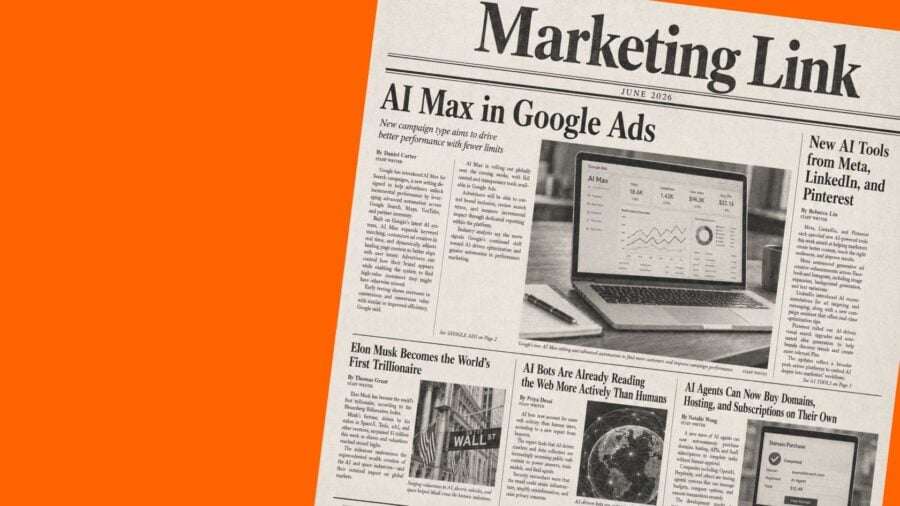
Marketing Link rounded up the most interesting news from June: AI Max in Google Ads, new AI tools from Meta, LinkedIn, and Pinterest, AI Overviews reports in Search Console, and the decline in organic clicks. Plus the month’s biggest tech signals—Anthropic released its most powerful Claude models, Elon Musk became the world’s first trillionaire, and AI bots are already reading the web more actively than humans and can now buy domains, hosting, and subscriptions on their own.
Paid Media
Google Ads
Google updates Smart Bidding—an important change for budget-limited campaigns and a cosmetic rename of Target CPA/ROAS
support.google.com, seroundtable.com
Starting August 17, 2026, Google is updating bidding for budget-limited Search, Shopping, Performance Max, and Demand Gen campaigns that use Target CPA or Target ROAS.
Google’s idea is to make performance more “predictable,” but the translation from ad-platform language is simple: if a budget-limited campaign was actually performing better than your target, it may start moving closer to the target you set. For example, if your Target CPA is $10 and your actual CPA was $5, after the update the system may push performance closer to $10 if you do not change anything. Very convenient—especially if you enjoy paying more for the same lead.
Google recommends checking budget-limited campaigns with target bidding strategies before August 17, and says a tool for quickly adjusting targets will be available starting July 6. For PPC specialists, the main point is not to leave old Target CPA/ROAS settings “as they were” if campaigns were actually outperforming goals. For businesses, this means some campaigns may temporarily see traffic and efficiency fluctuations, so it is better to review targets and budgets in advance instead of waiting for Google to create “predictability” at your expense.
Google Ads is also updating the names of Smart Bidding strategies: “Maximize conversions with target CPA” will now appear as “Target CPA,” and “Maximize conversion value with target ROAS” as “Target ROAS.” In other words, Google is not changing the bidding logic itself—it is just removing long names that looked like they were written for a legal document, not an ad account. During the transition, different places—Google Ads, API, Editor, and the mobile app—may still show a mix of old and new names, but they will work the same way. There is no direct impact on performance: CPA, ROAS, and algorithms should not change just because of a new name.
Google delays DSA migration to AI Max until February 2027 and clarifies reporting for Search campaigns
seroundtable.com, searchenginejournal.com
Google has moved the automatic migration of Dynamic Search Ads to AI Max from September 2026 to February 2027. The reason looks practical—advertisers did not want major automatic changes right before Q4, when businesses usually do not test radical updates in campaigns that are supposed to drive seasonal sales.
But that does not mean AI Max can be pushed into the long-forgotten drawer. Google is still moving Search toward more automation: AI Max is becoming the default setting for new Search campaigns, and some changes, including ACA and campaign-level broad match, are still expected to move forward as planned in September 2026.
At the same time, Google updated its AI Max documentation and added more reporting details. Advertisers will be able to better see search terms, post-click landing pages, and analyze AI Max and old Dynamic Search Ads data separately. There will also be more control options—weak queries or landing pages can be excluded through negative keywords or negative URLs.
For PPC specialists, the main point is not to wait for the automatic migration, but to test AI Max manually: look at which pages Google chooses for impressions, which queries bring traffic, where there are conversions, and where AI is simply expanding reach without value. At the same time, Google clearly hints that advertisers should not limit the system too aggressively with negative keywords, because that may reduce the “benefits of intent-based targeting.”
Google Ads will limit impressions for “unqualified” advertisers
Google is updating its limited ad serving policy and, starting in June 2026, will more broadly limit Search ad impressions for advertisers that may create a poor ad experience.
The targets are brands that often receive user complaints, ads with unclear branding, generic copy without a clear identity, and ads that mention other brands in a way that may make users unsure who is actually selling something to them. In short, Google wants fewer situations like “I clicked a familiar brand and landed on some unknown middleman’s shaky landing page.” For PPC specialists, the key point is that your own brand needs to be clearly visible in headlines, descriptions, and on the landing page—not hidden behind generic wording.
Google further integrates first-party data into ads—automatic customer lists in Google Ads and Customer Match through Merchant API
seroundtable.com, seroundtable.com
Google Ads is starting to automatically enable conversion-based customer lists for advertisers who already have Enhanced Conversions and Customer Match set up, but have not activated this feature yet. Activation starts on June 17, 2026, and data processing begins on August 18, 2026.
Google will be able to build audience lists based on conversion data so advertisers can better use their own first-party data in campaigns. But there is a catch: Google is turning this on automatically, so if a company does not want this kind of processing or has internal privacy restrictions, it needs to disable the feature in account settings before August 18.
Google also now allows loyalty program data and Customer Match data to be sent through the Google Merchant API. That means e-commerce companies can upload user identifiers, loyalty tiers, and other customer data not only for Google Ads, but also for personalized experiences in free listings inside Merchant Center.
Google is connecting ads, product feeds, and customer data even more tightly to show people more relevant products and offers. For marketers, this matters because it opens up more opportunities for cross-sell, upsell, and segmentation based on real customer data—not only on what Google guessed from behavior. But there is a catch—the more Google ties everything to first-party data, the more important it becomes to have a proper CRM, clean data, and technical integration.
Google Ads adds more diagnostics—new reports for PMax, search categories, and store sales
seroundtable.com, seroundtable.com, seroundtable.com
Google Ads is testing new channel diagnostics for Performance Max in the “Channel performance” section. It should show issues across all channels together and by each individual channel: missing assets, disapproved items, restrictions, and what can be fixed directly from that section. PMax has long lived in “trust the system and don’t ask too many questions” mode, and now advertisers at least get more clues about why a campaign may be underperforming.
For now, the feature is not available to everyone and looks like a test, but the direction is right: Google is gradually adding more diagnostics to PMax because advertisers still want not only to pay, but also to understand what is actually happening inside the campaign.
Google Ads is adding new metrics for unique search categories: advertisers will be able to separately see search query categories that received impressions, clicks, and conversions. In other words, advertisers will better understand how broadly a campaign covers different user intents instead of just looking at total clicks and conversions in the style of “well, something is working.” This can help identify coverage gaps, weak segments, and potential expansion areas. A small table update, but a practical one—because sometimes the difference between “we are present in Search” and “we are present where people buy” is hidden exactly in columns like these.
Google Ads is launching a new “Store Diagnostics” section inside “Conversions,” designed to help check store sales reporting and eligibility for optimization. There are not many details yet, but the idea looks like another diagnostics tool for businesses trying to connect online ads with offline sales. In other words, not just “someone clicked an ad,” but whether it is possible to properly measure how advertising affects real in-store sales. Not the loudest update, but a practical one: Google is gradually adding more diagnostics where advertisers previously had to guess why the numbers did not match.
Google Ads launches Hosted Forms for leads—a Google form for businesses that still do not have a proper CRM
Google Ads has started opening Hosted Forms for lead generation to some advertisers. This is a lead collection form hosted by Google that can be used directly in campaigns and configured through the “Conversions” section. The idea is simple—give advertisers a fast way to collect leads without a separate landing page, complex integration, or long CRM dance. For small businesses, this can be useful: launch a form quickly, get a contact, pass it to sales. For larger advertisers, the news is less revolutionary, because if CRM, call tracking, and proper analytics are already integrated with Google Ads, Hosted Forms are unlikely to become the main tool.
Google wants to keep more of the lead-gen process inside its own ecosystem. Convenient, but with the classic catch: the easier something is to launch, the easier it is to forget to properly check lead quality, CRM transfer, duplicates, follow-up, and real conversion into sales.
Google Ads will allow some redirects to another domain—but only with prior approval
Google is updating its destination mismatch policy: in some cases, the final URL from an ad will be able to redirect users to another domain if Google approves it in advance.
Previously, the logic was stricter—where the ad leads is where the user should land, without surprises like “I clicked a brand and ended up in another universe.” Google’s example: CPG product manufacturers will be able to send people to an approved list of retailers where the product can actually be purchased. For marketers, this can be useful for campaigns for brands that do not sell directly and instead send buyers to Walmart, Target, Amazon, or other partners. For businesses, the benefit is obvious—it is easier to build advertising when the sale happens not on your own site, but through retail partners.
But this does not open the door to chaotic redirects, cloaking, or “we will just send traffic wherever it is convenient.” Google’s prior approval is required, and it is still unclear exactly how to get it—through a form, the interface, or a Google representative.
Google adds AI suggestions in Demand Gen—more video formats and even less manual control
Google is updating Demand Gen campaigns: advertisers will be able to more easily rework videos into different formats—from vertical to square or horizontal, and from square to horizontal. In other words, one creative can now be stretched across YouTube and Google’s ad ecosystem more easily, without a separate mini-production drama for every placement.
Gemini will also start giving AI recommendations for images and videos in Demand Gen to help optimize ads for YouTube. Separately, Google is adding more customer journey analytics, including whether new users come through app installs.
Google adds new metrics for Video Reach and Video View
Google is updating Video Reach and Video View campaigns: actions from Shorts ads—likes, comments, and shares—will now be included in budget optimization if Shorts are enabled in the campaign.
Google will look not only at views, but also at whether people interact with the ad at all, instead of simply waiting until they can morally skip it.
There will also be separate reporting columns for these actions, so advertisers can better understand which formats actually trigger a reaction. Separately, Google is globally adding reporting for attributed brand searches—advertisers will be able to see how many people searched for the brand or product on Google within 30 days after viewing an ad.
Google partners with Walmart Connect—tying YouTube ads closer to real sales
Google is launching a partnership with Walmart Connect so brands can better see how their Google and YouTube campaigns influence sales at Walmart.
Advertisers will be able to use Walmart Connect audiences and measurement in Display & Video 360, and Google is also adding Gemini to help with campaign planning, launch, and analysis.
Separately, Google is testing expanded Local Services Ads for real estate—with prices, photos, and home features directly in the ad. For agents, this may bring higher-quality leads because people will see more details before calling. Although there is a catch—in real estate, not showing everything upfront is often intentional, because it pushes buyers to message. But if Google filters out random “just browsing” users, businesses may get less noise and more serious inquiries.
Google adds home listings to Local Services Ads—real estate moves closer to a lead-gen format
Google is rolling out Home Listings in Local Services Ads across all 50 U.S. states. Now real estate agent ads can show price, photos, and key home features, and buyers can immediately call, message, or schedule an appointment with a local agent.
Google gets the data through a partnership with HouseCanary, so this is no longer just an agent ad—it is a more complete property listing inside Google. For real estate marketers, this matters because Local Services Ads can become not only a “find an agent” channel, but also a channel for inquiries about specific properties. For businesses, the benefit is simple—leads may be warmer because the person sees more details before reaching out.
But there is a catch: in real estate, some information is often deliberately left “off-screen” to encourage a call. Google, as always, is moving toward user convenience, and agents will have to get used to the fact that less mystery in the ad may mean fewer random leads, but more real buyers.
Google tests “strongest match” trust badge in search ads
Google is testing new labels for search ads in the U.S.—“Strongest Match” and “Trusted Match.” The idea is to help users quickly see which ad Google considers most relevant to the query.
Sounds useful, but there is the classic “but”: Google has not explained which signals determine this label—ad quality, landing page, keyword, CTR, position, bid, or all of it together in a black box. The badge may influence clicks and effectively look like a recommendation from Google. The downside is also obvious—if a competitor gets it and you do not, users may decide that competitor is the “better match,” even if in reality it is just another Google experiment.
For now, this is not a new optimization feature, but a test without transparent rules. So the main takeaway is simple: ad quality, relevance, and a strong landing page are once again not just “best practice,” but a potentially visible competitive advantage.
Google launches Ask Ad Manager—a Gemini assistant for campaign diagnostics, reports, and media operations
Google announced Ask Ad Manager—a Gemini-powered AI assistant that will help publishers and marketers troubleshoot campaigns directly inside the Google Ad Manager interface. Users will be able to ask why a line item is not working, where revenue is dropping, which metrics to check, or what report to build—and instead of a manual scavenger hunt across tabs, the system will provide personalized answers, filters, links, and reports based on data from that specific account.
Google Ads updates the “All Campaigns” menu—complex accounts may finally become a little easier to untangle
Google Ads is testing an updated “All Campaigns” menu: campaign selection has moved to the top left corner, and a full campaign hierarchy has been added in a dropdown view. There is also search, so users can find the right campaigns or campaign groups faster. Sounds like a small thing, but for large accounts with a bunch of Search, PMax, Shopping, Demand Gen, and test campaigns, this can actually save time. Because sometimes the hardest thing in Google Ads is not optimizing ROAS—it is simply finding where the campaign is that someone named “Test_New_Final_Final_2.”
Google finally added the option to unsubscribe from emails offering a call with a Google Ads expert
For now, the unsubscribe option seems to appear not in all of these emails, but mostly in messages from third-party Google Ads partners rather than Google’s own reps. Still, for PPC specialists, this is a small win, because these emails have been a separate genre of ad spam inside the advertising ecosystem for years.
There is also a benefit for operational hygiene: less inbox noise, fewer “urgent” calls without a real need, and a bit more control over who shows up with advice about your account. The only thing left is to check whether the unsubscribe button actually works, because in Google Ads, even unsubscribe sometimes feels like something you should test as an experiment first.
Google tests an “open in new window” icon in search ads
Google is testing a new icon next to URLs in sponsored results—an “open in new window” icon. That means users may see directly in the ad that a click will open the page separately rather than simply take them through the standard search flow. The update is tiny, almost in the category of “someone at Google moved a pixel and now it is news,” but for PPC it may matter: any change in how an ad looks visually can affect CTR, trust, and user behavior. For businesses, there is no direct revolution here—sales will not skyrocket just because a tiny icon appears next to an ad. But if Google starts testing elements like this more broadly, advertisers should watch whether clickability changes, especially in competitive niches. Because in search advertising, sometimes even a tiny icon can decide who gets the click and who simply pays to participate in the auction.
Bing tested this in 2018, so now it is Google’s turn.
Bing Ads
Microsoft Advertising adds experiments for Performance Max—now PMax can be properly tested instead of just believed
Microsoft Advertising opened the beta version of experiments for Performance Max. Advertisers will be able to test two scenarios: whether a new PMax campaign works better than current campaigns, and whether it delivers real incremental lift instead of just taking credit for conversions that would have happened anyway. The second option is especially important—with a control group, advertisers can see what happens if the ad is not shown and whether PMax truly adds new results.
This is useful because automated campaigns often look good in reports, but it is not always clear whether they create demand or simply claim already-warm traffic. For businesses, the benefit is simple—you can make budget scaling decisions in Microsoft Ads more calmly, based on experimental data instead of only the platform’s optimistic presentation. For now, this is an open beta, and access needs to be requested through Microsoft Advertising representatives.
Microsoft Advertising updates UTM auto-tagging—GA4 should better distinguish Search, Shopping, Audience, and PMax
Starting September 2, 2026, Microsoft Advertising will automatically update UTM auto-tagging so traffic from different campaign formats appears more clearly in third-party analytics, including Google Analytics 4. In other words, Search, Audience, Shopping, and Performance Max should be more clearly separated by campaign type instead of being dumped into one pile that makes marketers stare at GA4 and remember every sin of auto-tagging. Advertisers do not need to take action—Microsoft will apply the updated tags automatically.
It should become easier to analyze Microsoft Ads performance not only inside the ad platform, but also in overall analytics alongside other channels—more accurate attribution, clearer comparison of formats, and better budget decisions. Because if PMax, Search, and Shopping all look like one murky channel in reports, that is not analytics—that is fortune-telling with UTM coffee grounds.
Paid Social
Meta
Meta adds appointment booking directly inside Lead Ads
Meta is launching built-in booking for Facebook Lead Ads: after filling out a form, users will immediately be moved into the scheduling process through Calendly, HighLevel, and starting in August—HubSpot as well. In other words, a potential customer does not just leave a contact and disappear into the black hole of “we will contact you soon,” but can immediately choose a meeting time while interest is still warm.
For service businesses, this matters because the biggest problem with lead ads is not getting the form—it is pushing the person toward a real consultation, call, or visit. For now, the feature is only for Facebook ads, does not support all calendars, and is expected to roll out globally by October, but the direction is right: Meta is trying to shorten the path from click to booking, because every extra step in the funnel is a place where a lead changes their mind, forgets, or goes to a competitor.
Meta launches new AI tools for advertising—creatives will now be tested on more than intuition
Meta is adding new AI features in Ads Manager for testing ad creatives: the system will analyze previous ads, posts, brand style, and tone, then suggest new ad variations based on what has already worked. In other words, instead of the classic “let’s make the button blue again and use a happier image,” advertisers will get more guidance based on real data.
Meta is also improving headline, caption, translation, and creative approval generation. Separately, the company is combining Creator Marketplace and Partnership Ads Hub into Meta Creator Marketing Hub—so brands can more easily find creators, see product mentions, and launch partnership ads.
Reels have already become Meta’s main format—more than 200 billion views per day and over 50% of ad placements, while new “series” are meant to bring audiences back to watch more
sqmagazine.co.uk, techcrunch.com
Reels on Facebook and Instagram have more than 200 billion views per day—twice as many as a year earlier. The format already accounts for about half of all time spent on Instagram and more than 50% of ad placements on the platform.
Reels deliver higher reach than photos, carousels, or Stories: on average, one Reel reaches 30.81% of a creator’s follower audience, and 55% of views come from people who do not follow the creator.
Meta is testing a “Series” feature for Reels on Instagram and Facebook. It will allow individual videos to be grouped into sequential series, where each Reel becomes a separate episode and the full collection is stored in a separate section of the creator’s profile.
Meta wants to turn groups into the new Reddit: smart AI search, photo and video editing
Meta is launching new AI features for Facebook: smart search based on public posts, comments, groups, and Reels, plus tools for quick photo and video editing.
Facebook groups and public discussions may become more important for brand visibility because Meta wants to use them as sources for search answers. In other words, content, reviews, comments, and community activity may influence not only feed reach, but also what AI shows users as the “real opinion of people.” Separately, Meta is adding AI collages, photo collections, and Story presets.
Meta brings back Facebook Creator Studio and tests an AI assistant in the U.S., Canada, and India—it will analyze content, trends, and suggest what to post
creators.facebook.com, creators.facebook.com
Meta is bringing back Facebook Creator Studio, which it itself shut down in 2023 when it moved creators into Business Suite. But now it is not just a dashboard for publishing and analytics—it is part of a larger AI ecosystem for creators on Facebook and Instagram.
The company is testing an AI assistant that will work like a chatbot inside the creator workspace. It will analyze the page, audience, content, post performance, trends, and creator goals, then provide recommendations for content strategy. The tool will also be able to suggest what to post next, how to improve results, and even offer replies to comments “in your voice.”
At first, the AI assistant is available to top creators in the U.S., Canada, and India.
For SMM specialists and creators, this is a logical step—less manual analysis, faster topic suggestions, and a more systematic way to test creatives. But there is a catch: if AI stamps out the recommendations, some advice may be too generic and similar across different creators.
Instagram now lets users reorder posts in the profile grid
Instagram is launching a “Reorder Grid” feature that lets users manually rearrange posts on their profile. That means your best work, case studies, products, or important posts can now be moved higher instead of praying people scroll far enough to see the right content.
For creators, this is a way to make the profile look more like a portfolio. For brands, it is a way to properly show key products, promos, reviews, or UGC without deleting old posts. It is especially useful for fashion, beauty, design, e-commerce, personal brands, and everyone whose Instagram is not just a feed, but a storefront. The profile becomes another funnel element: someone comes in after an ad, Reels, or recommendation and immediately sees what should sell or build trust.
Meta launches Pocket—an AI app for creating interactive “things”
Meta launched Pocket—an app where users can create small interactive games, tools, and “gizmos” through text prompts. That means you no longer need to know how to code—it is enough to describe what you want, and AI will try to build it. It sounds like the democratization of creativity, but there is a catch: the ability to create something does not mean anyone will care about it. Most of these AI projects will likely be at the “cool for 30 seconds and then forgotten” level. For marketers, what matters is not Pocket itself, but the direction—Meta is testing new formats of AI content, interactivity, and user-generated experiences. But once again, there is no magic—AI can build a “thing,” but the idea, scenario, and reason why people should use it still have to come from a human.
TikTok, Reddit, LinkedIn, Pinterest, Youtube
TikTok shows new accounts 59% AI content in For You—almost three times more than YouTube
Kapwing checked 500 videos in TikTok For You for a new account and found that 294 of them, or 59%, were AI slop—low-quality AI content with generated visuals, scripts, or voiceovers. By comparison, the same test on YouTube found 21% AI content.
TikTok still sells the dream of living creativity, but a new user may immediately get a feed full of content that looks like it was made in 12 minutes between coffee and a neural network update. The highest concentration is in kids’ content: in the Kids category, 57% of videos were AI slop, and in the #cartoonkids tag—97 out of 100.
TikTok is becoming even noisier and more synthetic, which means normal human content, faces, product demonstrations, and real expertise may stand out more strongly. But media planning also needs to be more careful—because next to your brand in the feed may not be a competitor, but yet another batch of AI garbage.
Reddit opens split testing to all advertisers—2 ad variants, 2–6 weeks of testing, and a winner with 65% confidence
Reddit has made split testing available to all marketers in Reddit Ads Manager. Advertisers can now run two ad variants at the same time, split the audience at the user level, and test one variable without overlap or “well, I feel like this creative is better.”
Reddit is finally giving advertisers a proper way to stop guessing on ROAS and test hypotheses in a controlled experiment. Tests can run from 2 to 6 weeks, and in early testing, Reddit says 4 out of 5 split tests were able to identify a winning variant by ROAS.
LinkedIn launches Creator Marketplace in the U.S. and Canada—brands will have an easier time finding B2B creators by audience, reach, and expertise
LinkedIn introduced Creator Marketplace—a new section where brands can more quickly find creators for work with the right target audience. Profiles will include information about audience size, audience composition, reach, and the creator’s expertise. In short, LinkedIn also decided that influencer marketing is not only dancing, cosmetics, and “unboxing of the day,” but also a legitimate B2B channel.
At the same time, the platform is launching BrandWorks—a team of experts in branding, creative, content, and events for B2B marketers.
LinkedIn launches AI tools for advertising—brand kit, copy generation, personalization, and automatic selection of the best creatives
LinkedIn added new AI features for advertisers: a brand kit with colors, fonts, logo, and brand voice, ad copy generation based on a URL, personalization by job title, company, and industry, and the creation of multiple ad variants with new headlines and intro text.
LinkedIn wants marketers to upload materials, set the direction, and then let the platform mix images, videos, and text, test variations, and shift budget to creatives that perform better. It sounds like AI, although some features feel like good old email marketing wearing a suit to a B2B conference. For businesses, the benefit is simple: scale LinkedIn ad campaigns faster and create more variations without manually building every creative.
LinkedIn adds collaborative posts—now brands and creators can officially post together, plus GIFs in comments
socialmediatoday.com, linkedin.com
LinkedIn is testing collaborative posts: an author will be able to add other users or company pages as co-authors of a post, and all of them will be shown at the top of the post.
LinkedIn is catching up to Instagram Collab, but in a B2B version—for product launches, partnerships, team case studies, company news, and brand collaborations.
LinkedIn added support for GIFs in comments, meaning users can now reply to posts with animations directly on the platform, without converting GIFs into MP4. The update is small, but for LinkedIn it is almost a cultural event—the platform is moving a little further away from the “corporate press release with the sales director’s reaction” format. But there is a risk the feed will become even more like Facebook in 2014.
Pinterest launches AI tools for ads and shopping—the platform does not want to be just an inspiration board
Pinterest is adding an AI-powered business assistant in Ads Manager that will analyze advertiser data, platform metrics, and suggest how to improve campaigns. There will also be tools for dynamic creative selection, ad review, creative reporting, and the ability to connect Pinterest ad data to AI chatbots through Model Context Protocol. Pinterest also wants its own set of “smart” tools so marketers guess less about which Pin will work and test more based on data.
Separately, the platform is launching Ask Pinterest—an AI application for more complex shopping and idea discovery, such as gifts, decor, or dinner planning. For businesses, the key point is that Pinterest is trying to strengthen the path from inspiration to purchase, which matters for e-commerce, fashion, home decor, beauty, food, and everything people save first and buy later. For now, some features are in beta or available only in the U.S.
Pinterest adds Amazon Storefront links—affiliate marketing gets even closer to purchase
Pinterest will allow Amazon Storefront creators to add affiliate links to their Pins so users can more quickly move to recommended products and buy them through Amazon. Pinterest is moving even further toward “saw it and bought it,” not just “saved it and forgot it on a board for 7 years.”
For creators, this is an easier way to monetize content: Pinterest will automatically pull Amazon affiliate information without manual affiliate ID entry and extra technical routine. For marketers, the main point is that Pinterest is becoming an even more interesting channel for creator commerce, especially in home decor, beauty, fashion, lifestyle, food, and DIY niches where people actually search for ideas before buying.
YouTube updates the Content tab in Studio, ad analytics, and adds AI comment filtering
blog.google, support.google.com, support.google.com
YouTube is releasing new tools for marketers in Google Ads Insights Finder: now it will be possible to see what content is actually gaining popularity on the platform by topic, location, demographics, and audience segments. YouTube will also add information about creators who are open to brand partnerships, “Brand Pulse” data for evaluating organic and paid performance, and Gemini AI will suggest which visuals are better to use in Demand Gen campaigns.
YouTube is redesigning the Content tab in YouTube Studio so creators do not have to run between Visibility, Monetization, and Restrictions like they are visiting different government offices. Now key video issues will be gathered in one place—the “Notices” column: red means full restriction, yellow means partial restriction, and gray means an informational warning.
YouTube is also adding a separate “Estimated revenue” column, where creators will see approximate revenue from ads, YouTube Premium, Shopping, and donations, but with a delay of about two days. Separately, YouTube is launching Account Status in the Studio mobile app—essentially a channel health dashboard with monetization, copyright, and community strikes.
Instead of the old exact keyword search, channel managers will be able to type conversational queries like “comments about my appearance,” “questions about my equipment,” or “people asking for part two of the video”—and the system will group similar responses. Users will also be able to find similar comments through the three-dot menu and quickly work with topics like “negative feedback” or “excitement.”
SEO
Cloudflare may accidentally block Googlebot starting September 15—if a site decided to “protect itself from AI training”
Cloudflare is updating rules for AI crawlers and now allows them to be split into three types: Search, Agent, and Training. That sounds logical until you get to the main catch: starting September 15, multipurpose bots will be handled according to the strictest rule. In other words, if a site blocks Training and a bot is used both for Search and AI training, it may be blocked too. The examples specifically mention Googlebot, Applebot, and Bingbot.
If a site uses Cloudflare, its AI bot settings need to be checked before September 15, especially if “Block AI Bots” was previously enabled. Protecting content from model training is normal, but losing Googlebot crawling because of one overly aggressive toggle is not strategy—it is an SEO self-own.
Google tests separate reports for AI Overviews and AI Mode in Search Console—SEO will finally see AI visibility, but still without clicks and queries
searchenginejournal.com, developers.google.com
Google is testing two new features in Search Console: a toggle that will allow a site not to appear in AI Overviews, AI Mode, and AI answers in Discover, and separate reports on visibility in generative AI search.
The reports will show URL impressions in AI features, pages, countries, devices, and dates, even with hourly breakdowns. In short, Google is finally giving SEO specialists a separate lightbulb for AI search, but still without the most interesting part—no clicks and no queries. That means you will know your site appeared somewhere in an AI answer, but you will not properly know whether anyone came afterward or for which exact query.
Google is also launching new Search Console reports for generative AI features in Search and recommendations. Site owners will now be able to separately see how many times their URLs appeared in AI features, on which pages, in which countries, on which devices, and how that changed over time.
AI Overviews take up to 39.8% of organic clicks—while Google traffic dropped to 23%
searchenginejournal.com, sparktoro.com
In the new SEO Pulse, the main signal is simple: Google AI Overviews can reduce organic clicks by 39.8%, but the study did not confirm Google’s explanation that those were supposedly low-value clicks with high bounce rates.
The second important part—AI agents may not see prices, specs, or key content if they are hidden behind JavaScript, a “contact us” form, or are simply not readable by systems. Then the agent does not stop—it goes looking for an answer on third-party sites, where the data may be outdated or not yours at all.
For marketers, the conclusion is unpleasant but useful: SEO is no longer only about copy, links, and Core Web Vitals. You need to check whether Google, AI Overviews, Claude agents, and other systems can actually read your page. Because if a human sees a beautiful site and AI sees an empty page, the customer may go not to you, but to whoever the robot could read properly.
According to new data from SparkToro and Similarweb, in the U.S., for every 1,000 Google searches, only 232 clicks lead to the open web. 68% of searches end without a click, and the share of searches that generate at least one click fell from 41% in 2024 to 32% in 2026.
The main reasons are AI Overviews and answers directly in search: when an AI Overview appears, CTR is almost 60% lower. SEO is not dead, but its role is changing—now not only site visits matter, but also branded demand, local searches, transactional keywords, and visibility inside Google’s own answers.
Queries in Google AI Mode are already 3 times longer than regular search—while most SEO content is still written for old keywords
Google showed data on AI Mode, and for SEO the signal is unpleasant but logical: the average query in AI Mode is already three times longer than a traditional search query. In other words, users are writing “best running shoes 2025” less often and increasingly asking normal human questions like: “I have flat feet and knee pain, what running shoes would work for me?” The old magic trick of stuffing the keyword into the title, H2, and first paragraph is aging fast.
Even more important: follow-up queries in AI Mode are growing by an average of 40% per month, multimodal interactions already account for more than 1 in 6 searches, and image-based queries are growing by more than 40% month over month. Plus, Google says AI Mode has more than 1 billion monthly active users, and query volume is doubling every quarter.
For SEOs and content marketers, the conclusion is simple: the “one page—one short keyword” strategy is quickly getting old. Content needs to be written around real questions, scenarios, clarifications, choices, comparisons, doubts, and users’ next queries.
ChatGPT and Gemini are “secretly Googling” for users
Mark Williams-Cook showed that ChatGPT and Gemini do not simply answer a user’s prompt—they often quietly launch traditional search queries in the background and then synthesize an answer from those results. In other words, a customer can write a long conversational question, and AI will break it into shorter queries and go looking for sources. In short, SEO is not dead—it has just been hidden behind a chatbot. For marketers and businesses, the main conclusion is simple: optimize not only for what a person types into ChatGPT, but also for what ChatGPT or Gemini searches on that person’s behalf. That is exactly what QueryFan shows—it generates queries for a specific persona, runs them through ChatGPT and Gemini, and records the real background search queries. The irony is that while everyone argues about the “death of SEO,” AI search still relies on good old search results—users just no longer see which queries decide who gets cited and who does not.
Google Analytics adds Source Group and hostname filters—less chaos in traffic sources
Google Analytics is launching a new dimension called Source Group, which will group different variations of one traffic source into a proper category. That means “facebook,” “fb,” and similar variations should no longer scatter across reports like three different realities.
Google is also updating Source Platform and adding support for new sources, including AI traffic from ChatGPT and Perplexity. Separately, GA is adding hostname filters in Admin—allowing events from unverified domains to be filtered out before they even enter reports. It is especially interesting that Google is already standardizing AI referrals—meaning traffic from ChatGPT, Perplexity, and similar systems is gradually becoming not a curiosity, but a normal line item in marketing analytics.
Google Analytics adds Google Business Profile data—calls, directions, and bookings can now be seen in GA
Google has documented a native connection between Google Business Profile and Google Analytics. After connecting, GA will show a separate section with 7 local metrics: interactions, website clicks, calls, directions, messages, bookings, and menu.
In short, local businesses will finally be able to see not only “someone clicked the site,” but also some of the real actions happening directly in the profile. For marketers, this is useful because previously UTM tracking mostly captured site visits, while calls, directions, and bookings lived separate lives. But of course, Google could not simply make it perfect: if there are multiple profiles, the data is combined without proper location-level segmentation, and it is stored for only 6 months. For a business with one location, it is a good update. For chains and agencies, it is useful, but still not a replacement for proper reporting by each location.
Google warns against Markdown versions of websites for AI SEO—HTML is still not canceled
seroundtable.com, searchenginejournal.com
Google’s John Mueller and Martin Splitt explained that a proper HTML website remains the standard for SEO, and separate Markdown versions of pages “for LLMs” or AI search do not provide any magic advantage. On the contrary, they can create extra technical work: one version of the site for people, another “for robots,” and then a separate headache to make sure none of it breaks. And if a regular page works poorly, users can at least notice it, while a hidden AI version can sit broken for weeks while automated systems calmly read it. For marketers, the main point is that AI SEO does not cancel the basic logic of search: pages must be accessible, understandable, indexable, well structured, content-rich, and usable. For businesses, the conclusion is simple—do not invent a second site for machines in hopes of pleasing AI. It is better to fix the main HTML site that people, Google, and all these new “smart” systems actually see.
AI bots bring +300% traffic year over year and read the web more than humans—in Cloudflare, 57.5% of page requests are made by machines
searchenginejournal.com, searchenginejournal.com
AI bots are increasingly loading websites: they parse content, may enter server-expensive areas like cart, checkout, internal search, or filters, and businesses get not customers, but infrastructure bills.
The bot came, walked around the site, loaded the server, and maybe took something for model training. According to the report, about 80% of AI crawling is specifically related to model training, and AI bot traffic grew 300% year over year; by the end of 2025, in TollBit’s network, about 1 in 31 visits was already from an AI bot. Traffic no longer always means audience, demand, or sales.
In Cloudflare’s network, bots overtook humans in web page requests this year: 57.5% versus 42.5%, and the AI segment is growing about 8 times faster than human visits.
The internet is being read more than ever—it is just often not humans anymore, but agents that open 30–40 pages, take what they need, and show the user a ready-made answer. Because of this, the old exchange of “we give the crawler content, and it brings us traffic” is breaking: AI can take the material, compose an answer, and give the site neither a click nor a reader. That is why Cloudflare already blocks AI crawlers by default for new sites and is testing pay-per-crawl, while 31 British publishers even want to turn robots.txt into a £500 invoice for reusing an article without payment.
Companies attack Reddit with fake posts to get promoted in ChatGPT—Reddit’s share of ChatGPT citations fell from 15% to less than 2%
Moderators of r/Biohackers say companies selling peptides and hormone therapy are mass-creating posts not just for sales, but to get into AI answers. In other words, this is no longer classic spam with “buy now,” but a new version of AEO—answer engine optimization—where a brand tries to plant the right mentions in discussions that ChatGPT, Google AI Search, and other systems may later pick up.
If gray-hat marketers once dreamed of ranking at the top of Google, now they dream of getting into a chatbot answer through a “very organic” Reddit post like: “Do these peptides actually work?” Then the right name appears in the comments, the discussion gains engagement—and AI may perceive it as human experience, not a carefully arranged marketing trap.
Social networks have become the main source of news—the 18–34 audience for British media is falling by 34%: young people are disappearing from the open web
reutersinstitute.politics.ox.ac.uk, searchenginejournal.com
The Reuters Institute writes in its Digital News Report 2026 that people are increasingly getting news from social networks rather than television or news sites. TikTok and Instagram are especially growing in importance, while X’s influence as a news platform is weakening. The information battle is moving even more into feeds, Reels, Shorts, TikTok, and creators whom audiences often trust more than media outlets.
But there is another side—algorithms do not love truth; they love engagement. That means disinformation, distorted topics, and “experts from the couch” also get more power.
According to data from the 15 largest British publishers, the share of the 18–34 audience does not look that dramatic—29.5% on average, almost like the population structure. But this is one of those cases where percentages beautifully hide the problem. In real volume, younger audiences are falling much faster: popular publishers—down 34.2%, premium—down 30.7%, public service—down 16.9%. In short, if older audiences are also leaving a little, the share of young people may look “almost normal,” but the pie is still shrinking, and younger users are disappearing from it the fastest.
The main unpleasant conclusion for media is that young people are not necessarily moving en masse to platform websites, because the data does not prove that. More likely, they are moving into feeds, apps, and environments that are harder to measure properly. In other words, it is not “TikTok took everyone directly,” but something worse—the open web is simply becoming a less familiar place for younger audiences.
Google Images is also mixing ads with organic results
Google has long mixed sponsored ads with organic search results, and now the same thing is getting more attention in Google Images. In image results, advertised products can appear directly among organic results, even when they do not fully match the query. For example, someone searches for a specific watch model and sees ads for other brands nearby—very convenient if your goal is not to find the right thing, but to accidentally buy something else.
Google is blurring the line between SEO and PPC even further: visual organic results are becoming less “clean,” while ads get more places to appear. For businesses, this may be a plus in paid advertising, but a minus for brands relying on organic traffic from image search.
Google Cloud introduces Open Knowledge Format—so AI agents can finally read company knowledge like something other than archaeologists
Google Cloud announced Open Knowledge Format—an open specification for organizational knowledge that can be read by people, AI agents, LLMs, tools, and teams. The idea is simple: inside companies, knowledge is often scattered across wikis, drives, repositories, documentation, spreadsheets, and internal systems, and then everyone is surprised that an AI agent cannot give an accurate answer.
OKF proposes putting this knowledge into Markdown files with YAML metadata: datasets, metrics, APIs, tables—everything in one understandable format. In short, this is not another “magic AI tool,” but an attempt to bring order to the corporate chaos that is later fed to agents.
Bruce Clay has died—one of the founders of SEO
Bruce Clay, often called the “father of SEO,” died at the end of May. He founded Bruce Clay, Inc. before SEO became a proper standalone industry, wrote books, created tools, trained specialists, spoke at conferences, and helped shape SEO as a profession—not just a set of magical keyword tricks.
Industry
AI
OpenAI
ChatGPT is preparing display, video, and conversational ads—more than 2,000 brands are already running ads through Criteo
OpenAI is hiring engineers for new ad formats in ChatGPT: display, video, native, interactive, and conversational. That means the small sponsored block under an answer is probably just the warm-up. ChatGPT ads are already being tested in 7 markets, moving from CPM to CPC, have a self-service ads manager, and more than 2,000 brands are already running them through Criteo.
ChatGPT’s market share fell below 50%: users are moving to Gemini and Claude
According to Sensor Tower, ChatGPT’s share of the global AI assistant market fell below 50% for the first time—to 46.4%. Meanwhile, Gemini grew to 27.7%, Claude to 10.3%, and users are increasingly switching between different AI services instead of living inside one chat and believing it will solve everything.
ChatGPT is still the leader with more than 1.1 billion monthly active users, but Gemini is gaining through integration into the Google ecosystem, while Claude is stronger in work tasks and productivity.
OpenAI turns Codex into an AI tool for non-engineers—analytics, design, sales, and presentations
OpenAI updated Codex and is gradually turning it into a tool not only for people who write code. The company says more than 5 million people use Codex every week, and about 20% of its audience are no longer developers. Now it is launching plugins for different office tasks: data analytics, creative, product design, sales, investing, and banking. Altogether, this covers 62 apps and 110 skills—from Snowflake, Tableau, and Databricks to Figma and Canva. In other words, Codex is gradually becoming not “AI for programmers,” but a work environment where you can build a dashboard, prototype, presentation, or internal tool without the classic “send this to developers, they’ll look at it someday” approach. For now, access is not available to everyone, and Sites are launching in preview for Business and Enterprise.
If you use the $200 ChatGPT subscription at full power, it could cost OpenAI $14,000
SemiAnalysis analysts calculated that if a user actually squeezes the maximum out of ChatGPT Pro for $200 per month, then at API rates, that usage could cost OpenAI up to $14,000.
The situation is similar with Claude—a $200 subscription could amount to $8,000 in actual token costs. The problem is that flat monthly pricing sells well to users, but does not play nicely with a reality where agentic tasks, long coding sessions, and automations can burn hundreds of times more tokens than a normal prompt.
Cheap access to top models may become less generous, and a normal AI strategy will not be “everything in one ChatGPT,” but task distribution: complex work—to frontier models; routine work—to cheaper or open-source solutions.
OpenAI may delay its IPO until 2027
OpenAI was preparing to go public as early as this year, but now appears to be leaning toward a pause until next year. The reason—the company wants a $1 trillion valuation, but after SpaceX shares fell following the largest IPO in history, advisors are less confident that the market will happily swallow another AI story with a giant valuation. Especially since OpenAI is actively spending money on data centers, marketing, and hiring engineers, while profitability is still in question.
Anthropic
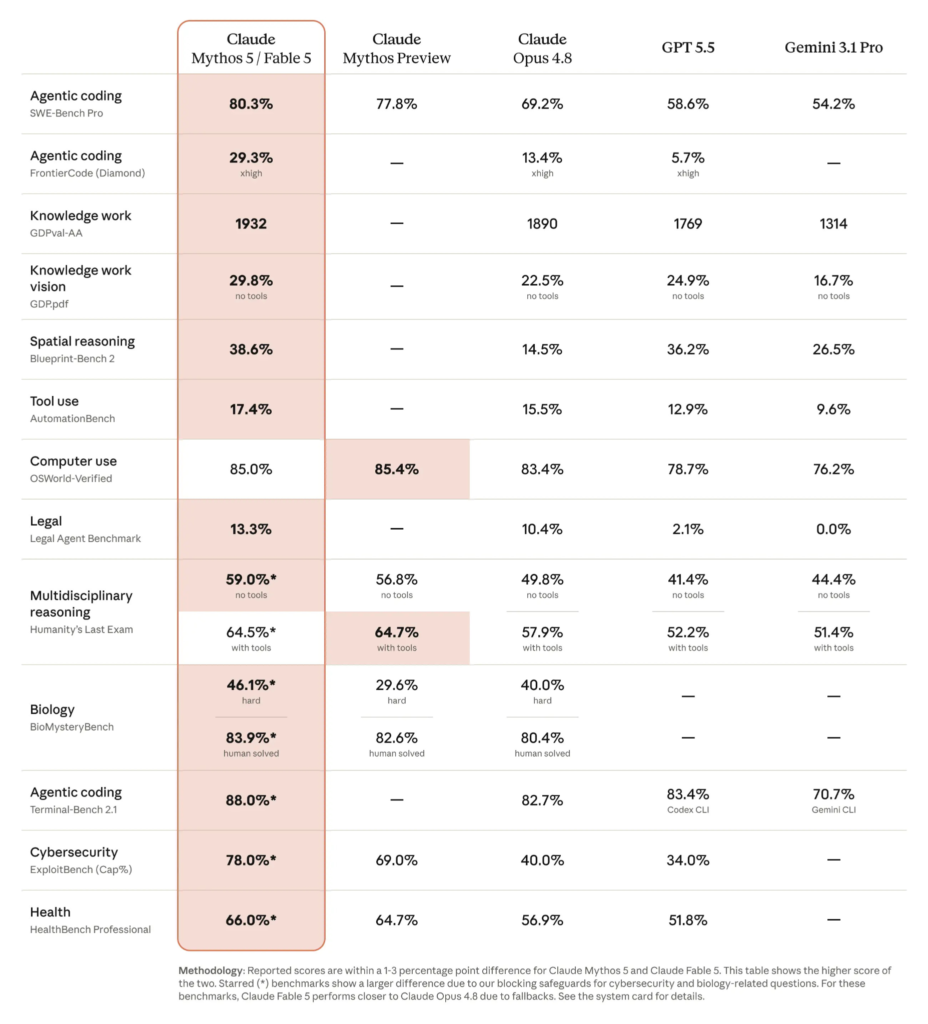
Anthropic released Claude Fable 5 and Mythos 5—the most powerful Claude models
Anthropic introduced Claude Fable 5 and Claude Mythos 5—the new strongest Claude models. Fable 5 is being opened to a wider audience, while Mythos 5 will only be given to vetted partners for now, because some restrictions are partially removed and its cybersecurity capabilities are especially strong. It is a model for long, complex tasks: large codebases, migrations, multi-step planning, work with subagents, self-checking, tests, financial data analysis, and even code recovery from screenshots.
But there is a catch—the model is expensive: $10 per million input tokens and $50 per million output tokens, meaning “just playing around” can quickly become a grown-up invoice. Anthropic also added safeguards for risky topics, and for the Mythos class it is introducing 30-day data retention for safety monitoring.
Anthropic restricted and then reopened access to Fable 5 and Mythos 5 for foreign nationals
At first, the U.S. government ordered Anthropic to restrict foreign nationals’ access to the strongest Fable 5 and Mythos 5 models due to national security risks. The company even temporarily disabled the models for all customers to avoid a violation. But now the U.S. Department of Commerce has canceled the export control, and Anthropic has once again received full approval for foreign nationals to use these models.
AI was almost labeled a strategic weapon, and then before the IPO, after a two-week conflict with the U.S. government, everyone remembered that without global access, trillion-dollar valuations look a little nervous. For investors, this matters ahead of the IPO: according to Polymarket, Anthropic’s chances of going public this year are 76%, while OpenAI’s are only 24%.
Anthropic promises to work more closely with the White House, Amazon, Microsoft, and Google on safety standards for powerful AI models.
Claude grew 386% in AI referral traffic—but it is still a very small channel
According to SE Ranking, Claude sent almost 4 times more referral traffic to websites in April than in January: its share grew from 0.0029% to 0.0141%. In short, it sounds like a “rocket” until you look at the scale—among AI sources, Claude still delivers only 1.40% of traffic, while ChatGPT has 78.23%.
Anthropic officially filed IPO paperwork—the AI race is going public
Anthropic officially submitted a confidential registration statement to the SEC, meaning the company has started the process of going public. According to The Verge, after its latest funding round, Anthropic is valued at $965 billion—higher than OpenAI’s $852 billion valuation. When companies like this go public, pressure to monetize increases, so there will be less free AI magic and more subscriptions, limits, and “premium features.”
Technology
German court recognized AI Overviews as Google’s own words—now fake answers can lead to fines
A court in Munich ruled that Google is directly responsible for false claims in AI Overviews because this is not just a list of links, but text generated by Google. In this case, AI Overview incorrectly linked two publishers to fraud, subscription traps, and questionable business practices, even though the sources did not support that connection.
Google tried to argue that users can click through the links and check everything themselves, but the court did not really accept that logic—because then why does this “smart” overview exist at all if it cannot be trusted?
Elon Musk became the world’s first trillionaire, while SpaceX is worth less than half of its $1.75 trillion IPO target
After SpaceX’s IPO, the company’s shares rose 20% on the first day of trading, and Elon Musk’s net worth reached approximately $1.2 trillion. The main reason—his nearly 50% stake in SpaceX, which was valued at $1.77 trillion after the IPO.
But Morningstar brought the rocket a little closer to Earth and valued the company at only $780 billion. Analysts say SpaceX is “significantly overvalued,” and xAI inside the business may not add value, but instead burn it. The most interesting part is that Starlink effectively looks like the profitable piece, generating 69% of revenue in the last quarter, while the space segment and AI segment posted losses. In other words, the story is beautiful—rockets, satellites, AI, Musk, and the biggest IPO on the planet—but investors are still pulling out calculators.
SpaceX buys AI development environment Cursor for $60 billion
SpaceX announced it is buying AI startup Cursor for $60 billion in stock—just days after the largest IPO in history. Cursor makes a popular AI tool for writing, editing, and reviewing code, and in November the company had already announced $1 billion in annualized revenue. On paper, everything looks good: SpaceX has already merged with xAI, now it adds Cursor, and clearly wants to build its own answer to OpenAI and Anthropic in the coding space. But there is a catch—Cursor’s share, according to Ramp, fell from 41% in June 2025 to 26% in May, while Anthropic already controls about half the category. So SpaceX is buying not just a “trendy AI editor,” but a chance not to fall behind in a market where the developer is gradually becoming not only the person who writes code, but the operator of AI systems.
Midjourney launches its own MRI-quality ultrasound body scanner
Midjourney, known by everyone for image generation, shared more details about its medical scanner—essentially, an ultrasound system in the form of a “bath” with a bunch of sensors, computers, and Raspberry Pi devices. The company wants to launch these scanners in spa and wellness formats and promises cheap, detailed, radiation-free body imaging.
It sounds beautiful, but The Verge directly writes that the main question still has no answer—where is the proof that this actually works at the level Midjourney promises? Experts have already said the company has not shown how it plans to overcome the old limitations of ultrasound technology, which has existed for decades. That is why Midjourney is carefully positioning the product not as a diagnostic medical device, but as a wellness tool for body composition—because real medicine requires FDA clearance, clinical studies, and far more evidence than a video with beautiful equipment.
Apple raises prices on Mac and iPad because of the AI boom, but doubles production of the $599 MacBook Neo due to wild demand
nytimes.com, hardware.slashdot.org
Apple raised prices on some MacBooks, iPads, HomePods, and Vision Pro because memory chips and storage became sharply more expensive due to the AI boom. For example, the base MacBook Pro now costs $1,999 instead of $1,699, iPad Air—$749, and iPad Pro—$1,199. In short, even if you are not training your own AI model in a data center, you may still end up paying for it through a new MacBook. Chip manufacturers are focusing more on data centers because the components are more expensive and the money is bigger, while consumer electronics get shortages and higher prices.
Apple, according to Ming-Chi Kuo, doubled its 2026 MacBook Neo production plan—from 5 million to 10 million devices. The reason is simple: demand for the budget $599 Mac turned out to be stronger than even Apple expected. Tim Cook said the buyer response was “off the charts,” and MacBook Neo helped bring a record number of new users into the Mac ecosystem.
Biohazard: OpenAI and Anthropic ask Congress to regulate synthetic DNA sales
OpenAI, Anthropic, Google DeepMind, and Microsoft AI signed a letter to the U.S. Congress asking it to regulate not AI models themselves, but the sale of synthetic DNA and RNA.
AI is becoming strong enough in biology to potentially help bad actors understand faster how to create dangerous biological threats. The companies therefore propose mandatory screening of all synthetic sequence orders, customer verification, and risk assessment before shipment.
AI versus humans: while Ford brings engineers back after a failed AI rollout, programmers around the world are holding the line
Ford rehired more than 300 experienced quality inspectors after AI systems for quality checks failed to meet expectations. The company had been actively implementing AI in manufacturing, including 900 cameras for defect detection, but later admitted a simple thing: if a model is not trained on the experience of people who have spent decades seeing real car problems, it will not become a magic engineer just because a presentation says “AI.”
Ford directly said it mistakenly believed it was enough to upload design requirements—and the system would produce a quality product by itself. Now veteran engineers have been brought back to train AI, mentor younger workers, and cover what automation could not handle.
AI was supposed to “kill” programming jobs—but new data shows engineers are holding up best. At large tech companies, overall hiring fell 25% compared with 2019, but in engineering it fell only 11%. Moreover, engineers made up 55% of all new hires in 2025 among the largest tech companies, compared with 46% in 2019. In startups, the situation is even more interesting—early-stage companies hired 7% more engineers than in 2019. In other words, AI really does make developers more productive, but that does not mean businesses suddenly need fewer engineers. Quite the opposite—when code can be written faster, companies simply want to build more products, features, automations, and internal tools.
Massive cyberattacks: AI at Meta let hackers easily steal Instagram accounts, while Russian hackers were behind the $2.5 billion Jaguar Land Rover breach
Meta wanted to make Facebook and Instagram account recovery “faster and easier,” but apparently made it faster and easier not only for account owners. According to security researchers, hackers used an AI support chatbot to request an email change on a targeted Instagram account and trigger a password reset. Accounts with two-factor authentication enabled were reportedly not fully compromised, but the fact that AI support made it so easy to reach the reset process looks very “Meta-like”—first automate support, then support the people who got hacked through it. Meta says the issue has already been fixed and affected accounts are being protected, but it is unknown how many profiles were impacted.
Russian hackers were behind the attack on Jaguar Land Rover—cybersecurity is now hitting not just websites, but the economy. Last year’s attack stopped the company’s production for months, cost the British economy about $2.5 billion, and even forced the U.K. government to support JLR with a £1.5 billion payment. It is still unclear whether this was direct work for the Kremlin, ordinary cybercriminal activity, or the classic gray zone of “we know nothing, but we do not stop them.” Microsoft, the FBI, the U.K.’s NCA and NCSC, Google Mandiant, and Palo Alto Networks participated in the investigation, and it also turned out that not only a Russian group, but also a separate hacker from Jordan had entered JLR’s network.
Google will pay SpaceX an astronomical amount—$920 million per month for xAI data centers
Google signed a $30 billion deal with SpaceX and will pay $920 million per month for access to xAI computing power. According to SpaceX documents, Google will get access to 110,000 NVIDIA GPUs, CPUs, and memory to meet massive demand for Gemini Enterprise. Yes, this is the same Google that has its own data centers around the world, but even it now has to rent capacity from a competitor because AI is eating compute faster than companies can build infrastructure.
SpaceX also already has a contract with Anthropic for access to the xAI Colossus 1 data center, where Anthropic will pay $1.25 billion per month through 2029.
Stripe launches Projects—AI agents will be able to buy domains, plans, and cloud infrastructure
Stripe launched Projects—a protocol that allows AI agents not just to “recommend buying something,” but to actually create accounts, buy domains, upgrade plans, configure infrastructure, and manage subscriptions on behalf of a user. The first partners are Cloudflare, Vercel, and Netlify, so we are not talking about sneakers in a shopping cart, but hosting, DNS, deployment, and technical services.
The customer of the future may not be a person reading your pricing page, but an AI agent comparing plans, checking documentation, and immediately buying what fits the task. For marketers and businesses, the main signal is that websites, pricing pages, documentation, and service catalogs need to be understandable not only to humans, but also to agents. This is especially relevant for SaaS, hosting, marketing platforms, analytics, design tools, and eventually even agencies with packaged services.
-
Tags
