


HOW TO CHOOSE NEWS FOR A DIGEST
-
Post author

-


Welcome, beginner Gatekeepers—or the mysterious guardians of information gates. How you select the news will decide whether your audience ignores you or reads with interest. Whether they click “Spam” in the newsletter or move it to “Important.”
You need to become a filter that saves time and empowers your readers—one that doesn’t trap them in doomscrolling but also keeps them engaged.
I’ll help a little by explaining the principles of news selection.
What This Is About
Not every news item is real news. Some are just opinions, some are meeting notes, and others are plain boring reports. If what’s called “news” turns out to be an analytics report—that’s not bad. Worse if it’s a paid press release from a competitor.
I’m Yulia Sotnikova. I have a journalism degree, 5+ years of experience in the field, and a decade in marketing. Experience isn’t just measured in years, but since people care—let’s go.
News Selection Principles
Freshness–news should be recent. If your digest goes out twice a month, gather news from the 1st to the 15th and from the 16th to the 30th. Burnt-out news is lost. If I miss something important for the client, my professional pride suffers. Don’t miss out. This principle is often called “the rule of chronological proximity”—the more recent the news, the more relevant it is.
Scale–this is about the news’ impact. For example, if utility rates are changing in the U.S., that’s big—relevant for everyone, no matter the state. But a new grain market report from Nebraska? That’s small and not nationally relevant.
Geography–the closer the event, the more important it is. People in Nebraska care more about what’s happening in their state or neighboring ones. What happens in California might not be as relevant. Local events must meet other criteria: scale, freshness, emotions. This is called “the rule of deadly miles”—for something far away to matter, it needs to be big: lots of victims, big fines, huge profits.
Emotion–the more emotional the news, the more important it feels. A record harvest on a farm? Emotional. But a news item about North Carolina farmers hosting the largest fair in the U.S.? Even more so. Or farmers in Wisconsin making a breakthrough in wheat growing? That’s widely appealing.
Clarity–the more understandable the news, the better. If you don’t get it yourself, don’t include it—especially if it’s not echoed on other platforms. For example: “Hermosa Beach council member Ray Jackson appointed to a Southern Coast seat”—makes no sense to most U.S. readers. Don’t include it.
Ability to share joy or sorrow–stories of disaster or achievement. Simple examples: cheering for athletes, sadness over a natural disaster. These are “word-of-mouth news”—the kind people tell their neighbor or friend. This is the principle of shared interests: Nebraska farmers will care about innovations from other U.S. farmers, not just local ones. Same with Ukrainian developers interested in stories about Indian or Canadian devs.
Status–for example: key legislation by prominent figures. You’ll need to know big names like the Secretary of Agriculture, the President, or celebrities farmers care about (like country musicians or athletes).
📌Read the article: How to write a User Story
How to Choose the Best of the Best Sources
If your English is weak, use browser translation to Ukrainian or Russian. Start with NYT. You may collect around 32 articles in two weeks. Pick 3 at minimum, delete the rest if needed.
What Not to Include in the News:
- California stories unless very innovative and covered by NYT.
- Local council meetings or decisions.
- News about plans—not real news.
- Expectations of future decisions.
- Opinions or interviews.
- Any animal or crop news except about grain, soy, corn, and rice.
- Other companies’ press releases.
So, the news “Virginia wines are growing”—not relevant, we’re focused on grain. “A road trip route through Northern Michigan”—also not relevant. “Trump lectures the President of South Africa during a televised Oval Office showdown”—has nothing to do with agriculture or grain. And so on. But stories like “Republican lawmakers and agricultural groups question the MAHA report” and “What the White House report says (and doesn’t say) about pesticides and health”—I would keep. Though presented in a much softer tone.
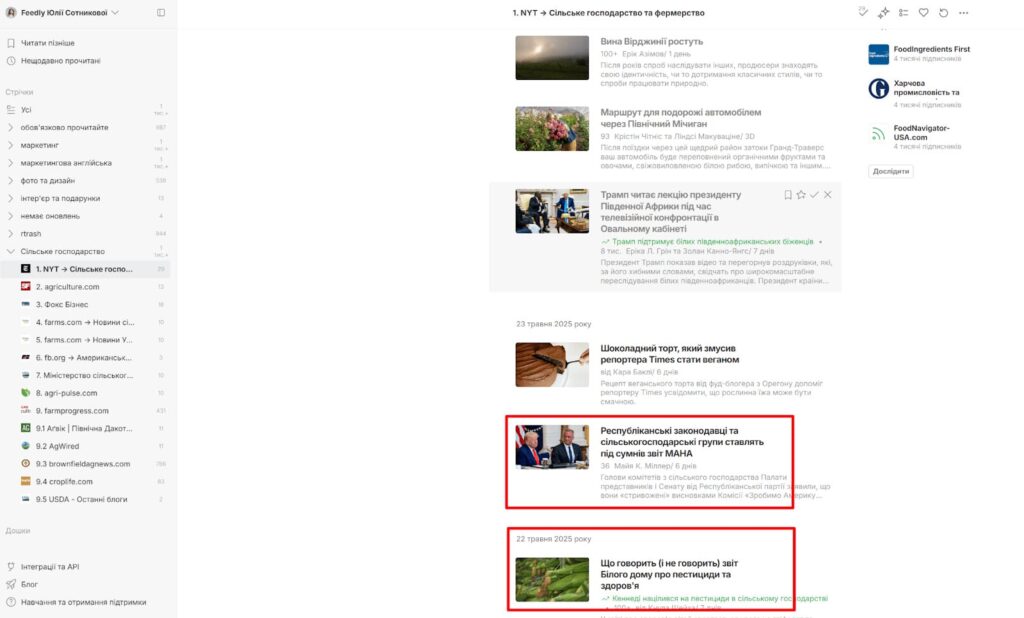
I chose one positive news piece about Virginia farmers, but I’m ready to add serious updates: Kennedy wants to ban the pesticide atrazine, and Republican ag committee leaders from both House and Senate said they’re “concerned” by the “Make America Healthy Again” Commission report and want it to rely on stronger science—we’ll look for these stories on free-access platforms.
So now on your screen is an example of a news item for the digest. It’s not about grain—but it’s an emotional, inspiring story.
📌Read the article: What is LTV (Lifetime Value) of a customer
Example of a Ready News Digest
Digest link:
Farm Roundup | May 15–30, 2025 copy
Virginia Farmers Bring Back Herb Gathering
https://www.nytimes.com/2025/05/20/climate/virginia-farmers-herbs-appalachia.html
Farmers in the Appalachians—especially Virginia—are switching to growing medicinal herbs like St. John’s Wort, echinacea, and ginseng. This is their answer to climate warming and soil moisture changes. These crops better survive in new weather conditions and have steady demand in natural health and supplement markets.
Why Read–to learn how climate adaptation opens new profitable niches for small and mid-sized farms.
Next, review agriculture.com. It has lots of Argentina-related news—but check what repeats in NYT?
Now collect news headlines. Then prompt ChatGPT:
“Write 2 short sentences summarizing the news: include main numbers and terms. Then write 1 sentence explaining why this news matters to an American farmer. The order should be: title, link, news summary, why read. Do not write ‘American farmers should read this’—just use the heading ‘Why Read’. [link]”
So your digest should have 10–15 news items. Don’t add more—less is better than boring.
Conclusions
Now you know how to make solid digests. Sure, you could just send the links to ChatGPT and let it pick the stories. But come on—we have a serious client with a defined audience. If your client suspects this, they’ll fire you and pay ChatGPT $20/month to do it all. Don’t tempt them.
Thanks for your attention. You’ve completed the rookie training for news digests. Time to make your own. Did you enjoy it? Any questions? Also check out the video—and don’t forget to like to stay updated.
Часті питання
Freshness, scale, emotion, geography, clarity, shared feelings, and status.
Gather sources, review news, select based on criteria, prompt ChatGPT, and format the final document. Repeat regularly.
-
Tags
