


+127% LEADS AND −48% CPL FOR A MEDICAL CENTER IN CALIFORNIA: GOOGLE ADS CASE STUDY
-
Post author

-


We reduced the cost per lead for a California clinic by 48%, while the advertising budget increased by only 18%.
A year of systematic work transformed a chaotic account into a stable source of leads. During this time, the number of leads increased from 22 to 50 per month, while the cost per lead dropped from $75 to $39. We took Google Ads out of “maintenance mode,” rebuilt the campaigns from the ground up, and made every dollar work twice as efficiently. Below, we break down step by step how to eliminate chaos in campaign settings and win the competition for clients in the U.S. medical niche.
We demonstrate how a systematic approach, deep analytics, and consistent optimization helped stabilize advertising campaigns and scale lead generation for an ENT clinic operating in one of the most competitive medical markets in the region.
Google Ads
Service
Medical Services—Vascular Diseases
Industry
USA, California
Target Region
Results
+18%
Budget
+127%
Number of Leads
-48%
CPL
Client
Our client—a medical center in Southern California with five clinics located in different cities across the region. Their primary focus—treating vascular conditions using minimally invasive methods.
The clinic specializes in procedures without major surgeries or incisions. Doctors perform most treatments on an outpatient basis. Patients recover quickly and return to their normal lives within just a few days.
In addition to vascular treatments, the center also works with the following categories:
- men’s health;
- women’s health;
- varicose veins;
- hemorrhoids;
- joint and spine pain.

The client approached us with a request to improve the performance of their Google Ads advertising, increase the number of leads, and reduce the cost of lead acquisition.
Marketing Audit
We started the cooperation with a full audit of the advertising account. We analyzed all active campaigns, their structure, keywords, search queries, targeting, and other important settings.
Before us, the account was managed by another contractor. The client also periodically made some changes independently. Because of this, the account gradually turned into a collection of campaigns without a unified logic.
We identified a typical situation: the campaigns were running, but no one was managing them systematically. From time to time, only negative keywords were added and budgets were adjusted in the account. These actions kept the advertising “afloat” but did not contribute to growth.
As a result, the account accumulated many issues and shortcomings, including:
- confusing and chaotic account structure;
- duplicate keywords;
- landing pages irrelevant to the keywords;
- incorrect budget allocation;
- a large number of irrelevant search queries;
- lack of a branded campaign;
- lack of a display campaign.
We documented everything in detail in the audit and proposed a clear plan for further actions.
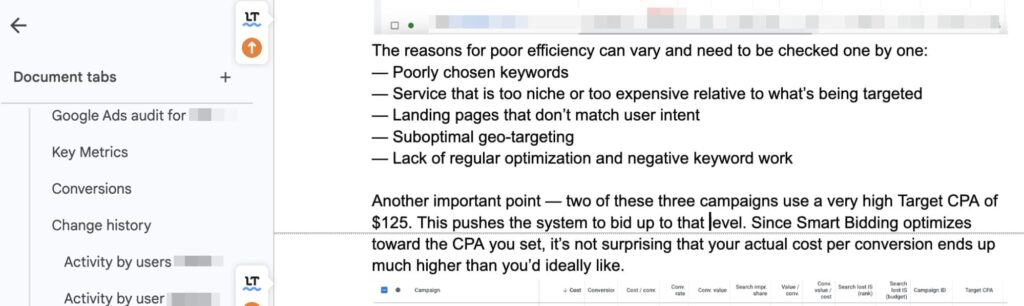
The client realized the scale of the lost budget and agreed to work with us. After that, we began rebuilding the entire advertising system.

Expert Commentary
At Marketing Link, we have worked with more than 50 medical website projects. In this case, one of the key issues was the structure, since more than a dozen different services such as Plantar Fasciitis, Frozen Shoulder, Knee Joint, Fallopian Tube, PCS, Hydrocele, Spermatocele, HSG, Lipiodol, Achilles have different average order values, different lead costs and competition levels, as well as different LTVs, and within combined campaigns—especially PMax campaigns without offline CRM feedback—this rarely works profitably.
Optimization effectiveness was also complicated by spam leads—from both other traffic channels and competitors—which were “training” the algorithms incorrectly. This issue was solved with an additional Cloudflare Turnstile CAPTCHA, as well as by increasing the minimum call duration required to count as a conversion.
We also separately refined the structure, expanded the keyword set, and improved ad quality. We identified both the mismatch between keywords and search terms, as well as the overall budget allocation, and focused on the true “bread and butter” services.
By the way, although remarketing is generally restricted in medical niches, there are still strategies that work in both Display and PMax campaigns. Submit a request for an audit—and we’ll show you how to improve your medical business.
Analytics
Any optimization loses its value if the advertising algorithms are learning from incorrect data. That’s why the first step was to review the analytics setup.
We tested the website forms from different devices, checked how the thank-you page was working, and verified that conversions from Google Analytics 4 were being passed correctly into Google Ads without duplication.
We kept only the actions that indicate stronger intent as primary conversions:
- form submissions;
- phone calls longer than 60 seconds.
In addition to the primary conversions, we added micro-conversions for additional traffic behavior analysis:
- clicks on the phone number;
- clicks on the email address;
- clicks on social media buttons.
We assigned these conversions as secondary so Google Ads would not use them during the learning and bid optimization process.
After verifying the analytics setup, we moved on to account optimization.
Optimization
Redistributed budgets based on priority service areas
The account contained many campaigns, each focused on a separate service category, but they generated different levels of business value.
Together with the client, we identified the highest-priority and highest-margin service areas and redistributed the budgets accordingly. Higher budgets were allocated to stronger campaigns, while lower-priority campaigns received smaller budgets.
At the same time, we discovered several old campaigns the client was not even aware of. These campaigns no longer matched the current services but were still spending budget. We completely turned them off.
Improved account structure
We regrouped keywords by specific service categories and landing pages so that each campaign matched a single keyword cluster, and each ad directed users to the exact page they expected to see.
We also removed keywords related to surgeries. The clinic only provides non-surgical treatments, so that traffic had no value.
After that, we analyzed the campaign data and paused keywords that were spending budget without generating conversions.

Expert Commentary
Advertising in the medical niche almost always requires careful decisions and a non-standard approach. This case demonstrates that well.
To reach the target audience in the Google Display Network, remarketing is usually used. However, this tool has limitations for medical-related advertising. That’s why we chose a different approach—we launched a display campaign targeting relevant audiences and received the first clicks within just a few days.
We also worked on optimizing the campaigns that were already running. Our task was simple: improve performance without harming what was already working. To achieve this, we turned off PMax campaigns that were not delivering the desired results and focused on optimizing the search campaigns.
First, we checked how relevant the headlines, descriptions, and landing pages in the ads were. Then we analyzed the keywords and paused those that were not generating conversions.
Next, we thoroughly reviewed the search queries, improved the ad assets, and redistributed the budget in favor of the more effective campaigns.
This systematic optimization produced strong results: CTR increased, CPL decreased, and traffic quality improved.
We conducted a thorough cleanup of irrelevant search queries
We analyzed the search terms report and added all queries with no commercial intent, no conversions, and low-quality traffic to the negative keyword list:
- informational queries;
- competitor-related queries;
- queries related to symptoms, causes, or prevention.
We also expanded the account-level negative keyword list. We added words such as why, symptom, prevention, side effects. These types of searches almost always indicate that the user is looking for information rather than a clinic.
Reviewed previous negative keywords
We reviewed the existing negative keyword lists and found terms that were blocking part of the relevant traffic. After cleaning them up, the campaigns started receiving more high-quality impressions.
Analyzed the effectiveness of Performance Max campaigns
The account had two active Performance Max campaigns. On the surface, they appeared to perform well: they generated clicks, spent budget, and occasionally brought conversions. However, after a deeper analysis of the data, we identified a different picture.
Performance Max campaigns underperformed compared to search campaigns in terms of cost per lead. In addition, they generated very few high-quality leads, which was confirmed through a comparison with the client’s CRM data.
We turned off these campaigns and shifted the budget into search campaigns, where we have more control over keywords, placements, and ad formats.
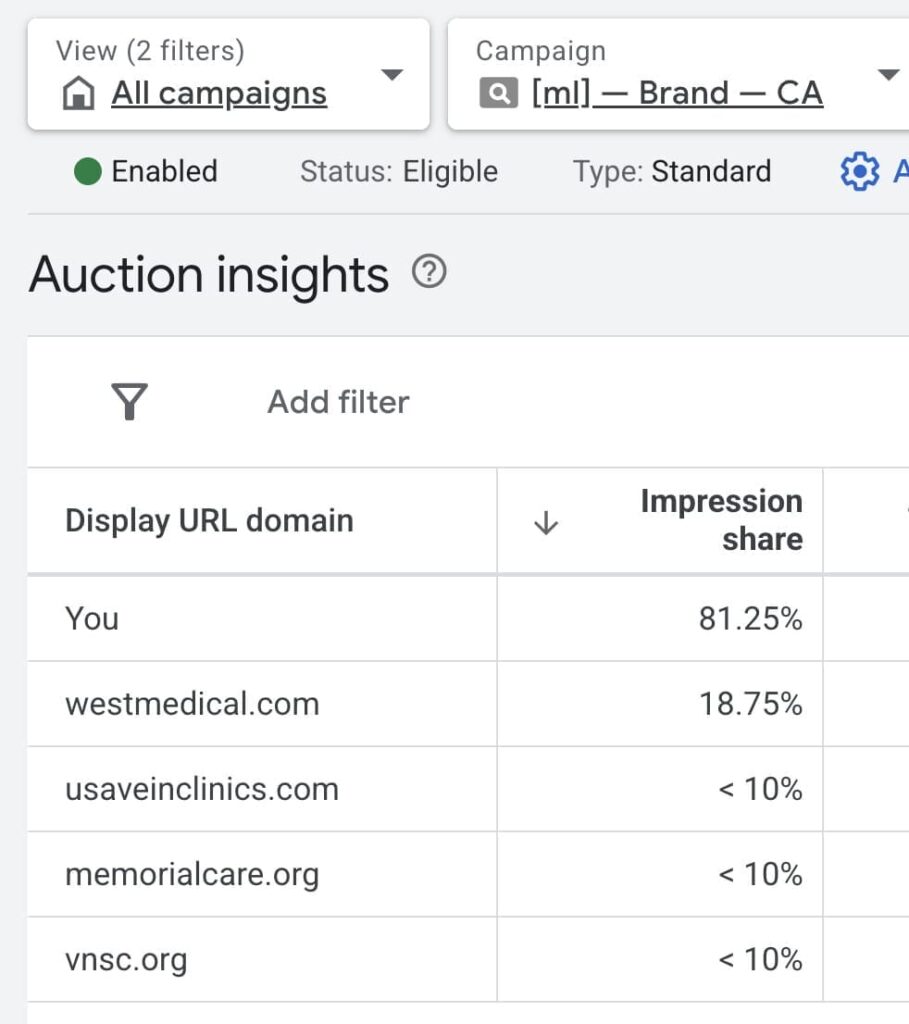
Set up a branded campaign
Previously, the client was not running a branded campaign. This meant that users who already knew the clinic’s name and searched for it on Google could still see competitors’ ads.
We launched a separate branded campaign and took control of branded demand. The clinic now controlled its own search visibility and no longer lost warm traffic to other medical centers.
Optimized demographic targeting
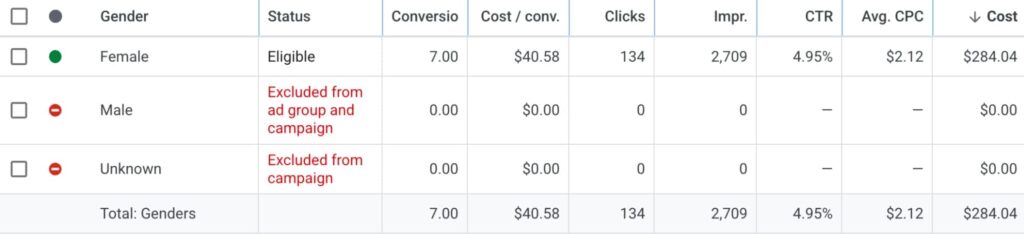
We analyzed the performance data and adjusted the targeting:
- campaigns for men’s health were limited to men only;
- campaigns for women’s health were limited to women only;
- musculoskeletal campaigns were shifted toward an older audience.
These changes reduced the share of irrelevant impressions—and improved performance.
Disabled Search Partners
Traffic from Google Search Partners regularly shows lower quality for local businesses. Our project was no exception.
Partner websites were consuming part of the budget but generating very few quality leads. Because of this, we completely disabled this channel and kept ads running only in Google Search.
Read the case study: How We Increased Leads by 115% for an ENT Clinic in the U.S.
Improved Ad Copy
The old ads looked too generic and barely explained what made the clinic different from competitors. In the new copy, we focused on what truly matters to patients—non-surgical treatment, faster recovery, and procedures without hospitalization.
We also updated part of the landing pages so they would better match the ad messaging.
Optimized Ad Extensions
We disabled outdated extensions, fixed errors, and added structured snippets. We also checked that the clinic address was correctly pulling from the Google Business Profile.
Launched a Display Campaign
Google does not allow remarketing in many medical niches. Because of this, it is impossible to bring visitors back to the site using the standard approach.
Instead, we launched a display campaign targeting relevant audiences. We used interests, topics, and keywords. The campaign helped us reach people actively interested in the services offered.
Resolved Disapproved Ads
Medical advertising often faces ad disapprovals. We regularly submitted appeals, adjusted ad copy, and updated landing pages. After that, the ads passed moderation again and continued driving traffic.
Updated Bidding Strategies
We reviewed all campaigns and selected more suitable bidding strategies for each one. Some campaigns remained on manual bidding. For others, we switched to “Maximize Conversions” or “Target CPA”.
Set Up Campaigns for New Service Areas
After the first successful results, the client added two new service lines—hemorrhoid treatment and Achilles tendinitis treatment. We researched keywords, created campaign structures, and launched separate search campaigns. The ads quickly started generating results for the new services as well.

Ongoing Optimization
After launch, we did not leave the account “as is.” Our team analyzes the campaigns weekly and continuously makes improvements.
We regularly:
- analyze search queries;
- add irrelevant searches to negative keywords;
- expand keyword lists with the most targeted search terms;
- redistribute budgets between campaigns;
- review bidding strategies;
- adjust bids by device, location, time of day, and audience;
- test new ad copy;
- monitor ad moderation and work on disapproved ads;
- analyze and either implement or reject Google recommendations;
- optimize or disable underperforming elements;
- scale high-performing areas.
This systematic approach allowed us not only to improve performance once, but also to maintain and grow results throughout the entire year.

Expert Commentary
The key factor behind this result was systematic work—not isolated adjustments in Google Ads or GA4 analytics. This was not just about setting up conversions, but about completely rebuilding the data collection approach—from cleaning up primary and secondary conversions to thoroughly auditing the accuracy of the entire tracking setup.
It was extremely important to align business goals with the actual signals the optimization algorithms rely on. Without a clear understanding of what the system interprets as a “high-quality” result, any changes to bids, strategies, or creatives are essentially made blindly.
In practice, the lack of this foundation is often the main reason why accounts lose efficiency after initial growth—especially during the scaling stage.
Challenges We Faced
Using a Portfolio Bidding Strategy
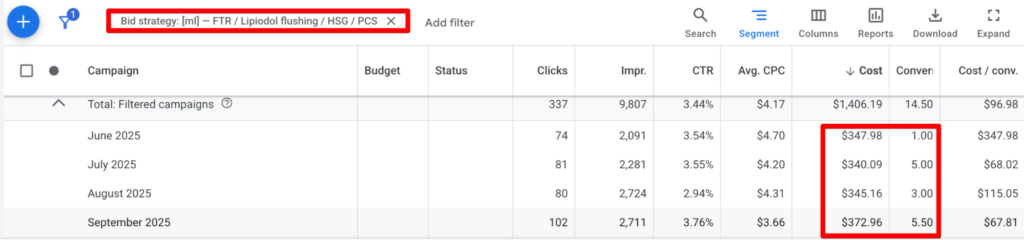
There were four women’s service campaigns running with small budgets. Each campaign individually was generating too few conversions, so Google’s algorithm was learning slowly.
We combined these campaigns into one portfolio bidding strategy with a shared budget. After that, Google started working not with separate campaigns, but with the entire data set. The campaigns accumulated data faster, and the system optimized bids more accurately.
Result: the number of leads in this segment increased 5.5x without increasing ad spend.
Lead Drop: How We Found the Cause Outside Advertising
During the second month of cooperation, the client noticed that the number of leads had decreased and spam had increased.
Google Ads metrics remained stable—the number of recorded leads and CPL did not change. Because of this, we suspected the issue was outside of advertising and identified several external factors that contributed to the overall decline:
- the period coincided with Martin Luther King Jr. Day, and during long weekends people are less likely to focus on medical issues;
- Google Analytics 4 stopped correctly transmitting some events;
- the client was comparing results to the previous year, when the budget was significantly higher;
- the website started receiving a large amount of spam from other traffic channels;
- as a result, page load speed slowed down, which worsened the issue and negatively affected advertising as well.
We restored data tracking and provided recommendations regarding website speed and form protection. The client gradually implemented these changes, and within a month the spam had almost disappeared and the conversion rate started increasing again.
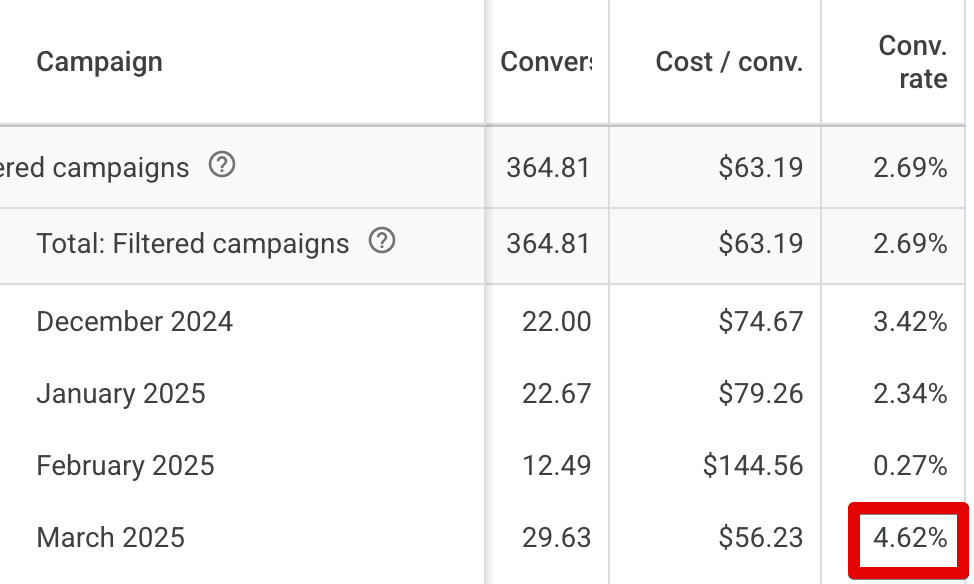
This episode clearly demonstrates our approach: if performance declines, we examine not only the advertising, but the entire system surrounding it.
Results
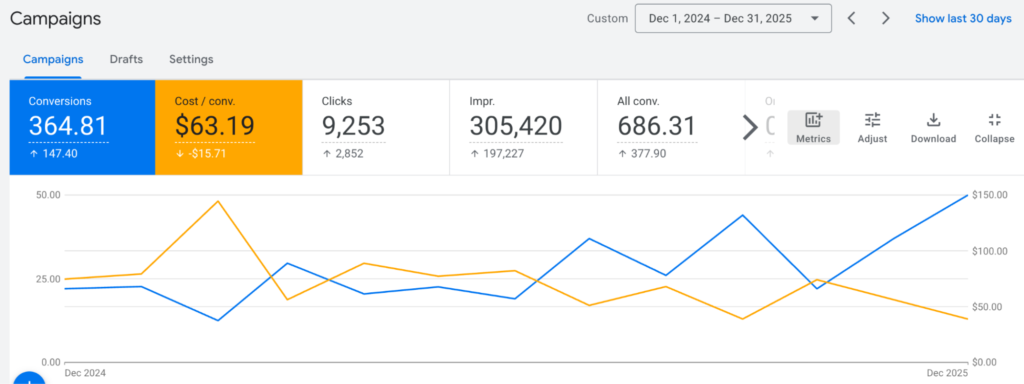
In the U.S. medical niche, increasing lead volume almost always leads to higher advertising costs. We broke this trend. As a result:
- Increased the number of leads by 127%—from 22 to 50 per month;
- Reduced cost per lead by 48%—from $75 to $39;
- The budget increased by only 18%.
Conclusions
In the U.S. medical niche, success is driven not by the largest budget, but by the precision of the setup. We came into chaos and built a transparent system. Order in the account structure, clean traffic, and fast response to external factors delivered the result: 127% more leads, while each lead now costs 48% less.
Order an individual consultation for your business
-
Tags
